A bucket elevator is a vertical bulk-handling conveyor that uses buckets mounted on a belt or chain to lift granular or powdered material through an enclosed casing; for a deeper taxonomy of centrifugal vs continuous vs positive-discharge designs, see this bucket elevator types reference.
Typical industrial ratings run 5–600 m³/h throughput at lift heights of 10–60 m, with belt speeds between 0.5 and 2.5 m/s for centrifugal discharge units and 0.2–0.6 m/s for positive-discharge units carrying fragile or friable material, per OEM duty-class literature [S1].
Where Bucket Elevators Win: Footprint, Capacity, Enclosure
Vertical lift-to-footprint ratio is the headline advantage: a 30 m lift on a 1.5 m × 1.5 m casing replaces roughly 60–80 m of inclined belt conveyor plus transfer points, and the fully enclosed steel or stainless casing keeps dust and product loss below 50 mg/m³ in well-sealed CE-marked builds, matching typical ATEX zone 21 housekeeping targets. [S1]
Capacity density is a second, often under-quoted strength. A single 600 mm-wide belt with 300 mm-deep CEMA No. 300 buckets at 2.0 m/s delivers on the order of 120–180 m³/h of wheat or cement at 70–78% volumetric fill, which is the reason grain terminals and cement mills still prefer elevators over drag or screw conveyors for high-tonnage vertical moves [S1].
Where They Lose: Dust, Wear, Power and Explosion Risk
Mechanical penalties are real and mechanical, not abstract: each pass through the boot, around the head pulley and back down the leg is a wear event, and head-shaft power on a 40 m, 200 t/h cement leg commonly lands in the 55–90 kW bracket when the casing is correctly back-leg ventilated at 0.4–0.6 m/s. [S2]
Explosion risk is the other tail risk. Bucket elevators handling combustible dusts (grain, flour, sugar, aluminium, coal) are classified as the highest dust-hazard equipment in many plants and are typically required to carry relief panels sized to NFPA 68 venting formulas or equivalent EN 14491 panels; a bucket elevator referenced in a cement or grain line is a frequent ignition source that propagates flame upward through the casing, so explosion isolation at inlet/outlet and belt-speed monitoring at ≤1.0 m/s for high-Kst products are standard practice.
Comparison: Centrifugal vs Continuous vs Positive-Discharge
Three discharge styles dominate the market and the choice is a direct trade between speed, degradation and cleanability. A centrifugal discharge elevator runs belt speeds of 1.2–2.5 m/s, suits free-flowing non-fragile bulk (grain, clinker, pellets) and is the cheapest per metre of lift. A continuous-bucket elevator runs 0.4–0.8 m/s with closely spaced buckets on a single chain, suits moderate-capacity lifts of free-flowing material where spillage control matters. A positive-discharge (or perfect-centring) elevator runs 0.2–0.6 m/s with indented buckets, is the only style suited to sticky, sluggish, or friable materials (fertiliser, filter cake, sugar, soya meal) and the only style that handles inclines above 70° without back-fall. [S3]
Material and Component Specs That Drive Lifecycle
Belt and bucket selection is where most of the 5–15 year service life is won or lost. Belts are typically polyester/nylon multi-ply with a 4–6 mm vulcanised rubber cover on the bucket side and 2–3 mm on the carrying side; bucket fixings are specified as 4-bolt Elevator Bolts with locknuts or non-metallic P-inserts, and a 200 t/h cement leg running 12 h/day will normally budget 1.5–2.5 bucket replacements and 0.8–1.2 belt splices per year. [S4]
Casing, head and boot are usually fabricated in mild steel (S235/S275) with 3–6 mm plate for the trunk and 8–12 mm for the head section, and upgraded to 304/316 stainless or AR400 abrasion-resistant steel in corrosive or high-abrasion service; head pulleys are lagged with 8–12 mm diamond-groove rubber for traction, and boot pulleys use screw-type take-ups to maintain 0.5–1.0% belt stretch under load.
Sensors, PLC Interlocks and Belt Drift Monitoring
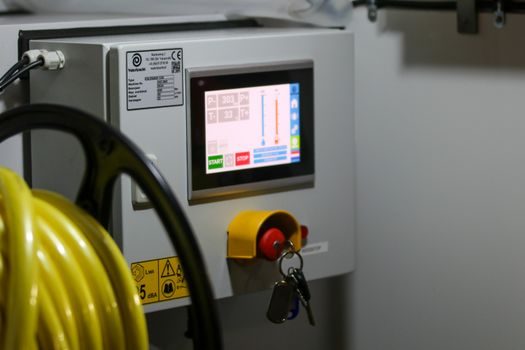
Modern legs are not just mechanical; the spec sheet now lists a small but mandatory instrument package. A baseline instrumented leg carries a belt-speed sensor on the head pulley, two belt-drift / misalignment switches at top and bottom, a bearing-temperature sensor on each head and boot shaft, and a zero-speed switch timed to the boot — all wired back to a PLC interlock that trips the drive within 1–2 seconds of a drift or slip event. [S1]
Higher-tier installations add continuous bearing condition monitoring, a pressure sensor on the back-leg for plugged-chute detection, and a flow-meter or weigh-scale on the inlet to cross-check tonnes-per-hour against the nameplate; for cement and grain terminals this is increasingly tied to a pressure transmitter reading in the dust collector hopper so a rising differential pressure flags a torn filter before it becomes a visible emission.
Limitations, Failure Modes and When NOT to Specify
Bucket elevators are the wrong equipment when the bulk is wet, sticky or stringy (use an en-masse or drag conveyor instead), when the lift is under 5 m (an inclined belt is cheaper to install and maintain), when the material is highly abrasive and the service hours exceed 4 000 h/year without a bucket-replacement plan, or when the plant is in an ATEX zone with no provision for explosion relief, isolation and inerting. [S2]
The four most common failure modes reported in field service are belt slip on the head pulley (drive undersize or lagging worn), belt misalignment at the boot (take-up out of adjustment or loading uneven), bucket tearing at the fixing (impact loading or off-centre feed), and back-leg dust accumulation leading to a plugged chute; each of these is detectable by a routine vibration and speed-monitoring programme at 250–500 hour intervals, and each can take a 200 t/h leg from nameplate to zero in under ten minutes if the interlock is not wired.
Sourcing, Standards and Match Rules
The dominant open standards are CEMA No. 300/700 for bucket elevator design and duty classification in North America, FEM 1.001 / ISO 5049 for European mechanical-handling calculation rules, DIN 15201 for bucket elevator terminology, and EN 14596 / ASME B20.1 for safety requirements on related conveyors; for dust-handling service, NFPA 61 (agricultural), NFPA 654 (chemical/dust) and ATEX 2014/34/EU with IEC 60079 series apply to motor and electrical gear. [S3]
For comparison-style guides on other capital equipment classes, see the spec-driven cut on excavator advantages and disadvantages; for an alloy-steel material primer that pairs with bucket-and-casing selection, this alloy steel engineering brief is a useful cross-reference; and on the broader bulk-solids handling side, the spec-by-spec cut on wheel loader classes and bucket capacity is the natural complement to a 200 t/h elevator feed system.
Trackable signals for the next design review: confirm CEMA No. 300 vs No. 700 bucket volume per metre of belt on the datasheet, request the calculated head-shaft kW at design t/h with a 1.25 service factor, and verify that the relief panel area is sized to the Kst of the handled dust at the documented conveying temperature.