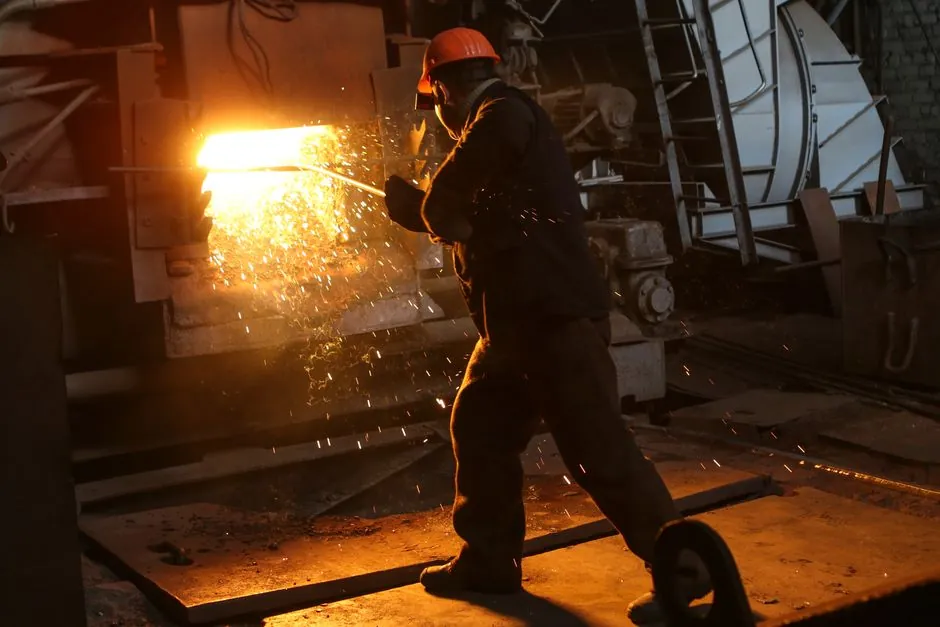
Superalloys containing aluminium, titanium, boron, or zirconium must be melted in a vacuum induction melting (VIM) furnace, not an air induction unit, because reactive elements oxidise before they can dissolve into the melt in air, leaving non-metallic inclusions that destroy creep life [S2][S4].
VIM holds chamber pressure at 7×10⁻³ Pa or lower, drives oxygen below 20 ppm and nitrogen below 10 ppm, and holds Ti/Al composition within ±0.05–0.12%, versus >100 ppm O, >50 ppm N, and ±0.3% Ti/Al control on an open-air induction line [S2]. Capital cost runs 3–8× higher than an equivalent-capacity air furnace [S2]. Engineers weighing induction furnace selection for reactive alloys should treat that cost gap as the price of doing business for any grade destined for hot-section turbine duty.
Where VIM wins on superalloy chemistry
VIM's first engineering payoff is removal of dissolved gases: hydrogen, oxygen, and nitrogen evolve from the melt once chamber pressure drops, which closes the porosity and embrittlement pathways that limit fatigue life in air-cast superalloys [S2][S4]. A second payoff is volatilisation of trace lead and bismuth, which have high vapour pressure at nickel-melt temperatures and literally boil out under vacuum, a purification step that air melting cannot perform at all [S2][S4]. A third is the carbon deoxidation reaction, in which residual oxygen combines with dissolved carbon to form CO that is pumped away, leaving a cleaner matrix than metallic deoxidiser routes [S4].
These three mechanisms together are why VIM is the default primary melt for nickel-based superalloys, turbine disc materials, aerospace castings, Co-Cr medical alloys to ASTM F75, and high-performance permanent magnets [S2]. For shops comparing melting furnace classes, VIM is the only induction route that delivers all three refining actions in a single cycle.
Where air induction still earns its keep
Air induction is the right answer for carbon steel, low-alloy steel, generic iron, and copper-base melts that contain no reactive alloying additions [S5]. It also wins on capital footprint, throughput per kWh, and the ability to pour in open air into sand or greensand moulds without a sealed transfer system. For shops that run ferrous scrap returns and structural castings, gas-fired aluminium melting furnaces and air induction remain the economic baseline; adding VIM only pays back when the alloy specification requires it.
The decision rule is binary on chemistry: if the target alloy lists Al, Ti, B, or Zr above trace levels, air melting will oxidise the reactive additions before they dissolve, so the chemistry cannot be met no matter how clean the charge [S2][S4]. If the alloy is plain ferrous or copper, VIM's cost and cycle-time penalty buys nothing the air furnace does not already deliver [S5].
Process physics: induction coil and frequency
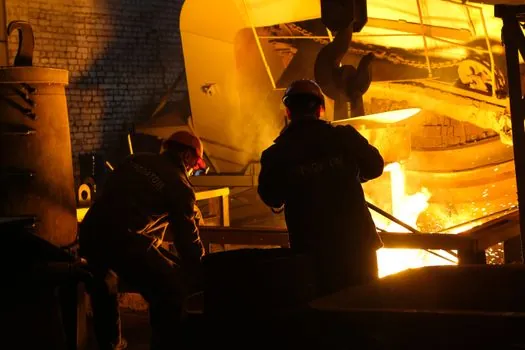
Both furnace types share the same induction heating core: a medium-frequency alternating current of 500–3000 Hz flows through a water-cooled copper coil, generating a time-varying magnetic field that drives eddy currents in the charge, which Joule-heats the metal from the inside out [S2][S6]. Because there is no electrode or flame in contact with the melt, induction avoids carbon pickup from electrodes and avoids combustion gas entrainment that would otherwise add hydrogen [S2].
The electromagnetic field also doubles as a stirrer, which matters more in VIM than in air melting: volatilised impurities, evolving gas bubbles, and alloying additions must all distribute evenly before pour, and the induced flow does that without a mechanical lance [S4]. That same stirring is what lets VIM hold Ti/Al composition within ±0.05–0.12% across a 5–20 t heat, a control band no air furnace can match on reactive grades [S2].
Crucible and refractory selection by alloy
Crucible choice is driven by the alloy chemistry, not by whether the furnace is vacuum or air, and the wrong refractory will leach oxides straight back into the melt [S2].
Operators also size the vacuum pump train to the alloy's vapour-pressure profile, since high-vapour-pressure additions such as Mn and Cr will partially evaporate during the vacuum hold and must be re-balanced or trapped at the pump inlet [S2]. Air furnaces sidestep this by never pulling vacuum, but they accept the gas pickup and reactive-element loss that come with that simplification [S5].
VIM is a primary step, not a standalone route
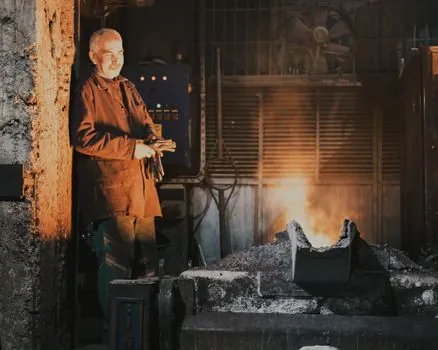
For rotating jet engine components, VIM is the first stage in a duplex or triplex melt route, not the final melt [S3][S4]. The VIM ingot becomes a consumable electrode for vacuum arc remelting (VAR) or electroslag remelting (ESR), each of which removes solidification porosity and refines the grain structure beyond what induction stirring alone can achieve [S3]. Specifying only VIM for a single-crystal turbine blade is a spec error; the metallurgical standard is VIM plus VAR, with ESR substituted for alloys sensitive to VAR arc-related white spots [S3].
That cascading-process reality changes the cost case: VIM is rarely the most expensive line item in a superalloy supply chain, because VAR or ESR downstream add their own capital and energy. The 3–8× cost premium cited earlier is the VIM contribution, and it scales with charge size and alloy reactivity, not with throughput [S2].
Selection criteria: VIM vs air induction for superalloys
Air induction should be specified only when the alloy contains no Al, Ti, B, or Zr above 0.5% combined, when the specification does not require sub-20 ppm oxygen, and when the downstream casting process tolerates inclusion populations typical of air melts [S2][S4][S5].
Throughput in tonnes-per-year is therefore lower on VIM at the same nameplate power, and that delta must be priced into any make-versus-buy decision for superalloy billet [S2].
Honest limitations of VIM
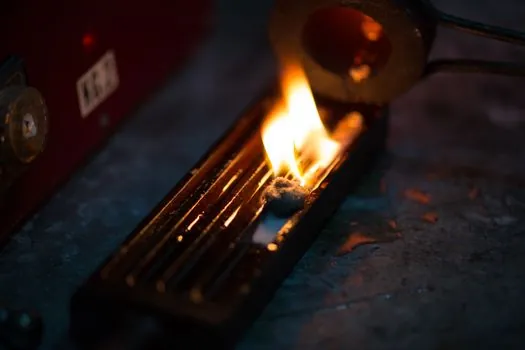
VIM is not a universal upgrade over air melting: it does not remove solidification shrinkage, it does not eliminate all inclusions, and it does not refine grain structure beyond what the cast mould controls [S3][S4]. A VIM heat poured into a dirty mould or fed into a non-vacuum casting station loses the gas-control advantage the vacuum stage just paid for, so downstream handling matters as much as the melt step [S2][S3].
VIM also cannot economically scale beyond about 25–30 t per heat in industrial practice, because the sealed vessel, pump stack, and copper coil costs scale nonlinearly with charge diameter; superalloy producers who need 50 t heats move to VIM plus VAR cascade or to electron-beam cold-hearth refining [S3]. Engineers who treat VIM as a capacity answer instead of a chemistry answer will overspend and underdeliver.
Sourcing and standards
The widely cited metallurgical baseline for VIM processing of nickel-base superalloys is the ASM Handbook treatment of vacuum induction melting, which frames VIM as indispensable for superalloy manufacture and contrasts it directly with air-melting EAF and AOD routes [S3]. For aerospace and medical grades, ASTM F75 governs Co-Cr-Mo alloy chemistry that VIM routinely delivers, and OEM superalloy specifications (GE, Pratt & Whitney, Rolls-Royce) all reference VIM or VIM+VAR for rotating components [S2].
Spec sheets should cite oxygen below 20 ppm, nitrogen below 10 ppm, Ti/Al control of ±0.05–0.12%, and chamber pressure of 7×10⁻³ Pa or lower, all of which are achievable on production VIM systems and verifiable by LECO gas analysis and inductively coupled plasma optical emission spectroscopy on a poured sample [S2]. Two trackable signals for buyers: (1) the OEM's preferred melt route is now VIM+VAR for nearly all new single-crystal and directionally solidified blade alloys [S3]; (2) air induction is being relegated in published guides to non-reactive ferrous and copper melts, with VIM specified whenever the alloy has reactive additions [S5].
See also our earlier report, Plunger vs Piston Pump: Picking the Right Reciprocating Pump for High Pressure.