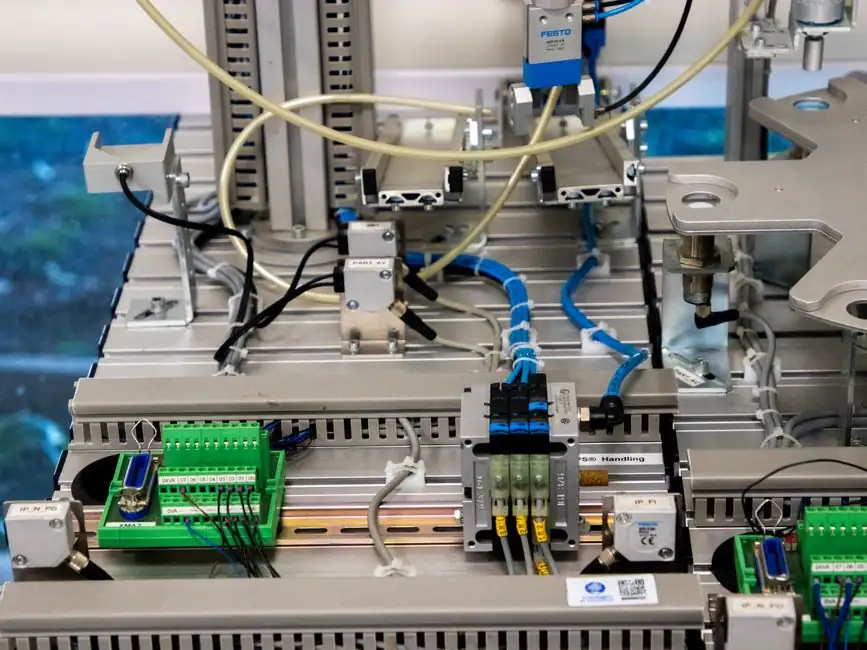
A machine-vision controller sized in 2026 must satisfy three hard numbers at once: aggregate pixel clock from every connected camera, sustained trigger-to-result latency the line PLC can tolerate, and the storage I/O bandwidth that logging or rejection needs [S1].
The practical decision is rarely a single datasheet match; it is a trade between FPGA-based smart cameras, PC-based GigE Vision/USB3 Vision frames grabbers, and industrial controllers with onboard CoaXPress, with selection driven by line rate, image resolution, and inspection depth [S1].
Frame Rate, Pixel Clock, and the First Pass/Fail Gate
Controller headroom starts with pixel clock, not frame rate: a 5 MP camera at 60 fps pushes roughly 1.5 Gbps of raw data, and four of them on one host bus saturate a single PCIe Gen3 x4 lane near 3.2 GB/s before protocol overhead [S1]. Engineers routinely over-spec the controller because the GigE Vision / USB3 Vision / CoaXPress stack consumes 15-25% of the nominal link for retransmits, header overhead, and trigger timestamps, so a controller that "should" handle 4 cameras is often committed to 2 in practice [S1].
The second gate is trigger latency. Discrete I/O triggers on most industrial controllers close the loop in 1-3 ms when no preprocessing runs on the host, but vision-specific FPGA controllers hold that latency under 200 µs even with region-of-interest extraction, which is the difference between rejecting a part on a 30 m/min conveyor (16.7 mm/ms) and missing it entirely [S1].
When an FPGA Smart Camera Wins Over a PC-Based Frame Grabber
FPGA-based smart cameras and embedded vision controllers are the right call when the inspection is deterministic, the I/O count is low (under 16 optically isolated inputs), and the line cannot tolerate a Windows update mid-shift [S1]. They typically ship with 1-4 GB onboard DDR, an ARM or x86 SoC, and a hardened image-processing library that bypasses the host OS, which collapses jitter from tens of milliseconds to single-digit microseconds at the cost of vendor lock-in for the toolchain [S1].
PC-based frame grabbers pulling GigE Vision or USB3 Vision streams into a GPU are the right call when the application needs deep learning inference, multi-camera stitching, or inspection recipes that change weekly, because retraining a model on a CPU-class smart camera is a 10-100x penalty in throughput and the toolchain openness pays for itself inside a year on a high-mix line [S1].
Who Should NOT Spec the Mainstream PC Stack
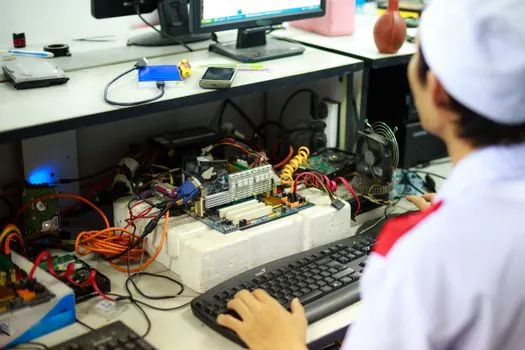
Plants running Class I Div 2 hazardous areas, food lines with daily wash-down, or any line where the controller sits more than 10 m from the camera should not spec a consumer-grade PC frame grabber, even if the per-channel cost is half an industrial unit [S1]. Sealed IP67 vision controllers, not panel PCs, are the right answer, and this is one of the few cases where a vision controller datasheet's operating-temperature and ingress-protection numbers actually decide the buy rather than the throughput curve.
Engineers building a single-camera barcode station or a 2D presence/absence check on a 5-part/min line should also not over-spec a multi-camera industrial controller, since a $400 compact vision sensor with onboard I/O outperforms a $4,000 PC stack on total cost of ownership and gives back cabinet space that a linear guide station or a crossed roller guide stage would otherwise need to grow around.
Criteria-Based Comparison of the Four Main Options
Four controller classes dominate 2026 line builds, and they line up against selection criteria as follows: (1) FPGA smart camera: typical 1-2 cameras, 0.2-1 ms trigger latency, $1k-$5k per station, IP67 sealing available, vendor-locked toolchain; (2) Industrial PC with GigE Vision/USB3 Vision frame grabber: 2-8 cameras, 1-5 ms latency, $3k-$10k, IP54 typical, open toolchain; (3) CoaXPress frame grabber + server: 1-4 cameras, sub-millisecond latency, $8k-$25k, IP20, cable runs to 40 m on CXP-12; (4) Edge AI inference appliance: 4-16 cameras, 5-20 ms latency, $5k-$15k, IP54, designed for models that retrain quarterly [S1].
The throughput-versus-cable-length trade is the single sharpest dividing line: CoaXPress over 40 m at 12.5 Gbps beats GigE Vision's 100 m at 1 Gbps only when the application cannot tolerate the protocol overhead and retransmit window that GigE imposes on noisy plant floors, otherwise the GigE stack wins on cable cost and switch reuse [S1].
Standards, Trigger Stacks, and What Buyers Should Verify on Datasheets
Buyers should confirm GigE Vision compliance to the current revision (the standard is anchored on the GenICam SFNC and is what lets a controller swap Basler, FLIR, or Allied Vision cameras without driver rewrites), USB3 Vision compliance for any USB3 link, and CoaXPress version on the grabber side, because the version dictates the per-channel ceiling of 6.25 Gbps (CXP-6) versus 12.5 Gbps (CXP-12) [S1].
On the trigger side, the datasheet must list opto-isolated inputs rated for 24 VDC, a hardware trigger latency that is specified (not "typical"), and an EN 61131-3 or vendor-native PLC interface for handshake with the line PLC, because a controller that cannot hand a pass/fail signal to a Siemens or Allen-Bradley master in under one scan cycle will force the line to derate regardless of how fast the image processing runs [S1]. For a step-back look at how EV charging stations handle similar multi-protocol acceptance, the EV charger procurement strategy for 2026 RFPs walks through the same connector/protocol gating problem from a different angle.
Limitations and Failure Modes Buyers Hit in Year Two
The three failure modes that surface in year two of a vision-controller deployment are, in order: storage I/O saturation when logging inspection images at full line rate, thermal throttling when a sealed IP67 controller is mounted in a 50 °C cabinet, and protocol-stack versioning drift when a camera firmware update pushes a feature flag the controller's GenICam SFNC does not recognize [S1]. Specifying NVMe storage with a 3 DWPD endurance rating and a controller chassis rated to 60 °C ambient eliminates the first two; the third is solved by locking firmware revisions in the procurement contract, since a "vision system" that stops talking to its cameras after a vendor push is the single most expensive line stop in this product class [S1].