
Warehouse safety mats in 2026 fall into four functional families, anti-fatigue standing mats, scraper entrance mats, flow-through drainage tiles, and ESD/static-dissipative runners, each keyed to a specific zone, fluid profile, and load class rather than a generic "warehouse" label [S1][S2][S4].
Selection is driven by three quantified triggers: 1800°F spark exposure in welding cells, NFSI high-traction certification for entrance and aisle slip zones, and flow-through open-grid construction where coolant, oil, or wash-down water is present [S1][S4]. For a deeper primer on the protection philosophy itself, see safety mat fundamentals.
Welding-Safe and Anti-Fatigue Mats: Hot-Work Zone Specification
Welding cells and fabrication bays need rubber compounds rated to 1800°F spark contact, a value that excludes standard SBR or PVC consumer matting which melts on first contact [S1]. Nitrile rubber and certain thermoplastic elastomer blends dominate this class because they carbonise rather than liquefy under brief slag exposure.
For 8-12 hour concrete-shift standing work, anti-fatigue mats in the 1/2-7/8 in. thickness range measurably reduce reported back and leg discomfort versus bare concrete [S2][S3]. Common product families such as Hog Heaven and TuffComfort Max pair the 1800°F spark rating with optional OSHA yellow safety borders, a visual edge-cue required in many U.S. aisle and equipment-zone configurations [S1]. Modular and linkable formats (tiles, linkable rolls up to 75 ft) handle L-shaped production lines and irregular workstation footprints [S1]. Within the broader plant-safety context, these mats are one element of a layered machine safety strategy rather than a standalone fix.
Entrance and Aisle Slip Prevention: NFSI High-Traction, Nitrile-Backed
Entrance and high-traffic aisle slip prevention is anchored by mats carrying NFSI "high traction" certification, a third-party slip-resistance test result rather than a self-declared marketing term [S4]. The construction that consistently meets this benchmark pairs solution-dyed BASF nylon yarn (UV-stable, crush-resistant) with a 100% nitrile rubber backing that resists curling, cracking, and grease wicking [S4].
Scraper mats with molded tread cleats are sized for loading-dock and pedestrian entrances to remove dirt and moisture at the door before it reaches forklift paths; grease-resistant nitrile compounds are specified where hydraulic leaks and pallet-jack drips are routine [S4]. Industrial rubber mat construction also damps the ambient noise and vibration from conveyors and dock equipment, a secondary but documented benefit in multi-shift distribution centres [S3]. For facility-wide risk framing, these traction mats fall under the wider fire safety and housekeeping compliance umbrella that OSHA 29 CFR 1910 references for walking-working surfaces.
Wet Areas, Drainage, and Chemical Resistance

Wet machining cells, wash-down bays, and coolant zones require open-grid or perforated flow-through rubber tiles; a closed-surface anti-fatigue mat in a coolant-sump area becomes a slip hazard the moment the surface films over [S1][S2]. Drainable modular tiles (e.g., Hog Heaven Drainable) combine the same 1800°F welding-safe compound with channeled undersides that evacuate fluid and allow hosing for sanitation [S1].
Oil and chemical resistance is a separate compound decision, not a thickness decision: nitrile-rich formulations tolerate hydraulic fluid, cutting oil, and many coolants, whereas natural-rubber mats swell and lose traction in the same service [S1]. Comfort Flow and similar grease/oil-resistant flow-through mats are the typical spec for food-grade wash-down, machining, and battery-charging rooms where standing water is the norm rather than the exception [S1]. The material decision tree here parallels the one used in NBR selection for fabrication, where ACN content and hardness govern the same kind of fluid-exposure trade-off.
ESD and Static-Dissipative Mats: Electronics and Explosive Atmospheres
ESD-conductive matting is a hard requirement in electronics assembly, cell-phone repair benches, and any zone handling components rated to ANSI/ESD S20.20, but it is also a quiet insurance policy in powder-handling and solvent rooms where a single static discharge can defeat the other machine safety layers [S1]. Conductive versions of Hog Heaven and static-dissipative Classic Solutions industrial mats route charge to ground through a continuous nitrile or carbon-loaded backing [S1][S4].
The trade-off is real: conductive mats are typically harder underfoot than pure anti-fatigue foam-backed products, so specifiers often limit ESD coverage to workstations and short run-outs rather than full aisle lengths. NFSI traction certification is independent of ESD rating, a mat can be high-traction but not static-safe, or static-safe but not high-traction, so both credentials must be requested separately on the cut sheet [S4]. For zone planning around battery charging and flammable-vapour areas, ESD selection is governed by the same safety barrier logic that separates ignition sources from fuel sources.
Loading-Dock and Forklift-Traffic Entrance Mats
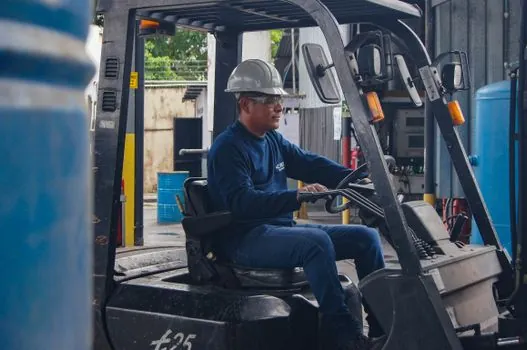
Loading-dock entrances take more mechanical abuse in a single shift than most retail entrances see in a year, forklift treads, pallet-jack wheels, and continuous foot traffic combine to crush standard carpet-backed matting within weeks [S1][S2]. Crush-proof rubber entrance mats with reinforced ribbed or aluminium-rail undersides are the working spec for this zone.
Outdoor scraper mats in nitrile rubber, with molded cleat patterns sized to forklift and foot traffic, stop dirt and oil at the threshold before either reaches the warehouse floor [S4]. Grease-resistant nitrile backing prevents oil and hydraulic fluid from wicking back onto the concrete and creating a downstream slip zone, a common failure pattern when general-purpose entrance matting is substituted [S4]. The dock area decision overlaps with broader material-handling equipment choices, and the dock leveler selection map covers the adjacent powered-equipment side of the same loading-bay envelope.
Comparison: Mat Type vs Decision Criteria
Four mat families line up against four selection criteria as follows. (1) Welding-safe anti-fatigue, 1800°F spark rating, NFSI traction not standard, oil/chemical resistant, forklift-rated versions available, 8-12 hr shift comfort rated good [S1]. (2) NFSI high-traction entrance mat, spark rating limited, NFSI high-traction certified, nitrile backing grease-resistant, foot and pallet-jack traffic only [S4]. (3) Flow-through drainage tile, spark rating available on premium lines, traction limited when wet-film present, oil/chemical resistant, open-grid wash-down compatible [S1]. (4) ESD/static-dissipative runner, spark rating varies, traction varies by construction, oil resistance limited, required for electronics and flammable-vapour zones [S1][S4].
The decision path is sequential: identify the dominant hazard (spark, fluid, slip, static), then pick the family that addresses it without violating the others, then verify NFSI traction, 1800°F rating, or ESD grounding on the cut sheet. Vendor self-declarations are not substitutes for the third-party marks.
Compliance Anchors and Sourcing Standards

U.S. buyers typically anchor mat specs to OSHA 29 CFR 1910 walking-working surface rules, NFSI/ANSI NFSI B101 tested slip resistance, and ANSI/ESD S20.20 for static-safe zones, while UK and EU sites reference EN 13501-1 reaction-to-fire and ISO 14001 facility-management documentation carried by major matting suppliers [S1][S2]. Third-party "high traction" marks from the National Floor Safety Institute are the most consistently cited slip-resistance credential across both U.S. and European industrial mat lines [S4]. Procurement language should require the mark, the test method, and a current certificate rather than a generic "slip-resistant" descriptor on the datasheet. Facility-level audits and the safety certification chain that backs them are the upstream control point.
Limitations and Failure Modes
Three failure modes recur in the field. First, anti-fatigue foam-backed mats used in wet zones delaminate within months because water wicks under the backing and breaks the foam-to-rubber bond; the fix is drainage tile, not thicker foam [S1][S2]. Second, consumer-grade rubber (SBR/PVC) specified near welding cells melts on first slag contact and becomes the ignition source it was meant to prevent, a documented misapplication that a 1800°F compound spec would have eliminated [S1]. Third, NFSI-certified mats lose their traction rating once oil film builds up, so grease-resistant nitrile backing plus a documented cleaning frequency is part of the spec, not an optional extra [S4]. ESD mats that are not grounded through a verified path are functionally ungrounded, so a wrist-strap-and-floor resistance check at commissioning is part of the procurement contract, not a post-install option [S1]. For broader facility floor-prep choices, the EPDM rubber spec map covers adjacent elastomer selection pitfalls.
Trackable signals to watch: NFSI's published list of currently certified "high traction" products, supplier datasheets that list both 1800°F spark rating and NFSI traction simultaneously (the cross-certified products are the easiest spec wins), and any OSHA citation pattern under 29 CFR 1910.22(a) for walking-working surface housekeeping that ties matting to general facility liability. Concrete-warehouse retrofits in 2026-2027 should reissue cut sheets with the mat compound, traction test method, and grounding resistance on a single line item.