The published membrane literature groups filtration classes by cutoff: microfiltration (MF) roughly 0.1–10 µm, ultrafiltration (UF) 0.001–0.1 µm (10 kDa–500 kDa), nanofiltration (NF) roughly 300–1000 Da, and reverse osmosis (RO) below roughly 200 Da, with the operating transmembrane pressure rising in step with the cutoff fall [S1]. For a deeper primer on membrane end-products and polymer chemistry, see the waterproof membrane encyclopedia entry, which is closely related to the flat-sheet stock used in MF and UF elements.
Polymer platforms and why each one wins a given duty
Polysulfone and polyethersulfone dominate UF and MF hollow-fiber and flat-sheet production because of their mechanical strength, thermal stability, and tolerance of chlorine cleaning at low ppm, and they are typically cast via non-solvent induced phase separation (NIPS) from NMP or DMAc solutions with PVP or PEG as the pore-forming additive [S1]. PVDF is favored for aggressive feeds (high pH swings, strong oxidant cleaning, oily wastewater) because of its halogen resistance, and is usually processed by thermally induced phase separation (TIPS) using diluents such as triacetin or dioctyl phthalate because PVDF has a narrow NIPS processing window.
Cellulose acetate remains a meaningful secondary chemistry for RO and UF because it tolerates free chlorine better than polyamide (roughly 0.5–1.0 ppm continuous is published as tolerable versus sub-ppm for polyamide), and it is cast from acetone-formamide solutions, but it hydrolyzes above roughly pH 6.5 and is temperature-limited to roughly 30–35 °C, which is why it has been displaced in most new seawater and brackish builds by PA-TFC [S1].
Phase inversion and TFC line: the unit operations that actually set the spec
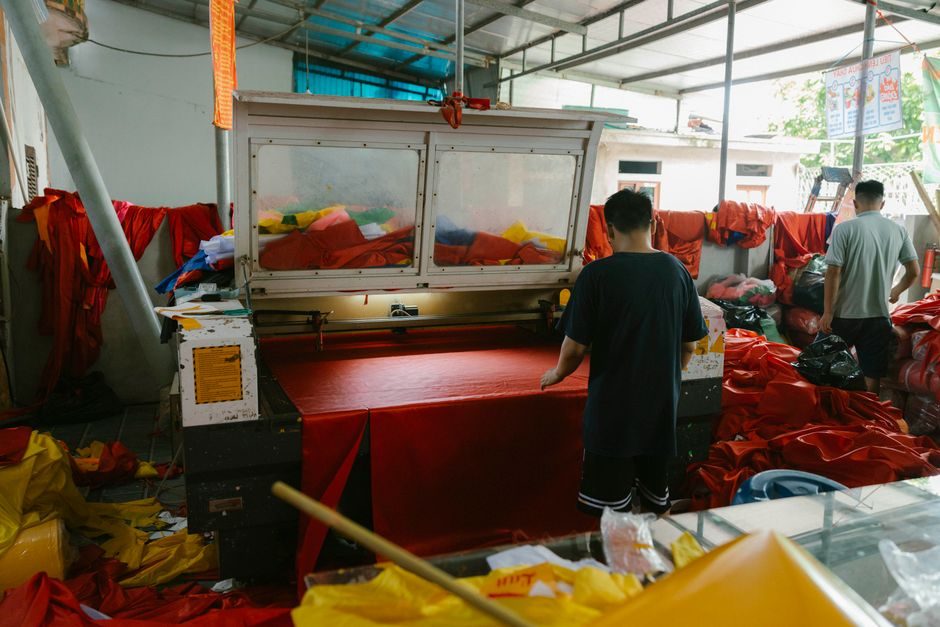
A modern polymeric membrane line is a sequence of dope preparation, casting or spinning, coagulation, washing, and post-treatment, and each step has a measurable window that drives pore size, bubble point, and permeability. For a polymer solution, a typical phase-inversion dope sits at 12–25 wt% polymer in a polar aprotic solvent (NMP, DMAc, or DMF), with 0–10 wt% pore-former (PVP, PEG, or LiCl) and water or alcohol as the non-solvent bath at 20–40 °C; deviation of more than roughly 1–2 °C in the bath or 1–2% relative humidity in the air gap shifts the resulting pore-size distribution measurably, which is why casting halls are climate-controlled to roughly 40–60% RH [S1].
For a TFC RO or NF element, the support UF is first cast (often PES at 15–18 wt%), then the aqueous MPD solution (roughly 1–4 wt% m-phenylenediamine) is applied, drained, and the support is immersed in trimesoyl chloride in Isopar or hexane (roughly 0.05–0.2 wt%), the interfacial polymerization runs for 10–60 s, and the web is washed and dried at 60–110 °C; rejection of NaCl above 99.0% and permeate flux above roughly 20 L·m⁻²·h⁻¹ at 225 psi (1.55 MPa) on a 2000 ppm NaCl test is a published commercial benchmark for brackish elements [S1]. The analogy to other film-forming processes is direct — the additive manufacturing material encyclopedia entry covers how polymer rheology windows are held in layered extrusion, which mirrors the dope viscosity and shear window a casting line must also control.
Pore-size class versus application: a criteria-based comparison
Membrane class is best specified against four decision criteria: nominal cutoff, operating pressure, material tolerance to oxidant and pH, and target contaminant. The table below lines up the main options against those criteria using the ranges published in the membrane review literature [S1]; an engineer choosing a separation should anchor on which constraint dominates, not on brand name.
For a brackish desalination or trace organics removal job, PA-TFC RO with roughly 200 Da cutoff, 10–30 bar feed, pH 2–11 continuous, and 0.1 ppm free chlorine cap, delivering 99.0–99.8% NaCl rejection on a 2000 ppm feed, is the default selection [S1]. For hardness and multivalent ion removal with lower pressure (5–15 bar), NF at 300–1000 Da on a polyamide or sulfonated polysulfone chemistry, with the same oxidant and pH envelope, hits the cost-versus-rejection balance. For TSS, turbidity, and most bacteria, UF at 10–500 kDa on PES or PSf, at 0.5–5 bar, gives high flux and tolerates 50–200 ppm free chlorine CIP, which is a meaningful operating advantage over PA-TFC. For oil-water, oily produced water, and pre-RO protection, MF at 0.1–10 µm on PVDF (often TIPS) at 0.2–2 bar tolerates pH 1–13 and oxidative cleaning, and is the workhorse in upstream produced-water and refinery service. For a procurement view of flat-sheet bitumen alternatives, the modified bitumen membrane encyclopedia entry is the right background reading for sheet-form roll goods, even though chemistry differs from the polymeric UF/RO film.
Fouling, cleaning, and the operating constraints that drive element replacement
Fouling is the dominant operating constraint, and the literature treats it in three layers: particulate cake (controlled by prefiltration and crossflow velocity), organic adsorption (controlled by feed pH and antiscalant), and biofouling (controlled by biocide dosing and CIP frequency) [S1]. For PA-TFC RO, the feed pH window of 2–11 is not symmetric: continuous operation below pH 2 hydrolyzes the amide bond, while operation above pH 11 with temperatures above roughly 35 °C accelerates the same pathway, and the published rule of thumb is to keep the upper pH–temperature product below roughly 400 in °C·pH-units on continuous duty [S1].
For polymeric MF and UF on PSf and PES, free chlorine tolerance is normally quoted at 100–200 ppm short-term CIP and 0.5–2 ppm continuous on feed, with cumulative exposure tracked in ppm-hours to roughly 1000–2500 before embrittlement risk rises, while PVDF extends this to 5000+ ppm-hours because the C–F bond resists oxidative attack; this is why PVDF dominates municipal MBR and many produced-water trains even though the as-cast flux is typically 10–30% lower than PES at the same cutoff [S1].
Standards, verification tests, and what a buyer should demand on a datasheet
Four product-side specifications are worth pinning on every purchase: nominal cutoff (Daltons or µm, with the test solute), pure-water flux at a stated transmembrane pressure and temperature, bubble point on MF/UF (ASTM F316 equivalent practice), and rejection on a reference test solution (NaCl 2000 ppm at 225 psi for RO, MgSO4 2000 ppm at 75 psi for NF, dextran or PEG for UF) [S1]. For the broader water-quality sampling chain upstream and downstream of the membrane, the online water analyzer encyclopedia entry covers the conductivity, pH, and TOC instruments the spec sheet must be consistent with, because a claimed 99.5% rejection only means something when the analyzer trace is in calibration.
Cleaning chemistry should be listed on the datasheet with explicit concentrations and temperatures, not left to the operator: a typical PA-TFC alkaline CIP is pH 10–11 with EDTA at 30–35 °C, an acid CIP is pH 2 with citric or sulfamic acid, and the chemistry is constrained so that no individual agent pushes the membrane outside its published pH–temperature envelope [S1]. Process-engineering context for the heat-clean step in CIP is covered in the heat treatment furnace encyclopedia entry; even though that page targets metal thermal processing, the same thermal-envelope discipline governs the dryer and post-treatment ovens on a membrane line.
Where the manufacturing line is heading in 2026 and what to track next
Three signals are worth tracking over the next 6–12 months. First, dry-preserved PA-TFC elements that pass rewet validation in under 30 minutes without glycerin — meaningful for plant logistics — are now appearing on brackish RO datasheets from multiple OEMs rather than just seawater elements. Second, TIPS-processed PVDF hollow fibers are displacing NIPS-PVDF in oily-water and MBR builds because the higher elongation at break and tighter bubble-point distribution remove one of the long-standing failure modes in the field. Third, tighter rejection specs on NF at 300 Da with sulfate rejection above 99% and chloride passage above 60% are being used for lithium-bromine selective concentration, which is a different duty from traditional water-softening NF. Process engineers evaluating new element supply should demand the test conditions that produced each datasheet number, not the number itself [S1]. For related process-engineering coverage, see the spec-driven selection logic used for high-performance polymers in PEEK pros and cons: spec-driven selection logic for engineers, which uses the same pore-and-permeability framing adapted for engineering plastics.