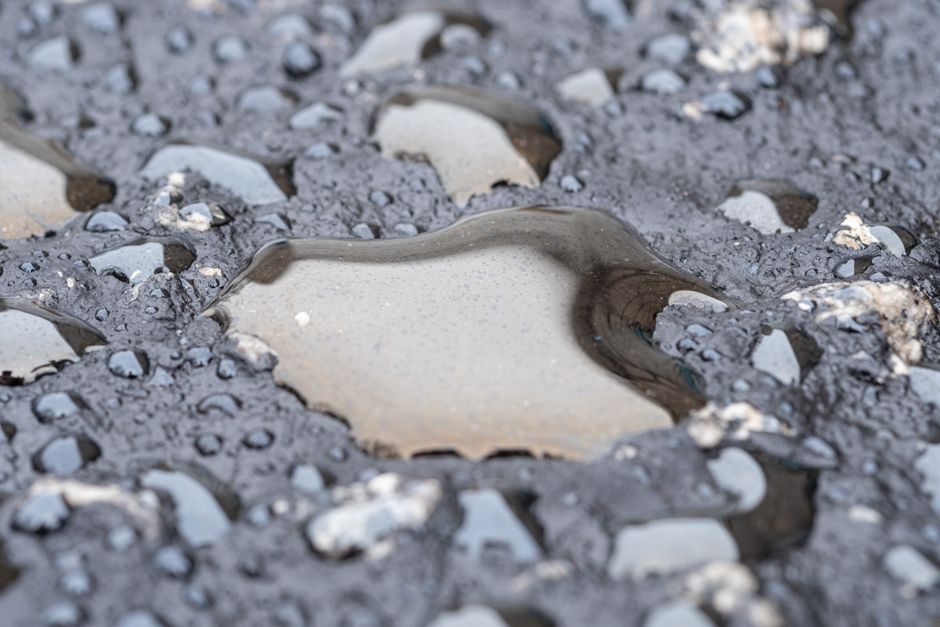
Single-component moisture-curing pure polyurethane waterproof coating is a liquid polymer waterproofing material applied to dry substrates, supplied by multiple Chinese export channels [S2]. Nano-CeO2 hybrid waterborne polyurethane dispersions are documented in 2018 polymer-science literature as a route to raise the UV resistance and thermal stability of waterborne PU systems, with the ceria phase confirmed by XRD as face-centered cubic [S1]. The two product families target different jobs: a coating seals a substrate against water ingress; an insulation is a closed-cell foam that reduces conductive heat transfer.
Specifying engineers must keep the two categories separated at the BOQ line, because a polyurethane waterproof coating and a polyurethane insulation board are not interchangeable — one is a film-former measured in mils or g/m², the other is a rigid or spray foam measured in W/m·K and kg/m³. S K Formulations Private Limited, an Indian polymer-coating manufacturer, lists four product lines that explicitly split anti-corrosion, electrical insulation, waterproofing and thermal insulation coatings as separate items, confirming that the industry treats them as distinct specification objects [S4].
What a polyurethane waterproof coating actually is
A single-component moisture-curing pure polyurethane waterproof coating cures by reacting with ambient humidity to form a continuous elastomeric film on the substrate, and is described in current Chinese export listings as a "liquid polymer waterproof material" suitable for dry substrates [S2]. Non-tar polyurethane waterproof coating (ChemicalBook entry CB21146592) is the tar-free variant widely specified where coal-tar pitch odours and leachates are a concern [S5]. Standard polyurethane waterproof coating (CB61125825) sits on the same chemistry family, with waterborne, solvent-borne and tar-modified variants differentiated by their upstream raw materials [S3].
Application thickness for roof PU waterproofing is normally 1.0–2.0 mm in multiple roller coats, giving a dry film weight of roughly 1.2–2.4 kg/m², although the export listing does not print a tight numeric tolerance [S2]. Substrate moisture is the controlling variable: a damp slab blocks the moisture-curing mechanism and produces a tacky, under-cured film, which is why the supplier label restricts use to "dry" substrates [S2]. For projects where the slab cannot be dried, waterborne PU dispersions (as in the CeO2 hybrid system) offer an alternative cure path that does not depend on atmospheric humidity [S1].
What a polyurethane insulation actually is
Polyurethane insulation is a closed-cell rigid or spray foam with thermal conductivity in the 0.020–0.028 W/m·K band at 23 °C mean, well below mineral wool (≈0.040) and XPS (≈0.030) at the same density. Spray PU foam (SPF) and factory-board PU/PIR share the same isocyanate-polyol backbone, but the board route uses pentane-blown or HFC-blown foam laminated with aluminium or glass-fibre facers, while the spray route is field-applied and density-controlled on site. The buying-guide articles on this site walk through the 2026 price and MOQ levers for polyurethane insulation and the 2026 spec gates on conductivity, fire grade and MOQ, both of which frame the same foam differently from a coating. [S1]
The functional metric is also different. A coating is graded on tensile strength, elongation at break, adhesion to substrate, and water-vapour permeance (g/m²·day). A PU insulation is graded on λ-value, closed-cell content (typically >90 % for SPF), compressive strength (kPa at 10 % deformation), and fire grade (B-s2,d0 for the foam core in European usage, with the exact class set by the full system test, not the foam alone). The water absorption of PU foam is typically ≤3 % by volume for a closed-cell board, which is the property that gives PU insulation its incidental waterproofing reputation — but that incidental property is not a substitute for a formulated waterproof coating on a roof or wet-room slab.
Chemistry overlap, application split
Both systems use the isocyanate-polyol reaction, but they diverge in formulation density and additives. A waterproof coating carries plasticisers, fillers, adhesion promoters and pigments to make a flexible film at 0.5–2.0 mm; a rigid PU insulation carries blowing agents and cell stabilisers to make a low-density foam at 30–60 kg/m³ for board, 30–45 kg/m³ for spray. The CeO2 hybrid study adds 5–20 nm ceria colloids to a waterborne PU dispersion, with the XRD pattern confirming face-centered cubic CeO2 and the hybrid showing improved UV-blocking and thermal stability versus the unhybridised dispersion [S1]. That kind of nano-additive package is what closes the UV-degradation gap that historically kept solvent-borne PU coatings out of exposed roof service.
For procurement, the practical decision tree is short. If the job is to stop water penetrating a roof, wet room, basement wall or tunnel segment, specify a PU waterproof coating system with the right primer and reinforcement [S2][S5]. If the job is to reduce conductive heat gain or loss through a wall, roof, pipe or cold-store envelope, specify a PU insulation board or spray foam at the right density, λ-value and fire grade. The two are sometimes layered — PU foam as the substrate, PU coating as the weather skin — but the bill of materials must list each as a separate pay item, because the unit, test method and warranty path are different. S K Formulations, for example, lists waterproof coating, electric insulation coating, anti-corrosion coating and heat-insulation coating as four parallel product families, not as a single multi-function item [S4].
Side-by-side comparison on spec criteria
The two product families line up against four decision criteria as follows. (1) Primary function: waterproof coating = hydrostatic barrier, typically 1.0–2.0 mm dry film [S2]; PU insulation = thermal barrier, typically 30–100 mm board or 50–150 mm spray. (2) Test metric: coating = elongation, adhesion, water-vapour permeance; insulation = λ-value, closed-cell %, compressive strength. (3) Substrate demand: coating = dry, primed, sound [S2]; insulation = clean, dry enough for adhesion but tolerant of minor surface irregularity for spray. The categories overlap on polymer backbone but not on specification.
A useful signal is the density of the cured product. A PU waterproof coating is roughly 1.1–1.4 g/cm³ when fully cured; a rigid PU insulation board is 30–60 kg/m³, i.e. 0.030–0.060 g/cm³, almost two orders of magnitude lighter. That density ratio alone tells the specifier which item is which on the BOM, and it is why a "polyurethane" line item on a quotation must be checked for both the test standard cited and the cured density, not just the polymer name.
Who needs a coating, who needs an insulation
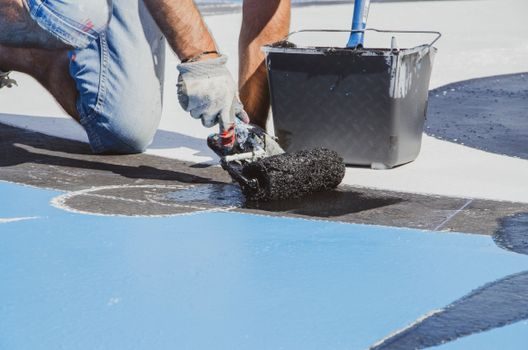
Waterproof coating is for: roof slabs, basement retaining walls, wet-room floors, balcony and planter-box concrete, potable-water tanks with food-grade approval, tunnel segment linings, and any detail that must hold back hydrostatic head. Non-tar variants are specified for hospitals, schools and indoor tanks where tar odour is unacceptable [S5]. Polyurethane insulation is for: external wall insulation behind cladding, flat-roof insulation under the weatherproofing layer, district-heating pipe shells, cold-store panels, LNG pipe supports, and refrigerated transport bodies.
Coating is not for: a wall assembly that needs an R-value — a 1.5 mm PU film gives roughly 0.01 m²·K/W, which is below the resolution of any thermal calculation. The two products are complementary, not substitutes.
Limitations and failure modes
Moisture-curing PU coatings fail on three predictable paths: (1) substrate moisture above the supplier's tolerance, producing an under-cured, soft film [S2]; (2) pinholes over porous concrete, fixed by priming and a base coat; (3) UV-driven chalking on exposed applications, mitigated by nano-CeO2 or other UV-blocking additives, with the hybrid waterborne PU/CeO2 system documented as a route to improved UV resistance [S1]. Tar-modified variants carry the failure modes of the tar phase — bleed, odour, and incompatibility with some potable-water approvals — which is why non-tar grades have displaced tar PU in most indoor and tank applications [S5].
PU insulation fails differently. Spray PU foam loses R-value if the blowing agent diffuses out faster than air diffuses in (aged R-value vs initial R-value is a 10–15 % drop over 5–10 years for closed-cell PUR/PIR). Closed-cell content below 90 % lets water migrate through the foam body, and the joint between spray passes or boards becomes a thermal bridge unless detailed with care. Fire performance is system-dependent, not foam-dependent: a foam core that passes B-s2,d0 in a panel test can fail in a wall test if the facing or adhesive is changed. Engineer must read the full system certificate, not the foam data sheet alone.
Standards and documentation to anchor the spec

For Chinese-market projects, the waterproof coating category is governed by the GB/T 19250 series for polyurethane waterproofing, with non-curable rubber-asphalt variants covered by JC/T standards as cited in domestic encyclopaedic entries [S6]. The CeO2-hybrid waterborne PU study uses XRD and HRTEM characterisation to confirm the ceria phase and the dispersion stability, giving an example of the lab evidence expected when a nano-additive package is specified [S1]. Indian suppliers such as S K Formulations publish application notes covering the four coating families — anti-corrosion, electric insulation, waterproofing, heat insulation — as a useful cross-check for engineers sourcing in South Asia [S4].
For Western and export projects, the relevant test methods for elastomeric waterproof coatings include ASTM D412 (tensile/elongation), ASTM D4541 (pull-off adhesion), and ASTM E96 (water-vapour permeance). For PU insulation, ASTM C518 (heat flow meter) and EN 13165 for factory-made rigid PU (PU/PIR) boards are the dominant references. The specifier should not interchange these — a coating data sheet that quotes an R-value per inch and an insulation data sheet that quotes a dry-film thickness in mils are both mislabelled at the quotation stage.
Engineers should track two signals: (1) the published list of GB/T revisions to the 19250 series, which historically move on a 5–7 year cadence and tend to tighten VOC limits on waterborne PU; (2) the next iteration of nano-additive data on waterborne PU/CeO2 systems, where the 2018 paper gives a baseline but field-aged data on hybrid roof coatings is still thin [S1]. Either of those will shift the spec window for exposed roof waterproofing within the next 12–18 months.
For related coverage, see Soft Starter Selection Criteria: Six Gates That Decide 2026 Specs.