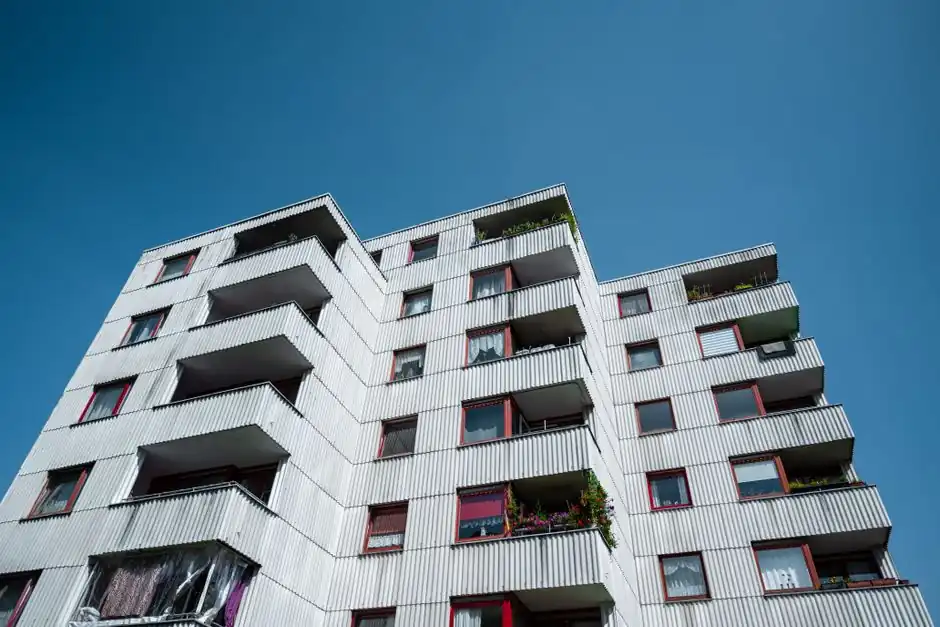
PVC ribbed waterstops, supplied in widths matched to wall thickness and head pressure, remain the default embedded seal for construction and expansion joints in high-rise concrete frames [S1].
For tower cores, basements, and podium decks, the engineering question is not whether to install a waterstop, but which compound, profile, and joint geometry survives decades of thermal cycling, wind sway, and hydrostatic load [S4].
Material Options: PVC, Rubber Compounds, and Hybrid Steel-Edged Profiles
PVC waterstops are graded for fresh concrete and supplied in different sizes keyed to expected fluid pressure and joint type, making them the workhorse of high-rise floor-to-wall and wall-to-slab interfaces [S1].
Rubber waterstops cover the cases PVC cannot: dynamic joints, chemical exposure, and very high water head. The dominant compounds are SBR (preferred for water containment), high-tensile neoprene/CR (recommended for sewage and chemical exposure), natural rubber, with EPDM, nitrile, and silicone available on request [S3]. Across the three workhorse compounds the published spec floors converge: hardness 65 Shore A (ASTM D-2240), water absorption 5% max after 2 days at 70°C (ASTM D-471), accelerated aging retention 80% minimum at 96 hours/70°C (ASTM D-573), and no ozone cracking at 50 PPHM, 70°C, 20% elongation for 7 days (ASTM D-1149) [S3]. Tensile strength floors diverge by compound: SBR 3000 psi minimum, high-tensile neoprene 2500 psi minimum, natural rubber 3500 psi minimum, all per ASTM D-412 [S3].
Steel-edged waterstops are a hybrid where rubber is mechanically bonded to galvanized steel plates; the steel flanges give exceptional tensile anchorage and cut displacement risk during concrete pours, which is the failure mode most relevant to thick raft pours in tower foundations [S3]. The waterstop choice is one of several long-life sealing decisions on a high-rise site, and the same selection-discipline mindset applies to adjacent systems such as the industrial valve population on the building's MEP risers.
Profile Geometry and Joint-Movement Mapping
Profile geometry, not just polymer, is the real selection gate in a tower. Center-bulb profiles absorb multi-directional movement (expansion, contraction, shear) and are the right pick for expansion joints between tower core and outrigger columns; dumbbell profiles anchor aggressively in static construction joints and resist water bypassing along the waterstop/concrete interface [S3]. Plain strips fit only minimally moving joints and are rarely used in primary high-rise basement walls. Steel-edged profiles cover very high hydrostatic head with the added anchorage of galvanized edge plates [S3].
Joint movement in a high-rise is driven by wind sway, seismic drift, and thermal expansion of the concrete mass; rubber's elasticity lets the seal survive building sway and differential settlement that would crack a rigid seal, while EPDM is the preferred outdoor-exposed compound because of its superior ozone, UV, and temperature resistance [S3][S4]. For buried basement and core-wall joints this is a non-issue, but for podium decks, planter zones, and any rooftop slab the UV-aging penalty on non-EPDM compounds must be priced in [S4]. Reference data from high-pressure detachable flood boards shows a comparable flood-height/tier table (2500 mm head, 7 tiers, 1900 mm post spacing) that engineers can borrow as a mental model for tiered waterstop layouts in deep basements.
Criteria-Based Comparison: PVC vs SBR vs Neoprene vs EPDM vs Steel-Edged

On the four decision criteria that drive a high-rise spec, the field lines up as follows. Head pressure / water containment: PVC and SBR are first-line for potable and groundwater; neoprene adds chemical and sewage resistance; steel-edged wins very high head with displacement risk during pour [S1][S3]. Joint movement tolerance: PVC handles small movement only; center-bulb rubber profiles (SBR, neoprene, EPDM, natural) handle expansion, contraction, and shear; EPDM and natural rubber are the most elastic at low temperature [S3][S4]. Chemical / UV exposure: neoprene and nitrile resist oils and many chemicals; EPDM is the top pick for outdoor UV and ozone; PVC is acceptable for buried joints but degrades in direct sunlight [S3][S4]. Tensile / aging floors: SBR 3000 psi, natural rubber 3500 psi, neoprene 2500 psi minimum tensile (ASTM D-412); all three hold 80% tensile and 80% elongation after accelerated aging (ASTM D-573) [S3].
For a typical 50-plus-story tower, the resulting material map is: PVC ribbed strip in basement construction joints; SBR or natural-rubber center-bulb in tower core expansion joints; EPDM where any section of the seal sees direct sunlight; steel-edged waterstop at the raft slab and any head exceeding 20 m of water column; neoprene where groundwater carries sewage-plant or fuel-station contaminants [S3][S4].
Use Cases by Building Zone
Basement raft and perimeter wall: PVC ribbed waterstop, sized to wall thickness and the design head (often 10-30 m of groundwater), with dumbbell or center-bulb profile chosen by expected movement [S1][S3].
Tower core wall and outrigger columns: rubber center-bulb waterstop, SBR or natural-rubber compound, minimum 2500-3000 psi tensile per ASTM D-412, minimum 450% ultimate elongation, sized to accommodate the calculated thermal and sway drift [S3].
Podium deck, planter, and rooftop: EPDM or EPDM-clad profile, with the UV-resistance rationale documented in the O&M manual; non-EPDM compounds need a protective cover or shade slab [S3][S4].
Chemical or fuel-exposed zones (loading bays, generator rooms, sewage lift stations): neoprene or nitrile, with chemical compatibility cross-checked against the project's exposure schedule [S3].
Limitations, Failure Modes, and Sourcing Standards

Rubber in a high-rise is not a free lunch. UV exposure embrittles non-EPDM compounds in podium and rooftop applications; extreme cold stiffens the polymer and reduces sealing pressure, while extreme heat softens it and risks deformation; oxidation and mechanical stress erode elasticity over the 50-plus-year design life of most towers, so the compound's accelerated aging retention (80% tensile, 80% elongation at 96 h/70°C per ASTM D-573) is a real longevity gate, not a marketing line [S3][S4]. PVC shares the UV weakness and can be damaged by certain groundwater chemicals, so a site-specific chemical compatibility check is mandatory before a PVC spec is frozen [S1][S4].
The reference test stack that ties a high-rise rubber waterstop order to verifiable numbers: ASTM D-412 for tensile, modulus, and elongation; ASTM D-471 for water absorption; ASTM D-2240 for hardness; ASTM D-395 for compression set; ASTM D-573 for accelerated aging; ASTM D-1149 for ozone resistance [S3]. Independent lab certificates to these methods, with batch traceability, are the practical defense against a counterfeit or under-cured compound landing on a tower site. Adjacent QA discipline, like the pressure transmitter calibration chain on the dewatering system, runs on the same batch-traceability logic. Engineers should also confirm a flow meter data trail during the leak-tightness test of any tanked basement, since the leak rate is the only direct field proof that the waterstop system is performing as designed.
Installation Constraints Specific to Tall Buildings
Installation on a high-rise site is constrained by working at height, congested rebar, and the impossibility of post-pour remediation once the formwork is stripped. Rubber's malleability lets crews form it around rebar cages and irregular joint geometry faster than rigid metal alternatives, which is a real cycle-time gain on repetitive floor cycles [S4]. PVC strips are lighter per meter but require careful welding at junctions and are unforgiving of splice contamination, so splice QA (heat-weld temperature, dwell time, pull test) is a documented hold point [S1].
For very high head zones (deep basements, swimming pool tanks, water features) a detachable flood-board approach is sometimes layered on top of the embedded waterstop: aluminum extruded panels, 60 mm thick, applied with a manual Gremon handle that seals sides and bottom simultaneously, flood-prevention performance equivalent to WS-6 (JTCCM Class 5), panel weight around 12 kg per meter at 360 mm height, install time roughly 5 minutes per panel [S2]. This is not a replacement for an embedded waterstop in a poured joint, but it is the practical add-on for openings and penetrations where an embedded profile is impossible.
Trackable signals for specifiers to watch over the next procurement cycle: any tightening of ASTM D-412 minimum tensile thresholds in project specifications (currently 2500-3500 psi across the three workhorse compounds [S3]); rising EPDM content in podium-deck waterproofing schedules driven by UV-aging field failures; and wider adoption of steel-edged profiles at raft slabs where concrete-pour displacement has caused PVC strip failures. Sourcing documentation should reference ASTM D-412, D-471, D-2240, D-395, D-573, and D-1149 for any rubber compound, and the manufacturer's batch certificate for PVC, before any waterstop is released to the tower crane.
Related analysis: Agricultural Aerial Work Truck Selection: Low-Rise Orchard Platforms vs Tall-Tree Boom.