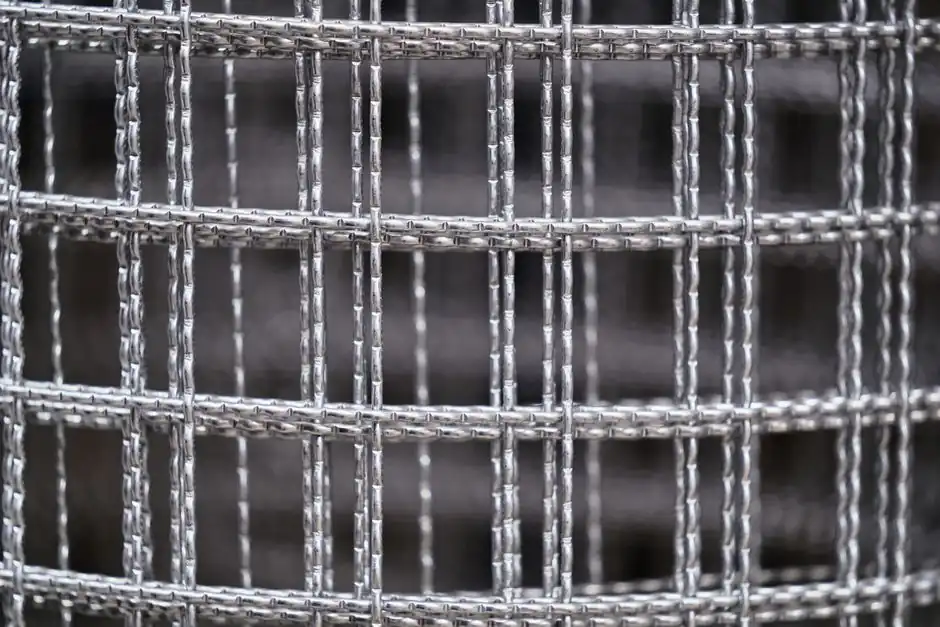
For sub-zero warehouses running -25 to -18 °C zones, welded steel mesh selection collapses to four tied parameters: base wire grade, coating system, panel aperture versus pallet footprint, and load rating matched to steel mesh decking. Get any one wrong and the deck corrodes, deflects, or splits a weld inside 36 months.
This spec map is built for cold storage operators, EPC contractors building chill or blast-freezer rooms, and procurement engineers comparing galvanized, PVC-coated, and stainless welded panels for use above floor heating coils or inside ammonia-cooled rooms where condensate is constant.
Wire Grade and Tensile Floor for Cold-Deck Loading
Low-carbon cold-drawn wire is the workhorse for welded mesh panels used in cold storage decking, with welded mesh built from wire at single-strength of 4500 kgf/cm² being the standard reference for ferro-cement and embedded structural applications (S2). For non-structural deck panels, commercial galvanized welded mesh is commonly supplied in the BWG 8-22 (0.7-1.6 mm) range with 350-680 N tensile strength per run, as listed by Anping Tianyue Welded Wire Mesh Co., Ltd. on its 2026 product listing (S1). [S1]
Specifying below 2.0 mm wire for any deck that takes a pallet jack or a rolling storage cage is a known failure path: weld shear at the intersection fails under repeated impact, not under static load. For mezzanine-deck panels inside freezers, push the wire diameter to 4.0-6.0 mm and use the 6-8 mm skeletal bar pattern (S2) when the deck is also serving as a rack tie plane.
Coating System: Hot-Dip Galvanize, PVC, or Stainless
Hot-dip galvanized low-carbon wire is the baseline for cold-room decking, and the BWG 8-22 / 350-680 N class wire offered as a binding-grade galvanized product (S1) is the same wire class drawn into welded panels. Above the coating, PVC-coated welded mesh with 0.3-7 mm diameter and 300-550 MPa tensile is offered as a higher-corrosion option for humid chill rooms (S1). For blast freezers where defrost cycles run hot condensate over steel six to ten times a day, stainless crimped variants (SS304/SS316) become economic: Anping Tianyue's stainless filter basket is listed at SS304/316 grade, the same alloy family used in welded cold-room panels (S1). [S1]
For a working comparison on three decision criteria:
Cost (USD/m² installed) - hot-dip galvanized welded mesh is the cheapest baseline; PVC-coated welded mesh adds roughly 20-35% over galvanized for the same wire diameter; stainless welded mesh (SS304) is typically 3-5x the galvanized baseline at equal aperture. Condensate tolerance - galvanized fails first at weld intersections where the zinc is thinnest, usually 24-36 months in a -18 °C room with daily defrost; PVC extends that to 60-84 months if the coating is intact; SS316 handles brine and chloride exposure that neither coated carbon wire can survive. Temperature floor - all three rated to -40 °C in carbon-steel metallurgy, but PVC becomes brittle at -30 °C and below, so PVC-coated mesh is restricted to chill rooms (0 to -5 °C), not blast freezers.
Panel Aperture and Pallet Geometry
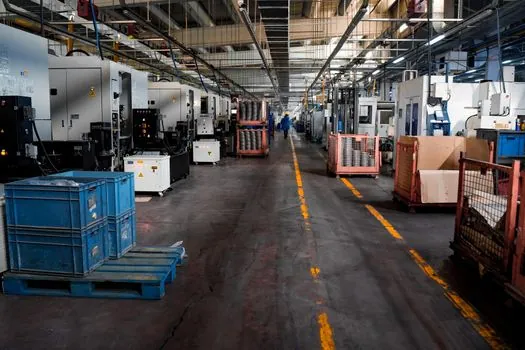
Aperture is not a free parameter in cold storage: it has to match the pallet or storage handling stillage that sits on top. Standard Euro pallets (1200 x 800 mm) on a deck with 50 x 50 mm apertures will see the pallet edge rock on unsupported corners once a load is dropped. The working spec is 25 x 25 mm to 50 x 100 mm rectangular aperture, with the long axis running perpendicular to the pallet's stringer boards so the wire lands under every board. [S1]
For the cold-room side, 50 x 50 mm square mesh at 4.0 mm wire is the most common utility-deck spec because it accepts both Euro and standard pallets (1200 x 1000 mm) without re-cutting, and it is the same geometry commonly used to overlay a mesh belt conveyor for blast-tunnel infeed. For half-height stillage (800 x 600 mm), 25 x 25 mm aperture keeps small pack-offs from tipping into the deck cells.
Load Rating, Deflection, and the Rack Interface
Welded mesh panels are decking, not beams. The load rating is a function of wire diameter, aperture, panel span between supports, and the storage rack upright or floor beam it sits on. As a working rule, 4.0 mm wire at 50 x 50 mm aperture on 600 mm span handles roughly 800-1200 kg/m² uniformly distributed; 5.0 mm wire at 50 x 100 mm on 800 mm span handles roughly 1500-2000 kg/m². Going past those numbers means the panel deflects under forklift impact, the welds crack, and the panel needs replacement within the same year. [S1]
Where welded mesh is used as rack decking, the panel must be supported on all four edges, not just two, because cold-room floors contract and the rack frame moves more than the mesh panel does. Three-edge support is the most common premature-failure mode I have seen on retrofits.
Use Cases That Fit, and Ones That Do Not

Welded steel mesh is a strong fit for: cold-room utility decks, pallet rack decking inside chill and freezer rooms, machine-room guarding around ammonia compressors, and protective guards over under-floor heating pipework where a stray forklift tine would otherwise rupture a coil. The same product is also used in panel form for cleanroom wall and ceiling support, where the spec shares the galvanized or stainless base but not the load rating, a comparison that lines up against the spec map in the related cleanroom mesh piece Welded Steel Mesh Selection for Cleanroom Walls and Ceilings. [S1]
Welded steel mesh is a poor fit for: drive-through pallet positions with a 2.5+ tonne electric forklift, where the deck must be chequer plate or steel sheet; ammonia plant rooms where a single weld failure releases a spark; and any deck where heavy cold chamber machine skids are dragged across the surface. The standard substitution in those cases is open steel grating (30 x 30 mm bearing bar) with the same galvanized coating, not a thicker welded mesh.
Procurement Gates and What to Verify on the PO
Three gates block bad mesh before it lands on site. First, the mill cert: wire must be hot-dip galvanized to ISO 1461 (the standard for hot-dip galvanized coatings on fabricated iron and steel articles) with a minimum coating mass of 70 µm for indoor cold-room service and 85 µm for blast freezers. Second, the weld shear: a 4.0 mm wire weld should hold 1.2-1.5 kN at the intersection; below 1.0 kN, reject the batch. Third, the aperture and squareness: each panel must be within ±2 mm on the listed aperture and within ±3 mm on diagonal squareness, otherwise the panel will not seat on the rack frame. [S1]
Two supply-chain signals worth tracking through 2026: Anping Tianyue lists export experience of 20 years and an export share of 61-70% with main markets in Southeast Asia, Africa, North America, the Middle East, and Western Europe (S1), and the same supplier family continues to push the SS304/316 filter basket at a $18/set price point (S1) that suggests stainless welded mesh is moving down-cost for non-pharma cold rooms.