
For 2026 reinforcement procurement, the choice between welded steel mesh and prestressing steel strand is set by stress type, not by price: welded mesh carries distributed tensile load across a two-dimensional plane, while 7-wire prestressing strand carries concentrated, pre-tensioned axial load along a single line.
Both products ship in coil or cut-panel form from long-established Chinese mills [S1][S6], and both share a common upstream base of low-carbon and high-carbon steel wire, but the wire diameter, carbon content, weld procedure and relaxation class diverge sharply once the application moves from passive rebar substitute to active tendon.
Product Forms, Wire Stock and Standards Anchors
Welded steel mesh is produced as a grid of orthogonal cold-drawn or cold-rolled wires, joined at every intersection by electric-resistance spot welding; common wire diameters sit in the 4 mm to 12 mm band, with panel apertures typically 100 mm × 100 mm, 150 mm × 150 mm or 200 mm × 200 mm [S1][S4]. The mesh is most often supplied in flat panels 2.4 m × 4.8 m or 2.0 m × 6.0 m, and is used to replace loose rebar in one- and two-way suspended slabs, walls, pavements and trench bases [S4].
Prestressing strand is a helical assembly of 2, 3 or 7 cold-drawn high-carbon wires; the 7-wire configuration is the volume product, with nominal diameters of 9.53 mm (3/8"), 11.11 mm (7/16"), 12.7 mm (1/2") and 15.24 mm (0.6"), and minimum tensile strength classes of 1860 MPa, 1960 MPa and the higher 2160 MPa band used in long-span bridge girders [S5][S6]. Strand is shipped in 2 t to 5 t coils, and is processed as either pre-tensioned bed-tensioned reinforcement or post-tensioned duct-encased tendon [S5].
Surface condition differentiates the two almost as much as wire carbon: welded mesh uses plain cold-drawn wire or hot-dip galvanized wire, with stainless variants available for aggressive exposure, while PC strand is supplied as plain (unbonded) strand, greased-and-sheathed unbonded strand for post-tensioning ducts, or epoxy-coated strand for bridge deck applications [S6]. Procurement should anchor the order to the governing standard: welded mesh typically references GB/T 1499.3, BS 4483, ASTM A1064 or AS/NZS 4671, while strand typically references ASTM A416, BS 5896, EN 10138 or GB/T 5224 [S1][S5][S6].
Mechanical Behaviour: Passive Grid vs Active Tendon
The fundamental mechanical difference is load state at installation. Welded mesh is passive reinforcement: it carries tensile stress only after the surrounding concrete has hardened and live load is applied, and its design yield is normally taken as 500 MPa for grade 500D or 600 MPa for higher-ductility classes [S1][S4]. The welded intersections transfer shear across the grid, and the spacing of wires — not the wire strength — controls crack-width distribution in slabs.
Prestressing strand is active reinforcement: it is tensioned to 70% to 80% of its ultimate tensile strength (UTS) at the stressing jack, and the resulting pre-compression in the concrete is what carries the service load. This low-relaxation behaviour is the reason PC strand can be specified at 1860 MPa UTS in bridge and high-rise transfer structures where a 12 mm rebar at 500 MPa yield cannot supply the same axial force per unit width.
Elastic modulus of prestressing strand is also higher and more tightly controlled: 195 GPa ± 5 GPa for 7-wire strand, compared with 200 GPa for typical hot-rolled rebar but with much wider scatter [S6]. Engineers reading the two products off the same shop drawing need to remember that welded mesh is sized by wire diameter × spacing × yield (a "kg of steel per m²" calculation), while PC strand is sized by cross-sectional area × jacking force × anchor set (a "kN of pre-stress per tendon" calculation). The steel mesh trades ductility and crack control for ease of placement; the strand trades cost per kN of pre-stress for jacks, ducts, anchorages and grouting equipment.
Application Split: Where Each Product Actually Wins
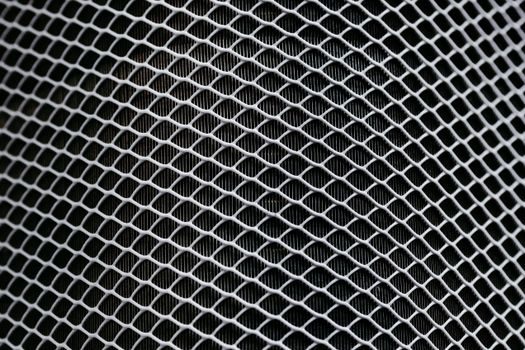
Welded mesh wins in distributed, low-stress, high-volume reinforcement: ground-bearing slabs from 100 mm to 200 mm thick, factory and warehouse floors, pile caps and raft foundations where the wire grid simply replaces tied rebar and cuts placement labour, road and airfield pavement, and shotcrete linings in tunnels. A typical spec calls for SL92 (8.6 mm wire at 200 mm centres both ways) or SL102 (10 mm wire at 200 mm centres) for house slabs, in either black or hot-dip galvanized finish for damp-ground or marine exposure [S1][S4].
Prestressing strand wins in long-span, high-load, deflection-sensitive members: post-tensioned flat slabs in commercial towers (typically unbonded 12.7 mm or 15.24 mm strand in HDPE-sheathed ducts), pre-tensioned hollow-core planks and lintels (4.7 mm to 9.53 mm indented or plain wire in pre-tensioning beds), bridge I-girders and box girders (bonded multi-strand tendons in 50 mm to 100 mm corrugated steel ducts), and ground anchors and rock bolts [S5][S6]. The strand is also the reinforcement of choice for railway sleepers, LNG tank prestressing rings and nuclear containment dome tendons, where the relaxation class, fatigue rating and corrosion protection system (grease + HDPE for unbonded, cement grout for bonded, epoxy for severe chloride exposure) form part of the QA package [S6].
Selection collapses fast once the question is asked: is the member cracked under service load? If no, welded mesh in a thin slab is cheaper and faster. If yes, and the deflection budget is tight, the engineer is in strand territory. A deformed rebar 2026 cost guide sits between these two as the workhorse for beams and columns, but neither mesh nor strand can substitute for it in a tied column cage.
Comparison Frame: Welded Mesh vs PC Strand on Five Decision Criteria
The comparison below uses the criteria that matter on a real PO: structural function, unit supply form, governing standard, typical diameter / spacing envelope, and corrosion-protection option. [S1]
1. Structural function: welded mesh is passive, distributed reinforcement for slabs and walls; PC strand is active, concentrated pre-stress for beams, slabs and bridges. The two are not substitutes — they are sometimes used together, with strand providing pre-stress and welded mesh providing crack-control surface steel. 2. Supply form: welded mesh ships as flat panels or rolls (2.4 m × 4.8 m panels, 50 m rolls in light gauges); PC strand ships as mill coils of 2 t to 5 t, with cut-to-length and pre-bundled strand assemblies available for pre-tensioning beds [S1][S4][S6]. 3. Governing standards: welded mesh to GB/T 1499.3, BS 4483, ASTM A1064, AS/NZS 4671; PC strand to ASTM A416, BS 5896, EN 10138, GB/T 5224 [S1][S5][S6]. 4. Diameter envelope: mesh wire 4–12 mm, strand 9.53–15.24 mm for the common 7-wire series. 5. Corrosion protection: mesh in plain, hot-dip galvanized, or stainless; strand in plain, greased-and-HDPE-sheathed (unbonded), grouted-in-duct (bonded), or fusion-bonded epoxy-coated (FBC) [S6].
A 1-tonne order of SL82 welded mesh and a 1-tonne order of 12.7 mm 1860 MPa strand are not economically comparable — they are sold into different BoQ lines and approved by different engineers in different design offices.
Installation, Equipment and Labour Footprint
Welded mesh installs with a bar tie and spacer chair: panels are lapped one full mesh square (typically 200 mm to 300 mm) at the splice, and the whole grid is lifted into the form on plastic or concrete spacers. No jacks, no anchorages, no grout pumps. A two-person crew can place 200 m² to 300 m² of SL82 per shift on a house slab, which is why mesh has displaced loose rebar in low-rise residential work where tied rebar fixing would dominate the schedule [S1][S4].
PC strand installation is a different job. Pre-tensioning requires a stressing bed with multi-strand jacks, anchor chucks and a hydraulic pump; post-tensioning requires duct installation, strand threading or pushing, stressing jacks (single- or multi-strand), anchor seating, and either grout injection for bonded tendons or grease filling plus HDPE cap sealing for unbonded tendons. The QA paperwork is heavier: jack calibration certificates, elongation-vs-load records, and lock-off slip measurement [S5][S6]. A small post-tensioned slab pour for a 200 m² transfer deck may consume 4 t to 6 t of 12.7 mm strand, four single-strand jacks, two grout pumps and a full-time stressing crew for two days. The mesh alternative would be trivial by comparison, but the deflection control and crack control would be unattainable.
For projects where both products will be ordered, the rebar bender selection frame applies only to the rebar fixing on the same site; mesh arrives pre-cut and pre-bent from the mill, strand arrives on coil and is cut to length on site or in a pre-assembly yard, and neither needs an on-site bender.
Quality Control, Traceability and 2026 Procurement Watchouts
Welded mesh QA is dominated by the weld shear test (the strength of the spot weld at the intersection, typically specified as ≥ 50% of wire UTS in light gauges and ≥ 75% in heavy gauges) and the dimensional tolerance on aperture (typically ± 5 mm on a 200 mm pitch). Mill test certificates should record wire grade, weld shear, panel mass per m², and either the steelmaker's heat number or a traceable cast code [S1][S4]. Common 2026 procurement pitfalls are undersized wire (mill ships 7.5 mm where the spec calls for 8.0 mm to hit the 500 MPa yield envelope), excessive weld spatter that masks undershear, and panels supplied without the standard overhang tails for lap splicing.
PC strand QA is dominated by the 0.2% proof load, ultimate tensile strength, elongation at rupture (≥ 3.5% for 7-wire strand on a 600 mm gauge), relaxation at 1000 h, and — for indented or crimped wire used in pre-tensioning — the bond strength in a standard pull-out test [S6]. Mill test certificates for strand carry the heat number, the cast number, and the strand-construction code, and each coil is identified by a tag that must reach the QA file before the strand is stressed. The 2026 procurement watchouts are: substitution of stress-relieved for low-relaxation strand without paperwork (relaxation is the spec, not the strength), undersized sheathing on unbonded strand (grease pocketing reduces the corrosion-protection envelope), and inconsistent strand modulus across a multi-coil delivery (more than 5 GPa spread between coils can push the elongation-vs-load reading out of tolerance at stressing).
For both products, the practical 2026 sourcing step is to lock the standard reference in the PO (GB/T 1499.3 + grade 500 for mesh, ASTM A416 Grade 270 + low-relaxation for strand) and require a 3.1 mill certificate to EN 10204 with each batch. Anything less means a site QA fight, not a guaranteed performance [S1][S6].
Limitations, Failure Modes and What Each Product Will Not Do
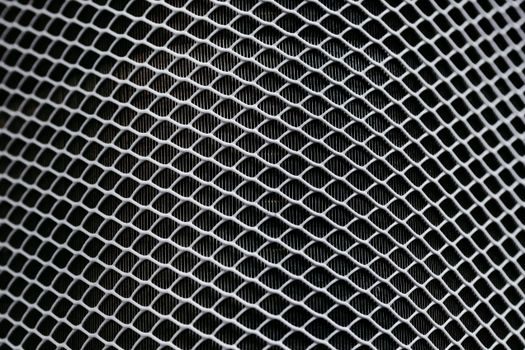
Welded mesh is not a primary load-path reinforcement in a beam: the orthogonal grid and the small-diameter wires do not develop the bond and anchorage length needed to anchor a bar in flexural tension. It is also not a substitute for shear links in a deep beam or pile cap — the wires lack the bend geometry to carry shear across a diagonal crack. In chloride exposure, plain mesh will rust through the wire cross-section in 15 to 25 years if cover is below 40 mm; galvanized mesh extends that to 30 to 50 years, and stainless mesh to 75+ years, but at a cost premium that often forces the designer back to conventional rebar with adequate cover [S1][S4].
PC strand cannot be field-bent: once the helical wires are cold-drawn and stress-relieved, any attempt to bend the strand cold will fracture the outer wires. Strand also cannot be welded: the high-carbon wire and the residual stress from drawing mean that arc strikes at a strand intersection will embrittle the wire and cause delayed fracture under load. The strand needs anchorages sized for full UTS, with ductile wedge cones or swaged anchors that grip without cold-working the wire at the gripping point [S5][S6]. And PC strand without corrosion protection will fail in 5 to 15 years in a coastal or de-icing-salt environment — the small wire diameter and the high sustained stress mean that any pitting corrosion becomes a fatigue and stress-corrosion-cracking problem on the first loading cycle. Greased-and-sheathed strand in a sealed duct is the standard mitigation; epoxy-coated strand is the alternative for bonded applications where the duct will be grouted with a low-bleed cement.
Both products are also subject to the project-level concrete cover and crack-width rules in the governing concrete code (ACI 318, Eurocode 2, GB 50010), and neither product relaxes those rules — the cover and the crack-width limit apply on top of the reinforcement choice. A spec that calls for 30 mm cover with PC strand is non-compliant in most exposure classes, regardless of the strand's corrosion coating.
For projects that need a reinforcing product that does what neither mesh nor strand does — heavy primary flexural and shear steel in beams, columns and pile caps — the procurement conversation moves to the rebar bender 2026 buying guide or the deformed rebar 2026 cost guide for the mill and grade reference. The welded steel mesh 2026 buying guide covers the mesh side in full procurement detail.
Trackable signals for the next procurement cycle: mill announcements of wider FBC-strand capacity (epoxy-coated strand is the growth segment for coastal bridge decks in 2026 to 2028), and a tightening of GB/T 1499.3 weld-shear acceptance windows for heavy-gauge mesh (above 10 mm wire) where undershear has been a recurring QA finding on imported panels. Watch for mill certificates that move from 2.2 to 3.1 under EN 10204 on the strand side — that single paperwork change cuts a full day of site QA on a bridge girder pour [S1][S6].