The Honeywell North Primair PA800 welding helmet pairs an auto-darkening filter (ADF) with a light-state shade 2.5 view, infinite shade selection from 8 to 12, an infinite adjustable delay from 0.1 s to 1.0 s, and a dedicated grind mode, certified NIOSH-approved for use with the PA700 PAPR at an Assigned Protection Factor of 25 [S1].
Specifying a welding helmet for fabrication, shipbuilding, or construction welding is governed by three independent choices: the auto-darkening filter (ADF) shade range matched to welding current, the impact/penetration class of the shell under AS/NZS 1337.1 (or the relevant regional head-protection standard), and whether the head section must also serve as a safety helmet under a Type I/II industrial standard.
ADF Shade Range and Welding Current Mapping
Auto-darkening filter selection is anchored to welding-process current, not helmet brand: AS/NZS 1338.1 publishes a recommended shade table covering stick, MIG, TIG, and plasma-arc processes, with shade numbers rising as current climbs, and shade 10 being a common mid-range reference value for general fabrication [S3]. The Honeywell North Primair PA800 covers shade 8 to 12 in the dark state with shade 2.5 in the light state, which is engineered to allow inspection and setup without lifting the shell [S1].
For sites that do not require respiratory protection, a passive-filter configuration such as the UniSafe WL530 uses fixed-shade polycarbonate filter lenses available in shade 7, 8, 9, 10, 11, 12, 13, and 14, in a 108 x 50 mm format, paired with a clear cover lens that must be replaced once sparks and spatter pit the surface enough to impair vision [S3]. The lower-shade end of that range covers low-current gas welding and light TIG work; the upper end (shade 13-14) is reserved for high-current arc processes where visible-light intensity would otherwise exceed safe exposure.
Shell, Cover Lens, and ADF Consumables
The UniSafe WL530 uses a thermoplastic shell, a high-density polyethylene head harness, and 108 x 50 mm polycarbonate cover and chipping lenses; the WL530 filter lens is glass, also 108 x 50 mm, while the polycarbonate cover lens is medium-impact rated under AS/NZS 1337.1:1992 [S3]. The Honeywell PA800 takes a different consumable geometry: front lens cover PA8221 (5-pack), inside lens cover PA8222 (5-pack), replacement headgear PA823, sweatband PA824, silicone grind-button cover PA825 (10-pack), and PA827 face seal for the helmet version [S1].
Spare-part discipline is itself a spec line: 3M Speedglas technical documentation restricts use of the helmet to original spare parts and accessories listed in the reference leaflet, and explicitly warns that substitute components, decals, paint, or modifications not specified in the user instructions can degrade the certified protection [S2][S4]. For procurement, that translates into a standing replacement schedule for front cover lenses, inside cover lenses, sweatbands, and headgear cushions rather than ad-hoc field replacements.
Respiratory Integration and PAPR Pairing
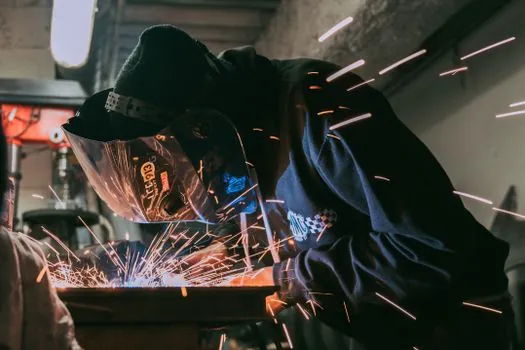
Where the welding atmosphere is not IDLH and oxygen is at least 19.5 %, a powered air purifying respirator (PAPR) configuration such as the Honeywell PA700 paired with the PA800 welding shell delivers an APF of 25 with positive-pressure head-top air delivery; loose-fitting facepiece helmets/hoods without documented Workplace Protection Factor testing default to APF 25 as well [S1]. For the chemical-plant and heavy-fab shop, this is the gate that decides whether the helmet is a stand-alone optics product or a respiratory-optics assembly.
The PA800's grinding shield sits on the outside of the ADF and is sized to absorb slag impact before it reaches the auto-darkening cartridge, and the dedicated grind mode lets the welder switch to abrasive work without manually adjusting shade [S1]. In a multi-process bay, that single shell can cover stick welding, MIG/TIG set-up, and post-weld grinding without a helmet change, which is one of the main productivity arguments ADF shells make over passive-shade designs.
Impact Class and Helmet-Hard-Hat Conversion
AS/NZS 1337.1:2010 separates face-shield impact into four levels by projectile speed: low impact at 12 m/s, medium impact at 40 m/s, high impact at 120 m/s (6.00 mm projectile) or 110 m/s (6.35 mm), and extra-high impact at 190 m/s or 175 m/s, with grinding, machining, and woodworking covered by medium impact, and abrasive shot blasting or electrical maintenance requiring the extra-high visor rating [S3]. A welding helmet used for general fabrication with intermittent grinding should therefore be specced at medium impact minimum, while shipyard and structural-steel work with overhead crane traffic often requires high impact.
On sites where the welder is also exposed to falling-object hazards, the head section must satisfy a separate industrial safety-helmet standard, which is where dedicated welding-helmet covers such as the 3M Speedglas Safety Helmet Cover are layered over an existing hard hat for high-visibility or welding-spatter conditions, with the manufacturer explicitly limiting use to the storage conditions published for the head-protection part [S2]. The selection logic for those cross-over sites is covered in detail in Safety Helmet Selection for Construction Sites: Type, Class, and Hazard Match and the parallel Mining Helmet Selection: Type, Class, and Hazard Match, both of which use the same Type/Class taxonomy for hard-hat selection.
Decision Matrix: Passive vs ADF, With vs Without PAPR
Four configurations cover the bulk of procurement requests: (1) passive fixed-shade with replaceable filter (WL530-style), lowest cost, suits low-mix/high-volume production of identical welds; (2) ADF-only shell (shade 8-12 dark state, shade 2-3 light state), the workhorse for mixed-process shops; (3) ADF plus grinding shield and grind mode (PA800-style), best fit where grinding follows welding in the same bay; (4) ADF plus PAPR integration (PA800 plus PA700), required when fume exposure is above the loose-fitting respirator's capability or when an APF of 25 with positive-pressure comfort is specified. Each step up the matrix adds roughly one consumable category (inside cover lens, headgear cushion, sweatband, face seal) and one maintenance procedure. [S1]
For a chemical-plant or process-industry site that already mandates a hard-hat program, the alternative is to keep the existing safety helmet and add a flip-front welding visor or cover, which avoids double-stacking head protection and keeps the Type/Class rating of the underlying hard hat intact, a selection pattern detailed in Chemical-Plant Safety Helmet Spec Map: Type, Class, Shell Material.
Verification and Sourcing Standards
For Australia and New Zealand, the binding documents are AS/NZS 1337.1 for eye and face protection (low, medium, high, extra-high impact classes) and AS/NZS 1338.1 for filter lens shades; the WL530 carries the AS/NZS 1337:1992 medium-impact rating and AS/NZS 1338.1:1992 filter approval as its two certification numbers [S3]. For the United States market, NIOSH 42 CFR Part 84 governs PAPR assemblies, and the PA800 is listed on the NIOSH approval label for use with the PA700 PAPR, with APF 25 contingent on OSHA 29 CFR 1910.134 or CSA Z94.4 oxygen and IDLH conditions being satisfied [S1].
Procurement should require the supplier to provide (a) the standard reference on the shell or in the user instructions, (b) the published shade table applicable to the welder's process mix, and (c) a consumable schedule with the OEM part numbers, since the Speedglas documentation explicitly voids the certification when non-OEM spares or unauthorised modifications are fitted [S2][S4]. Next checkpoints: confirm the welding-process list against AS/NZS 1338.1 shade guidance and lock the cover-lens replacement interval to the site's spatter exposure class.
Component reference pages worth checking: safety barrier, and safety fence.