Suspended ceiling installation in the United States runs from $4 to $20 per square foot fully installed, with most standard projects landing between $9 and $13 per square foot for labor and materials combined, and a national average total near $2,200 [S2]. Materials alone span $1 to $13 per square foot, grid rails add roughly $1.50 to $2.25 per square foot before labor, and the tile specification is the single largest line-item driver [S2].
General contractor overhead and markup for organising and supervising the install adds 13% to 22% on top of the subtotal, per US trade cost references [S1]. A separate 2026 national guide reports drop ceiling project totals between $972 and $2,914, with tile material choice named as the dominant variable pushing the final number [S6]. For a working budget, treat the drivers below as the actual cost levers, not the headline per-square-foot number.
Tile Material: the Single Biggest Cost Lever
Tile material moves the materials line from $1 to $13 per square foot, a 13x spread, and that ratio holds across multiple US sources [S2][S4]. Mineral fiber and fiberboard panels sit at $1 to $7 per square foot and dominate offices and basements because of their sound absorption, with the trade-off that they stain readily when exposed to moisture [S2]. Black acoustic tiles run $2 to $7 per square foot and are common in theatres, gaming rooms, and home cinemas [S2].
Plastic and PVC tiles land at $5 to $9 per square foot and are the easiest DIY option because they tolerate moisture, which makes them a common pick for bathrooms and food-service back-of-house areas [S2][S4]. Metal (tin) panels jump to $12 to $20 per square foot for materials, are heavy, and are usually flagged for professional installation only [S2]. Wood tiles top the chart at $10 to $70 per square foot and represent the premium decorative end of the market, with the largest swing between commodity and bespoke product lines [S2].
Decorative or specialty finishes, including fire-rated tile, vinyl-coated washable tile, and fiberglass insulation-backed tile, add further per-square-foot cost on top of the base material number [S4]. When acoustic performance is the project goal, the tile's NRC rating matters as much as the price, and pairing the right panel with insulation above the grid changes how much noise the assembly actually blocks [S2].
Room Size, Geometry, and Bulk Discount Curve
Room size sets the baseline because more square footage means more grid, more tile, and more installer hours. At a $9 to $13 per-square-foot installed rate, a 100 sq ft bedroom lands at $900 to $1,300 in the standard band and $400 to $2,000 across the full range, while a 500 sq ft basement hits $4,500 to $6,500 standard and $2,000 to $10,000 at the extremes [S2]. A 300 sq ft living area projects to $2,700 to $3,900 standard and up to $6,000 in the high band [S2].
Larger areas often carry a slightly lower per-square-foot rate because installers and distributors reduce the per-unit price when materials are bought in bulk and crew hours are amortised over a longer run [S2]. That effect matters most on full-basement or open commercial-floor projects priced against single-room jobs, where mobilisation and setup costs are spread across more square feet. Obstacles in the ceiling cavity, including HVAC ductwork, sprinkler risers, cable trays, and recessed lighting rough-ins, cut against the bulk discount because they add cutting time per tile [S2][S4].
Labor: $1.50–$5.00 per sq ft or $50–$150 per Hour
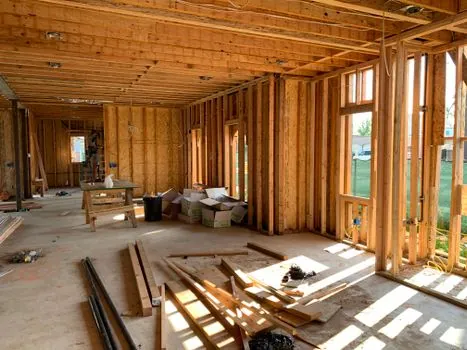
Professional labor for a suspended ceiling averages $1.50 to $5.00 per square foot, or $50 to $150 per hour for the crew [S2]. That labor line covers the metal grid (main runners, cross tees, wall angle) plus the placement of every tile, and the per-square-foot number moves with project complexity: tight ceiling heights, fixture cutouts, integrated lighting, and acoustic insulation above the grid all push labor upward [S2][S4].
Trades call out three project features that consistently inflate labor: cutting around existing fixtures, accommodating special lighting layouts, and working around HVAC or sprinkler geometry in the plenum [S4]. For a quick cost sanity check at the basic end, the per-square-foot installed price can drop to $6 with economy tiles and minimum-cut labor, while complex projects with premium materials and add-ons reach $25 to $28 per square foot [S2][S4].
Overhead, Markup, and What's NOT in the Quote
General contractor overhead and markup for organising and supervising the install runs 13% to 22% on top of material and labor, which is the line that often surprises owner-builders doing a like-for-like comparison against DIY pricing [S1]. A vendor-neutral US cost guide updated for 2026 frames its estimates as "basic mid-range work performed in readily serviceable conditions" using "IN STOCK products" from home improvement retailers, and explicitly excludes sales tax, dump charges, delivery upcharges, and any repair or remediation not described in the original scope [S1].
Items the standard estimate deliberately leaves out include master-craft or premium-craftsmanship labor upcharges, expedited scheduling, local labor shortage premiums, difficult site conditions, and excessive transit, all of which "may result in HIGHER COSTS" per the source [S1]. For a complete budget, line items to add on top of the per-square-foot figure are: sales tax, dump fees for any removed ceiling, asbestos or hazardous-material testing if the building predates the 1980s, permit fees where the local authority requires them, and post-install painting or touch-up of adjoining walls and trim. Read more on how ancillary services move the final number in our Sewage Pump Wetted Material Selection reference for plant-side cost logic, and revisit 90-Minute vs 3-Hour Emergency Lighting for another code-driven spec decision.
Regional Price Bands: US, UK, and Australia Compared

US installed prices sit at $4 to $20 per square foot, with mid-range projects at $9 to $13 [S2]. UK suspended ceiling cost in 2026 is quoted at £22 to £35 per square metre, averaging around £28.50 per square metre, with ceiling area, height, tile specification, and services integration named as the four biggest pricing factors [S7]. Australian commercial fit-out pricing runs AUD $30 to $60 per square metre in Sydney and Melbourne, with residential projects dipping to as low as AUD $15 per square metre in lower-spec scenarios [S5].
Converting at rough current rates, the Australian commercial band lands inside the US mid-range, the UK band is broadly comparable on a square-foot basis after currency conversion, and the headline takeaway is that the cost-driver hierarchy, tile material, then room size, then labor complexity, then overhead, holds across all three markets rather than being a US-specific pattern. For a side-by-side material decision on a related building-envelope spec, see the Aluminium Window Profile Series 50, 60, 70 breakdown.
Total Cost of Ownership Beyond the Install Day
Purchase price is the smallest line in a 10-year view. Acoustic performance drives measurable HVAC and open-office productivity savings: a well-specified tile-and-insulation assembly reduces plenum sound transfer and lets HVAC setpoints run with less rework on masking noise, which is the mechanism behind the "keeps your home cool in summer and warm in winter" benefit claimed for insulated suspended ceilings [S5]. Maintenance cost is the long tail: fiberboard and mineral fiber tiles stain under moisture and need spot replacement, while PVC, metal, and vinyl-coated tiles tolerate wipe-down cycles and last longer in food service, healthcare, and restroom applications [S2][S4].
Access cost is the often-missed operational line. The same plenum that hides ductwork also gives maintenance teams a fast route to cabling, sprinklers, and sensors without opening walls, which is why data centres, hospitals, and trading floors over-spec the grid rather than the tile [S4][S5]. For a comparable trade-off on access versus permanence in industrial flooring, the SPC Flooring Wear Layer Thickness reference covers the same "spend a bit more now to save on access later" logic.
Decision Matrix: Pick the Right Cost Driver for Your Project

For a basement or storage room on a tight budget, the right move is $1 to $3 per square foot mineral fiber tile on a standard 15/16" grid, accepting the moisture-stain risk and planning on a 10 to 15 year replacement cycle [S2]. For an open-plan office where acoustic comfort and access to the plenum both matter, step up to mid-grade acoustic tile in the $4 to $7 per square foot band, specify a 15/16" or 9/16" grid depending on the aesthetic, and budget for insulation above the grid [S2][S3].
For healthcare, food service, or any wet area, skip fiberboard entirely and move to PVC or vinyl-coated tile in the $5 to $9 per square foot range, with stainless or aluminum metal tile ($12 to $20) for the back-of-house kitchen and wash-down zones [S2][S4]. For a feature lobby, boardroom, or retail front, the $10 to $70 per square foot wood or decorative metal tile range applies, and the per-square-foot number will dominate the budget more than labor or overhead. In every case, hold a 15% to 20% contingency for the cut-tile waste factor, integration of light fixtures and HVAC diffusers, and the contractor markup line that runs 13% to 22% on top of the subtotal [S1][S2].
The next two signals worth tracking are tile material price moves (PVC resin and aluminum coil pricing) and any local building code shifts on plenum fire-rated assembly requirements, both of which directly feed the per-square-foot line and can re-rank the matrix above. For another industrial-grade material trade-off that uses the same cost-driver logic, the AR500 vs AR400 plate reference pairs a higher unit cost against a longer service life, the same calculation every suspended-ceiling decision ultimately turns on.
Component reference pages worth checking: suspended ceiling, suspended platform, and pressure transmitter.