Wheeled excavators fill the niche where a machine has to drive itself between job sites at road speeds, work on paved or compacted surfaces, and still dig like a tracked unit. The defining spec is a 2- or 4-wheel hydrostatic drive undercarriage with steerable axles, paired with a full hydraulic upperstructure — see the excavator reference for the full family [S3].
Buyers comparing a 2016 Volvo EW180E on the used market to a new JCB Hydradig 110W chassis-rearranged tool carrier are not choosing between similar machines; they are choosing between two distinct design philosophies, and the wrong pick costs years of fuel and tire bills [S2][S7].
Duty Class, Operating Weight, and Engine Tier
Wheeled excavator operating weight typically spans 6 t compact / utility units through 18–25 t highway-capable machines, with the Volvo EW180E class sitting near 18–20 t and the JCB Hydradig 110W in the 11–12 t class as a purpose-built urban tool carrier [S2][S7]. Selection starts with the heaviest single load case — pipeline bedding, utility trench, demolition grab — because that figure sets the minimum counterweight and the minimum hydraulic flow at the stick.
Engine emissions tier is the second gate. New units sold in the EU are expected to meet Stage V emissions; Hengwang's HW-10 platform is explicitly listed as Euro V compliant on the manufacturer line, illustrating how Chinese compact wheeled platforms now target the same European regulatory bar [S4]. Buyers in non-road mobile machinery should require the engine tier be stated in writing — model code plus emission stage — because a Stage IIIA unit is 20–40% cheaper to acquire but is locked out of many urban low-emission zones.
Hydraulic architecture matters more than peak pump pressure on paper. A load-sensing variable-displacement piston pump with flow-on-demand behaviour cuts fuel burn 8–15% versus a fixed-displacement gear-pump system on the same duty cycle, and it is now standard on mid- and large-class wheeled platforms from Komatsu, JCB, Volvo, and Doosan [S2][S3].
Undercarriage, Axles, Brakes, and Tires
The undercarriage is what separates a wheeled excavator from a backhoe loader or a telehandler. Look for a purpose-built rigid axle with planetary hub reduction and external wet-disc service brakes — components that survive continuous roading duty — rather than automotive-style drum brakes adapted from a truck chassis [S2]. JCB's Hydradig 110W moved the engine, tanks, and ancillaries down into the chassis frame itself to lower the center of gravity and improve all-round visibility from the cab [S2].
Tires are a billable consumable, not an afterthought. The MAXAM MS908 is a purpose-designed construction tire for wheeled excavators, with a tread pattern and sidewall construction rated for the cyclic side-load that digging imposes — a generic industrial rib tire will chunk and sidewall-crimp within a few hundred hours on a wheeled excavator [S5]. For a 18 t class machine, dual-tire configurations are common on the rear axle for flotation and tire life.
Travel speed and gradeability close the undercarriage gate. Highway-capable units run 30–37 km/h; slower site-only units cap at 10–15 km/h but offer tighter turning radius and lower acquisition cost. Four-wheel steering and crab-steer modes are increasingly common above 15 t and are worth the premium on confined urban sites [S3].
Upperstructure, Hydraulics, and Work Tool Range
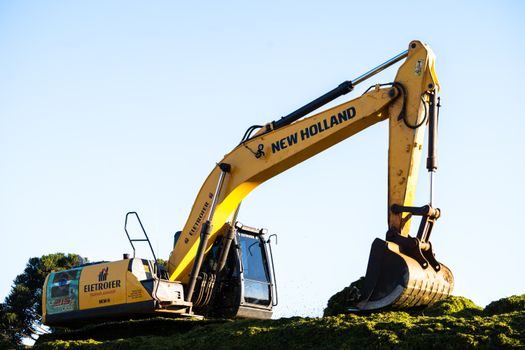
A wheeled excavator's upper is essentially a crawler excavator's — boom, stick, swing circle, house — bolted to a wheeled chassis. The case 688 parts catalog groups crawler and wheeled upper structures under the same windshield part number (S/N 3101 & after, 12/85-12/93), which confirms that upperstructure wear parts are largely interchangeable across undercarriage types in legacy fleets [S9].
Work tool range drives real-world productivity. Buyers should require quick-coupler compatibility, hydraulic lines for tilting buckets, hammer, shear, and grapple circuits plumbed to the stick, and adequate auxiliary flow — typically 100–250 L/min depending on class. A machine that only runs a bucket is half a tool; a tool carrier that runs 10+ attachments is the modern baseline [S2].
Slewing torque and tail swing radius matter on urban sites. Zero-tail or reduced-tail-swing designs protect pedestrians, parked cars, and adjacent structures when the upper swings; they also let the machine work in a single lane without traffic management — a hard economic advantage on roadside utility work.
Selection Comparison: Three Realistic Options
Three configurations cover most wheeled excavator buys, each with a different cost-mobility-productivity profile: [S2]
Compact utility class (6–10 t, e.g. Hengwang HW-series): lowest acquisition cost, single-axle, 20–30 km/h travel, best for landscaping and small utility work; limited to light bucket work and small hammers. Euro V engine compliance is now standard on Chinese-built units in this class [S4].
Mid-range tool carrier (10–13 t, e.g. JCB Hydradig 110W): purpose-built chassis with engine and tanks lowered into the frame, 360° visibility, four-wheel steer, full quick-coupler tool range; best balance of mobility, visibility, and tool flexibility for urban utility and rental fleets [S2].
Highway-class production unit (16–22 t, e.g. Volvo EW180E, Komatsu PW-series): 30–37 km/h road speed, two-axle with dual rear tires, highest hydraulic flow, longest reach; best for pipeline, road-building, and high-hour production trenching where the operator drives between sites daily [S3][S7].
On a 2,000 hour/year utilization, the compact class breaks even fastest but caps revenue per job; the highway-class unit earns the highest revenue per shift but requires lane closure permits and trailer backup if it has to cross urban low-emission zones. The mid-range tool carrier wins on mixed rental-fleet utilization because it works both on and off the trailer.
Who Should NOT Pick a Wheeled Excavator
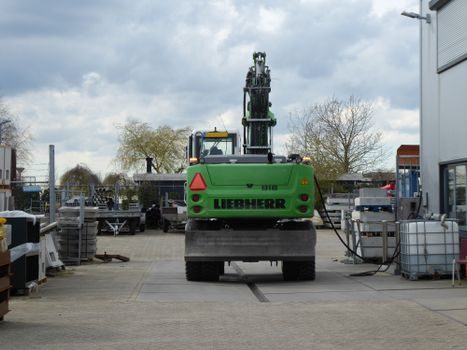
Wheeled excavators lose money on soft ground, mud, steep grades, and unmade sites. If the average site is a clay pit, a peat bog, or a 30% grade, a crawler excavator is the correct spec — flotation, low ground pressure, and side-hill stability on tracks are not optional on those sites. A wheeled unit will dig and travel, but tire wear, recovery time, and chassis stress consume the operating margin. [S2]
Buyers who need a single machine to do loader work and excavation work at the same time should look at a backhoe loader instead — different kinematics, lower cost, lower transport weight — or commit to a compact tracked excavator and a separate wheel loader. The wheeled excavator is a specialist; it does not replace a loader.
Sourcing, Standards, and Pre-Purchase Checks
For a used machine, request the hour-meter reading, the engine tier plate, the undercarriage component serial numbers, and the service log; these four items predict 70% of the first-year repair spend. Plant & Equipment's Middle East / Africa / Europe listing shows that the used wheeled excavator market is active and cross-regional, with both Volvo and JCB machines regularly turning over [S8].
For new machines, require: an EU Stage V or EPA Tier 4 Final engine certificate, ROPS/FOPS cab certification per ISO 12117, hydraulic line burst protection per the relevant ISO 4413 safety standard, and a load-moment indicator on machines rated for crane-lift work. Tire spec should be stated by size, ply rating, and tread pattern code — the MS908 construction pattern is the reference benchmark, not a generic industrial rib [S5].
For a deeper crawler-vs-wheeled trade-off, the crawler vs wheeled excavator decision map lays the two families side by side on mobility, flotation, transport weight, and hourly cost. For new-machine sourcing, the mini excavator factory map shows where Chinese compact platforms — including wheeled mini units — are currently being built and exported.
Track three signals over the next 12 months: (1) the rollout of factory-fitted electric and hybrid wheeled excavator platforms above 10 t, which will reset urban low-emission zone compliance; (2) tire OE pricing and lead time, because construction-tire supply remains the swing factor in operating cost per hour; (3) Stage VI emission rulemaking for non-road mobile machinery, which will set the floor for new-unit pricing from 2027 onward.
Spec-level background on the components involved: pressure transmitter, and flow meter.