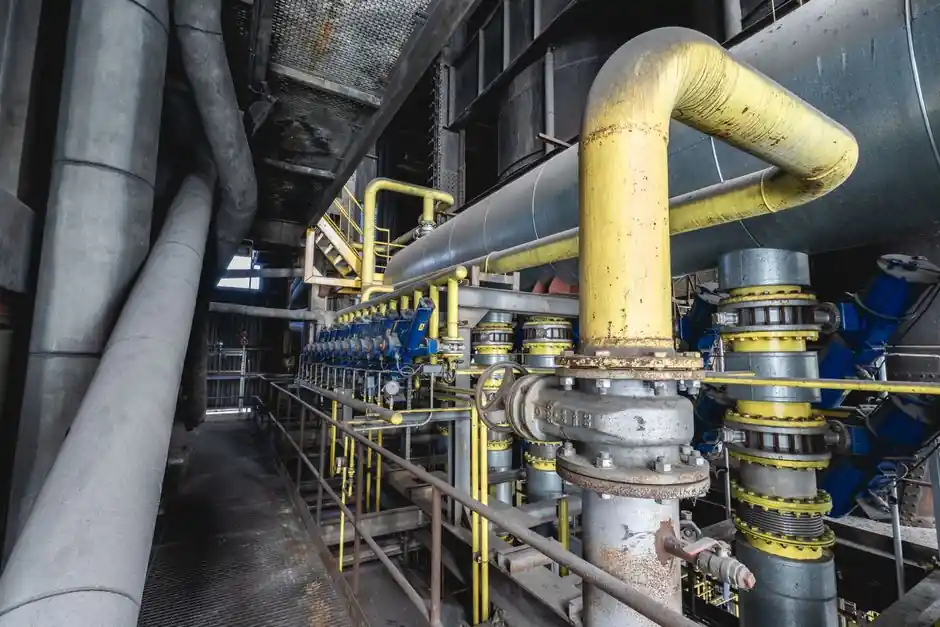
A standard soft-seated ball valve fails in abrasive slurry service primarily because particles impact the seat and ball faces directly, while the closed body cavity traps solids; published selection guidance in 2026 ranks this combination as a high-risk isolation choice, not a throttling one [S3].
Spherical-style valves (ball sector, Roto-Clean sanitary spherical) shift the seal away from the throttling edge and open the flow path, which is why the same guidance points to them, plus pinch and knife gate types, for moderate to severe slurry duty [S1][S3][S4].
Why the standard ball valve geometry fails in slurry
A ball valve closes by rotating a full sphere with a through-bore against two opposing soft seats; in abrasive slurry the seal line sits exactly where solids are accelerating past the ball, so particles embed in the seat and score the ball [S3]. NTGD Valve's 2026 slurry selection guide states explicitly that a ball valve held partly open exposes both the ball and seat faces to direct particle impingement, which is why standard soft-seated units are only acceptable for isolation, never for continuous throttling, on abrasive lines [S3].
The same guide documents three failure modes that show up together in field service: seat wear that progresses to internal and external leakage, body-cavity buildup that dead-loads the ball and prevents full closure, and rising breakaway torque that operators first notice as a "stiff" handle before a seat is cut through [S3]. Dixon Valve's 2025 mining comparison table echoes this, listing "seats wear quickly in abrasive service" and "prone to clogging in high solids" as the two defining limitations of ball valves in mining slurry lines [S4].
What changes in spherical-style valve designs
Ball sector and Roto-Clean spherical valves keep a quarter-turn rotary principle but reshape the closure element so the throttling edge and the sealing surface are no longer the same line. Schubert & Salzer's design principle for ball sector valves states that the seal engages on a surface part of the ball sector that is less exposed to wear, while the control edge takes the throttling hit, and the sealing surface is not exposed to high flow velocities, which significantly increases service life in abrasive media [S5].
Roto-Clean's sanitary spherical valve takes a different route: the body opens around the sphere so solids do not accumulate in a dead cavity, and the unit is hand-disassemblable in under five minutes for cleaning between batches, an approach aimed at pharma, food, and pigment/dye dry-or-slurry service where contamination control matters as much as wear [S2]. Neither design is a drop-in for a standard ball valve; both are application-specific, but both attack the same root problem, which is that a full-bore, soft-seated sphere in a closed cavity cannot survive sustained particle contact [S2][S5].
Decision criteria: ball valve vs spherical vs alternative slurry valves

For mining and process-plant slurry, the 2025 Dixon comparison lines up the four common types against decision criteria directly: knife gate valves for high-solids on/off service and low cost, pinch valves where only an elastomer sleeve should contact the slurry, ball valves for moderate service where tight shutoff matters more than abrasion margin, and diaphragm valves for corrosive or mildly abrasive throttling [S4].
NTGD's 2026 guide sharpens the ball-valve branch further: soft-seated units are only acceptable in mild slurry for isolation, metal-seated or hard-coated balls (Stellite, tungsten carbide, chrome carbide overlays) are the minimum for severe duty, and full-port plus low-cavity flushable construction is required once solids exceed a few percent by volume, with stainless steel body alone considered insufficient because the trim, not the body, takes the wear [S3]. Continuous modulation on abrasive lines is the disqualifying condition for a standard ball valve; even a slurry-engineered ball valve should be specified for isolation duty, with a knife gate, pinch, or sector valve handling the modulating role [S3][S4].
Where ball valves still earn a place in slurry service
Not every slurry line rules out a ball valve. A clean, low-solids carrier fluid, intermittent rather than continuous duty, and an isolation-only function (open or closed, no partial-burn operation) are the conditions under which a soft-seated ball valve remains a practical, low-cost choice [S1][S3]. RuB Inc.'s 2025 industry note frames this generally: ball valves are robust, have fewer moving parts, and give tight shutoff with low pressure drop when fully open, but they are not designed for throttling, and the moment debris enters the flow the seat and ball begin to wear, with leaks and failure as the predictable endpoint [S1].
For lime slurry, where scaling compounds the abrasion problem, the same 2026 guidance warns that PTFE and other soft seats are high-risk, that cavity buildup is rapid, and that a ball valve often is not the best starting point at all, with rotary-stem or elastomer-lined alternatives typically specified instead [S3]. General high-pressure history also notes that metal-to-metal spherical/ball-and-cage designs pit and corrode easily under constant metal contact and require more frequent replacement, reinforcing that "spherical" alone is not a magic word; the geometry of the seal relative to the flow is what matters [S6].
Selection checklist and operating signals for slurry service
The minimum slurry data to capture before sizing a ball valve, per the 2026 NTGD selection guide, are: solids concentration by weight or volume, particle size distribution and hardness (Mohs or Vickers), slurry pH and temperature, duty cycle (isolation vs modulating, cycles per day), and maximum system pressure defined by the lowest-rated component, a point Dixon also flags for any mining slurry line [S3][S4]. Without those numbers, switching from a soft-seated to a metal-seated or hard-faced ball is guesswork, and the upgrade is wasted if the real failure mode is cavity clogging rather than seat scoring [S3].
Operating signals that a ball valve in slurry is heading toward failure, in the order they typically appear, are: rising breakaway torque, a pressure-drop increase at constant pump output, visible external seat leakage, incomplete closure reported by operators, and finally full-bore blockage when the cavity solids bridge. NTGD's maintenance guidance treats these as inspection triggers, not as background data, and recommends logged operator observations as a primary input alongside torque and pressure trending [S3]. Fluid coupling selection for pulp lines and adhesive joint fatigue monitoring sit in the same asset-reliability conversation, where slurry valves, drive trains, and structural joints are tracked against the same duty-cycle data.
The practical trackable signal for 2026 is OEM and distributor literature moving away from generic "ball valve for slurry" claims and toward explicit seat material, hard-facing alloy, and cavity-flushing options in the model code; a slurry RFQ that does not name solids concentration, particle hardness, and duty cycle is the clearest indicator that the spec is still treating a ball valve as a commodity, which is precisely the failure mode the 2026 guidance is trying to eliminate [S3][S4].
Detailed specification references: spherical plain bearing, and electric ball valve.