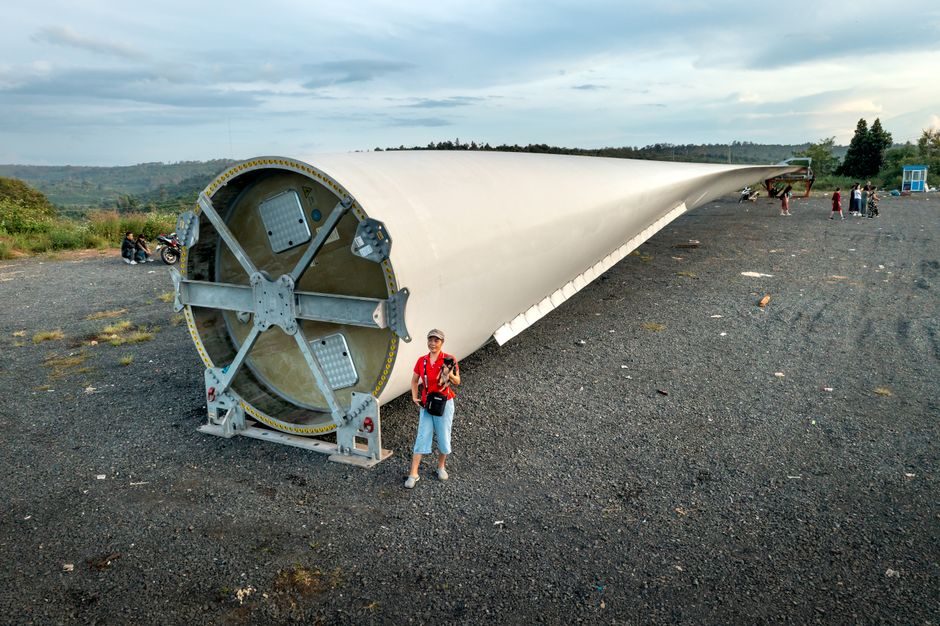
Wind turbine blade development in mid-2026 is now a three-track race: modular retrofits validated on legacy platforms, a mounting European end-of-life composite mass, and a steadily rising intelligent-turbine spend that bundles structural sensing into the blade itself. The intelligent wind turbine market is forecast to reach $25.39 billion by 2026 at a 4.38% CAGR over 2021-2026 [S1].
ACT Blade's textile-membrane ACT100 retrofit received a Type Test Evaluation Conformity Statement from DEWI-OCC Offshore and Certification Centre GmbH on 6 July 2026 for the Senvion MM92 platform, validating the aeroelastic model behind the design [S2]. On the end-of-life side, the Springer decomposition inventory published in 2023 projects over 7.6 million tonnes of end-of-life wind turbine blade composite mass needing decommissioning in Europe by 2050, based on the wind-farm database up to 2022 [S3].
ACT100 Retrofit Metrics: Weight, Energy, LCOE
ACT Blade's published figures for the technology cite 32% blade weight reduction, 10% longer blades, 9% increase in energy production, 7% reduction in the cost of energy, and 60% reduction in tooling costs versus a conventional baseline [S2]. The internal composite structure, fully covered by a tensioned textile skin, exploits aeroelastic tailoring originally validated on high-performance marine platforms before the founders moved into wind energy.
The ACT100 is engineered as a drop-in revamp product, not a greenfield airfoil, which is why the DEWI-OCC conformity statement on 6 July 2026 is the gating event: a retrofit blade must match the original turbine's load envelope without re-certifying the whole machine [S2]. Capital cost reduction is stated at up to 45% on assembly thanks to modularity and the use of existing supply chains. For operators weighing repowering against life extension, the composite-tier and vessel-gate breakdown for 2026 frames the capex and logistics side of that decision.
End-of-Life Mass: 7.6 Mt by 2050 Across Europe
The Springer inventory breaks the European EoL blade mass into decommissioning year, country, and blade architecture, sourced from the windpower.net wind-farm database up to 2022 [S3]. The composite stream is the part without a mature recycling route: glass- and carbon-fibre-reinforced laminates with thermoset matrices do not behave like the steel or gearbox streams that already have established scrap channels.
Reference cases in the inventory draw on DNVGL-ST-0262 (lifetime extension of wind turbines, 2016 edition) and DNV GL's 2010 certification guideline, plus the Beauson et al. 2022 review of European blade EoL context, when modelling decommissioning timing [S3]. The implication for 2026 buyers: specify recyclable or modular architectures now, because today's blade set defines the 2045-2055 waste stream. Operators selecting new turbines should treat EoL pathway as a tender line item, not a CSR footnote.
Intelligent Turbine Spend Bundles Blade Sensing
The $25.39 billion 2026 intelligent wind turbine market figure, 4.38% CAGR over 2021-2026, is driven by sensing, control, and condition-monitoring subsystems retrofitted to drivetrain and blades [S1]. Onyx Insight's 2025 product line groups these under "Advanced Sensing" and "Advanced Blades" categories, with 24/7 blade monitoring pitched to prevent multi-million-euro blade failures that drone inspections miss [S4].
The hardware attaches inside the blade shell: accelerometers, acoustic emission, strain gauges, and edge processors feed drivetrain analytics platforms that flag root-insert failures and underperforming drivetrain monitoring systems before they propagate. The trend matters for signal conditioner selection because every additional blade sensor channel is a new analogue front end that has to survive a 20-year fatigue environment inside a composite shell. For turbine-side wiring, 4-20 mA loop-power architectures remain the workhorse, and the spec gates for those channels are tightening as blade monitoring density rises.
Comparison: Retrofit, Repowering, or Life Extension
Three options face an operator with an ageing European fleet: ACT-style modular retrofit, full rotor and nacelle repowering, or DNVGL-ST-0262 life extension on the existing airfoil. On capital cost, ACT Blade states up to 45% capex reduction versus a new build through use of existing supply chains and faster assembly [S2]. On energy uplift, ACT publishes 9% energy gain and 7% LCOE cut for a 10% longer blade on the same drivetrain envelope [S2]. On end-of-life risk, the Springer inventory makes repowering the worst-case path because the old blade set moves to the EoL queue within the model window, while life extension defers but does not eliminate the 7.6 Mt composite stream [S3].
For a fleet where the tower, drivetrain, and grid connection are still healthy, the ACT-style modular retrofit dominates on payback period. For turbines approaching the 25-year mark with gearbox wear, repowering wins on availability. For turbines under 15 years, life extension under DNVGL-ST-0262 plus added blade sensing is the lowest-disruption path, and it generates the condition-monitoring data that informs the next decision cycle.
Who the 2026 Blade Stack Is For — and Who It Is Not
The ACT100 retrofit is sized for legacy platforms with healthy drivetrains and grid connections; it is not a fit for machines whose tower, foundation, or controller are themselves end-of-life. Operators with strong PPA terms and tight land-use constraints favour it because the modular assembly keeps crane and vessel time low. [S2]
The intelligent-turbine spend, by contrast, is for operators running large fleets where condition-monitoring data feeds a central O&M control room. It is a poor fit for single-torque, single-site owners who cannot amortise the analytics platform across dozens of units. New-build composite selection should also account for the material decisions tracked in titanium and aluminium sourcing and the aluminium-ingot automation wave, since nacelle and hub castings share the same commodity pressure as blade composite inputs.
Trackable Indicators for the Next Buying Cycle
Two signals to monitor through late 2026 and into 2027: first, the rollout of ACT Blade Europe and whether the DEWI-OCC conformity line expands beyond the Senvion MM92 to other legacy platforms [S2]; second, the first commercial deployments of structural-health-monitoring data feeds from inside-blade sensors into O&M control rooms, which will determine whether the 4.38% intelligent-turbine CAGR holds or accelerates [S1]. The DNVGL-ST-0262 life-extension framework remains the gating standard for any third decade of service on the existing fleet [S3].
For component-level specifications, see turbine flowmeter, pressure transmitter, and flow meter.