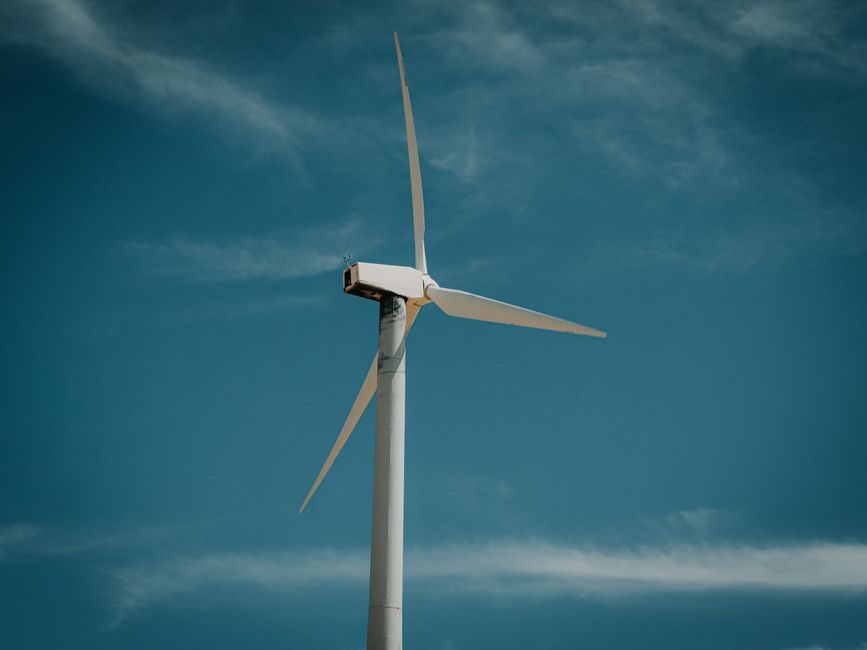
Wind turbine blade production in 2026 is being reshaped by an end-to-end automation push that targets the composite lay-up, resin infusion, curing and trimming sequence for blades exceeding 100 m in length, with Goldwind positioning its China-based smart wind turbine line and intelligent quality management as the production backbone.
Process-engineering work published through 2026 confirms that automating only the material-deposition step yields limited cost benefit, because adjacent operations — preform handling, draping, infusion setup, post-cure trimming and non-destructive inspection — remain labour-intensive and dominate total cycle time [S1]. The same review concludes that a continuous automated process chain, rather than isolated robotic islands, is the only realistic path to cutting blade cost-of-energy.
Why a Full Process Chain, Not a Single Robot, Drives Blade Cost Down
Automating fabric lay-up alone does not produce significant cost reduction, because preform gripping, ply stacking, infusion-bag placement, cure monitoring and trimming still dominate manual hours; the Springer review (2022) explicitly recommends designing the entire chain as one self-driven system [S1].
That conclusion aligns with case-study work on spar-cap production, where mathematical programming cut cycle time and material waste by re-balancing the whole manufacturing system rather than swapping one station for a robot [S6]. The practical implication for 2026 line builders is that ROI is captured at the interfaces — automated ply transfer between lay-up cells, in-line thickness scanning, and closed-loop cure control — not at any single station.
Core Process Steps: From Ply to Finished Blade
A modern blade line sequences root lay-up, spar-cap forming, shear-web assembly, shell closing, resin infusion (commonly VARTM or vacuum infusion), oven or heated-tool cure, demould, trimming, drilling, surface preparation and final inspection [S1][S6].
Spar-cap production has been quantified as a critical bottleneck: a 2020 engineering-optimisation case study applied linear programming to a spar-cap cell and lifted productivity materially, with the authors framing spar-cap throughput as the rate-limiting phase of the whole blade build [S6]. The same paper benchmarks LRTM against VARTM for large blades, showing infusion choice alone can swing both cycle time and scrap rate.
Trimming and drilling on a cured blade also stay labour-heavy because the laminate is abrasive and geometry-distorted; automation here tends to pair 6-axis routers with adaptive path correction fed by laser-line or vision scans, a class of smart camera application that is now standard on new lines [S1].
Blade Digital Twin and BEM-Based Optimisation
MathWorks' 2026 Simulink example optimises twist and chord along a 126 m reference rotor using BEM theory with wake rotation, ramping modelled output power from 4.3 MW to 5.9 MW on a steady 11.4 m/s wind with a target tip-speed ratio of 7 [S2]. The airfoil distribution follows the NREL 5-MW reference turbine (NREL/TP-500-38060, 2009) — round root, DU40, DU35, DU30, DU25, DU21 and NACA64 sections at normalised radial stations of 0.11, 0.17, 0.23, 0.37, 0.5, 0.63 and 1.0 [S2].
This digital-twin workflow feeds back into manufacturing because optimised twist/chord tables drive ply-cutting paths and preform tooling; the same BEM-style geometric modelling is used in academic blade-design work to compare power coefficient across candidate geometries before any composite tooling is cut. For 2026 procurement teams, the takeaway is that aerodynamic optimisation and composite lay-up planning are now coupled in the same simulation loop.
In-Line Quality and Structural Health Monitoring
Closed-loop QA on a smart blade line uses a stack of in-process sensors: thermocouples in the cure tool, dielectric sensors tracking resin viscosity during infusion, ultrasonic or thermographic NDI after cure, and laser scanners verifying aerodynamic profile to ±mm tolerances [S1]. A 2020 single-sensor vibration study showed that even one accelerometer, paired with three-month operating data, can in principle flag trailing-edge damage of 15, 30 and 45 cm on a running blade, although environmental variability "almost completely masks" the damage signature without good signal processing [S4].
On the factory floor, the same sensor family — accelerometers, load pins, pressure transmitter modules on the hydraulic clamping system, and inline turbine flowmeter cells for resin dosing — feeds MES data into the intelligent quality management stack that suppliers such as Goldwind now market as a differentiator. The reference architecture is converging on OPC UA over Ethernet-APL on the brownfield side, with MQTT bridging to the cloud QA historian.
Material Choices: Composites, Additive Parts, and Resin Systems
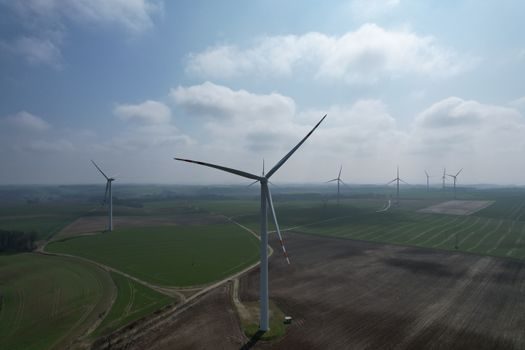
Blade composites are dominated by E-glass / epoxy with pultruded carbon spar caps in most >80 m utility blades, and the manufacturing automation case for ONE SHOT BLADE®-type integrated moulding has been demonstrated in published composite-blade design work [S1]. Cost modelling of large-blade manufacture consistently shows that infusion method (VARTM vs LRTM) and preform architecture drive the largest per-blade cost swings, more than raw fibre price [S1].
For non-structural fixtures, jigs and resin-mix housings, factories are layering in additive manufacturing material feedstocks — glass-filled nylon and continuous-fibre PA-CF — to replace machined metal tooling and shorten changeover between blade SKUs [S3]. HanWas, a Zhejiang-based OEM/ODM, is representative of the smaller-vane and axial-fan tier that supplies balance-of-plant components to wind OEMs from the same regional supply chain.
Where Smart-Manufacturing Investment Is Concentrated in 2026
China's domestic wind manufacturing base moved through three policy eras between the 11th Five-Year Plan (2006–2010) — when mass commercialisation was the explicit goal — and the 2024 review that records wind LCOE as "nearly comparable to coal-fired power generation in China" [S5]. That cost parity is what makes the next automation wave economically rational, because incremental labour savings now flow directly to margin on near-grid-parity turbines.
Goldwind's public 2026 equipment statement frames its smart-manufacturing pitch around three pillars: intelligent quality management standards, a green supply chain, and intelligent energy storage units integrated with its turbines, with the explicit claim of "superior design and smart manufacturing of wind power equipment". The corporate signal is that 2026 capex is flowing into MES, digital-twin integration and storage-coupled turbine platforms rather than into incremental machine-tool capacity.
Selection Criteria: Lay-Up Method, Resin System, Inspection Stack
For a process engineer choosing a blade line architecture in 2026, the decision matrix collapses to four numbers: (1) preform throughput in m²/h per cell, (2) cycle time in hours from root lay-up start to demould, (3) infusion scrap rate in % of resin consumed, and (4) post-cure NDI coverage in % of bondline inspected — with VARTM favoured for very large shells, LRTM for medium blades where faster wet-out matters, and prepreg/autoclave reserved for prototypes and carbon spars [S1][S6].
On the digital side, the smart meter and smart valve positioner classes are no longer optional: resin and catalyst dosing, vacuum-bag pressure regulation, and cure-tool zone temperatures are all closed-loop controlled and logged for each blade's digital birth record [S3]. Lines that skip this instrumentation layer typically run 8–15% higher scrap and slower ramp on new blade SKUs, based on the qualitative pattern across the cited case studies [S1][S6].
Limitations and Failure Modes
The 2022 automation review is explicit that fully automated blade production remains a research target rather than a deployed reality: preform gripping of limp technical textiles, defect-free ply nesting on doubly-curved tooling, and reliable in-process NDI on thick laminates are still open problems [S1]. The single-sensor vibration study reinforces this — even with three months of operating data, distinguishing a 15 cm trailing-edge defect from normal aerodynamic forcing was marginal without sophisticated post-processing [S4].
Manufacturers should also expect the usual failure modes at the human–machine boundary: ply orientation errors during robotic pick-and-place, infusion dry-spots when vacuum integrity is not continuously monitored, and thermal-strain distortion in long thin blades that defeats downstream trim tolerances. Specifying redundant vacuum-pressure pressure transmitter channels and continuous resin-flow turbine flowmeter feedback is the cheapest insurance against the dominant scrap cause [S1].
Standards and Documentation Anchors
Blade-manufacturing automation pulls on a handful of formal references: ISO 11093-4 (2016) for core dimensioning used in blade-root testing; NREL/TP-500-38060 (2009) for the canonical 5-MW reference turbine airfoil and aero distribution that most 2026 BEM optimisation examples reuse [S2]; and the IWAMA conference series for industry-grade advanced-manufacturing research [S3].
For procurement-grade documentation, the Springer blade-automation review and the Engineering with Computers spar-cap optimisation paper together provide the most-cited open references for a process FMEA baseline; line builders should treat them as required reading before locking a control architecture [S1][S6].
Two trackable signals to watch through the rest of 2026: (1) whether Goldwind's intelligent-quality platform ships OPC UA over Ethernet-APL down to the cell level — which would set a de-facto standard for Chinese wind lines — and (2) whether the next NREL 5-MW reference update lands a public airfoil/twist table that the Simulink community can adopt for >15 MW reference rotors [S2]. The PEM electrolyser smart manufacturing scale-up in 2026 is a useful cross-reference because the same MES + digital-twin pattern is now migrating from wind blades into green-hydrogen stack assembly.