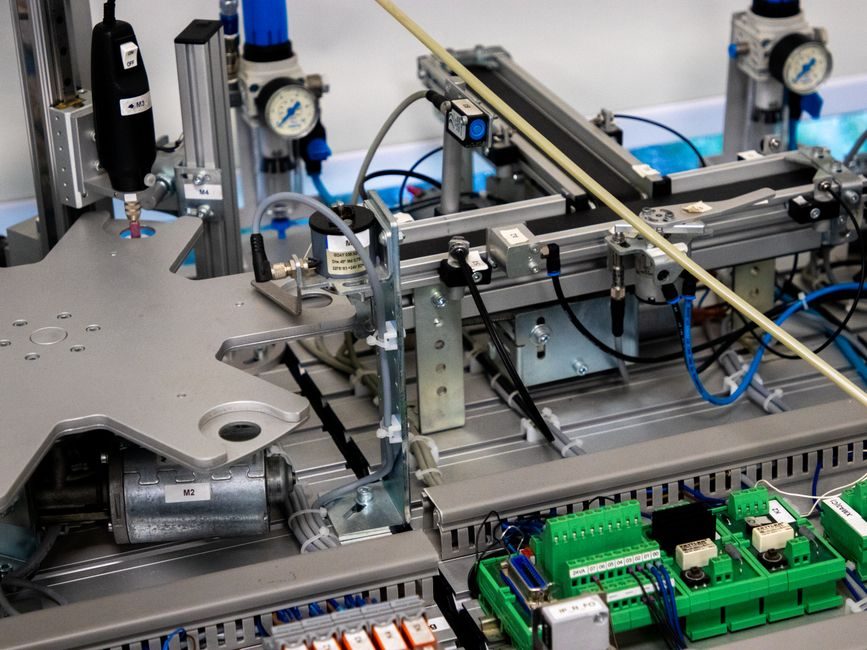
Hystar's PEM electrolyser programme — supported by Semcon since 2022 — is engineering stack-assembly automation aimed at producing up to 150% more hydrogen per unit of input energy than conventional PEM designs, with a two-year scale-up phase that expanded into cost-effective, high-volume automated production lines [S3].
The build-out sits inside a wider 2026 industrial pattern: electrolyser and fuel-cell plants are being commissioned using automotive-grade flow-meter and pressure transmitter discipline, and OEM system houses (Comau, Semcon) are re-using fuel-cell mass-production know-how to slash stack unit cost [S2][S3].
What "green hydrogen smart manufacturing" actually means on a 2026 line
Green hydrogen in this context is hydrogen produced by electrolysing water with renewable electricity (wind, solar, hydro, nuclear), separating H2 and O2 with no fossil carbon in the molecule — the definition used by Plug Power and ITM when they market PEM and GenEco electrolyser products [S1][S4].
"Smart manufacturing" in the H2 domain means three things on the shop floor: (1) automated PEM or alkaline stack assembly with vision and torque control, (2) continuous inline leak/performance testing of every cell rather than batch sampling, and (3) MES/SCADA-level orchestration that ties smart valve positioner setpoints, rectifier load, deionised-water feed and H2/O2 separators into one deterministic recipe — the same architecture Comau describes for its hydrogen systems portfolio [S2].
Adjacent reference lines for cell-level QA, dry-electrode coating and pack formation are catalogued in the battery cell manufacturing process 2026 spec stack, which provides a useful structural template because PEM stack lay-up,MEA coating and hot-pressing overlap closely with lithium-cell electrode calendering.
Process architecture: stack, BoP, and BoS in 2026
A 2026 PEM electrolyser line is best decomposed into three blocks. The stack itself — a repeat unit of membrane-electrode assemblies, bipolar titanium plates, and gaskets — is the highest-yield-risk block; Hystar's stated engineering target is +150% hydrogen per kWh at stack level, which forces tighter MEA catalyst loading and thinner proton-exchange membranes than legacy designs [S3].
Balance-of-Plant (BoP) is the conventional skid: pressure transmitter-instrumented water feed, flow-meter-metred recirculation, lye/glycol cooling loop, oxygen and hydrogen phase separators, and H2 drying/PSA. The control layer mirrors a chemical skid — ISA-style analogue loops with HART or Ethernet-APL smart instrumentation, plus a higher-speed Modbus/OPC UA link to the rectifier setpoint. The architecture in Comau's hydrogen cells follows the same decomposition [S2].
Balance-of-Station (BoS) is the renewable interface. The 2026 Mathworks reference design for a green-hydrogen microgrid is a DC islanded bus fed by a solar array plus BESS, sized to run an electrolyser over a 7-day operating window with electrical, thermal-liquid and thermal-gas co-simulation — a clean digital-twin template for sizing PV+BESS against a given Nm³/h H2 demand [S6].
Selection criteria: PEM vs alkaline vs SOEC for automated lines
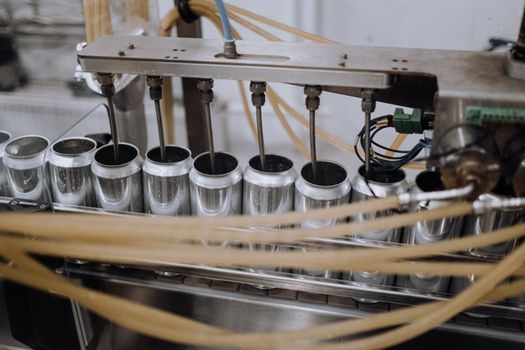
Three electrolyser chemistries are competing for the same factory footprint. PEM dominates green-hydrogen procurement because it tolerates intermittent renewable input and produces high-purity H2 at ~30–80 bar stack outlet, which is why ITM, Plug (GenEco) and Hystar all build PEM units [S1][S3][S4]. Alkaline remains the cheapest at MW scale but is harder to automate dynamically, and solid-oxide (SOEC) runs at 700–850 °C with steam, which complicates stack-assembly automation and is still mostly pre-commercial.
For a 2026 line build, the four decision criteria that matter are: dynamic-load range (PEM ~0–100%, alkaline ~25–100%), hydrogen purity at stack outlet (PEM >99.99%, alkaline ~99.5–99.9% before PSA), cold-start time (PEM minutes, alkaline tens of minutes), and stack-assembly automation maturity (PEM is closest to fuel-cell MEA processes, which is the lever Semcon is exploiting for Hystar) [S3].
The build-vs-buy split is also moving: system integrators like Comau position themselves as turnkey cell builders, while Hystar and ITM retain stack IP and outsource BoP/BoS — a pattern identical to the OEM/ODM split mapped in the robotics OEM vs ODM sourcing reference, which a process engineer can read across to H2 stack sourcing.
Who this stack architecture is for, and who it is not
The automation-heavy PEM stack line is FOR: large refinery and ammonia developers needing multi-hundred-MW electrolyser deployments, gas-utility blending projects requiring on/off renewable duty, and steel/DRI pilot plants where dynamic load is mandatory. It is also for forklift, truck and stationary-fuel-cell fleets (Plug GenDrive, GenSure) that anchor offtake demand and justify the upstream PEM capex [S1].
Standards, codes and 2026 compliance signals
Several compliance threads now touch an automated PEM line. Hydrogen production installations in the EU must meet ATEX 2014/34/EU for equipment in explosive atmospheres, with IEC 60079-series zoning applied to the electrolyser hall, separator skid, compressor room and H2 storage. Piping follows ASME B31.3 process-piping rules for the BoP, while the electrolyser pressure-vessel side is increasingly aligned with the PED 2014/68/EU framework. On the product side, H2 purity for mobility and fuel-cell feed must satisfy ISO 14687 grades, and renewable-attribution claims are audited against schemes such as ISCC PLUS or CertifHy in Europe. [S1]
Nature Chemical Engineering's February 2025 research highlight on the "green hydrogen implementation gap" stresses that electrolysis scaling still faces major techno-economic headwinds, which is why automation-driven stack cost reduction — the Hystar/Semcon lever — is treated by OEMs as the single largest unlock to bankable green H2 [S5].
Real use cases and instrumentation footprint
A representative 2026 PEM block runs at ~2–10 MW electrical input, ~400–1,000 Nm³/h H2 production, with a BoP instrument count of roughly: 1 smart meter on the MV feeder, 4–8 pressure transmitter channels on H2/O2/cooling-water headers, 3–6 Coriolis flow-meter runs on water feed, recirculation, O2 vent and H2 product, 2–4 smart camera-based stack-frame vision stations for MEA alignment, plus thermocouples and conductivity meters on the deionised-water loop. [S2]
Plug's 10x customer-demand growth in five years — nearly a 200% annual rate — is the demand-side signal that justifies those instrument densities, with named deployments in Georgia (USA), the HOPE North Sea project and a wider European electrolyser rollout [S1].
Failure modes and engineering constraints to design for
Three failure modes dominate 2026 field reports. First, membrane crossover and pinhole formation under dynamic load, mitigated by tighter catalyst-coating uniformity from automated slot-die lines. Second, titanium bipolar-plate passivation, addressed by switching from carbon-steel to platinum-group-coated titanium and adding inline pressure transmitter leak decay tests. Third, BoP sensor drift in humid H2 service, which is why most 2026 specs mandate HART or Ethernet-APL smart valve positioner and flow-meter devices with humidity-compensated H2 measurement rather than legacy 4–20 mA-only units. [S3]
Adjacent process disciplines — dry-electrode calendering, dry-room dew-point control and inline electrode defect vision — are mapped in the solid-state battery smart manufacturing reference, and a stack engineer can borrow that dry-room and inline-CT stack directly into a PEM MEA line.
Trackable signals for the next planning window
Two near-term nodes are worth watching: ITM Power's commercial shipment cadence of its PEM units as renewable-power prices continue to fall [S4], and the production ramp of The First Element's Smart Tank storage product line, which targets safe, accessible hydrogen storage for distributed green-H2 sites. A third signal is the rate at which Comau-style fuel-cell mass-production cells get re-tasked for PEM stack assembly, because every cell converted is roughly one more order of magnitude of stack-cost reduction available to the line.