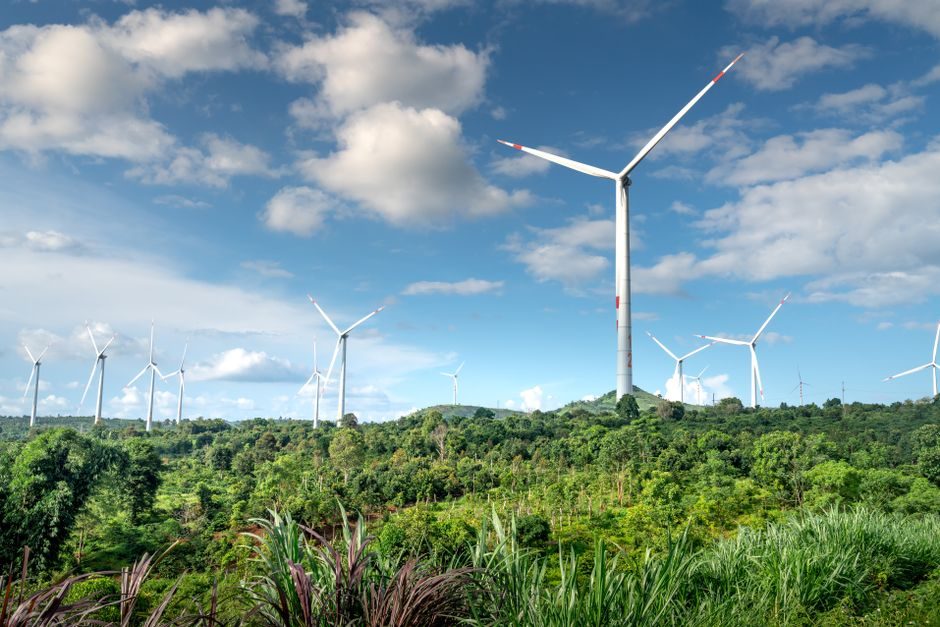
Wind turbine manufacturing breaks into two distinct equipment markets: utility-scale horizontal-axis (HAWT) platforms from OEMs like Vestas and Goldwind, and small-to-medium HAWT/VAWT units from Guangdong and Jiangsu factories such as First Wind Turbine, Wuxi Flyt, Wuxi Rexco, Better Success, and Baoding Rich Wind [S1][S2][S3][S4][S5][S6][S8].
The first spec gate on any procurement is rated power and rotor diameter, which together set tower class, foundation mass, and IEC 61400-1 wind class — not generator topology, not blade count, not hub height alone [S2].
Vestas and Goldwind: Utility-Scale Equipment Platforms
Vestas US operates manufacturing, service, and the Steelhead Americas segment for onshore and offshore wind platforms, with offshore reform and U.S. offshore wind manufacturing listed as active 2026 workstreams [S1]. Goldwind reports 3,000+ R&D technicians (29%+ of headcount), CNY 2.8+ billion R&D spend in 2024, 7,300+ patent applications, and 70 national key R&D projects, with explicit focus on steel-concrete hybrid tower design, deep-sea floating offshore platforms, and large-megawatt turbines [S2].
Both OEMs converge on direct-drive permanent-magnet generators and modular steel-concrete hybrid towers as the 2025-2026 reference design; Goldwind publicly markets the hybrid tower as a standalone engineering offering for operators [S2]. For plants sourcing nacelle assembly tooling, turbine flowmeters for hydraulic pitch-system test rigs are commonly paired with hydraulic power units on these lines.
Small and Medium HAWT/VAWT Suppliers: Guangdong-Jiangsu Cluster
First Wind Turbine Manufacturing (Tanzhou, Zhongshan, Guangdong) has been registered since 2010 and lists Wind Power, Wind Turbine, Wind Generator, Aerogenerator, Wind Solar Hybrid, Wind Turbine Generator, and Solar under main products [S3]. Wuxi Flyt New Energy (Binhu, Wuxi, Jiangsu) operates with ISO certification and lists Auto, Motorcycle Parts & Accessories, Consumer Electronics, Electrical & Electronics, Industrial Equipment & Components, Light Industry & Daily Use, Lights & Lighting, Manufacturing & Processing Machinery, Metallurgy, Mineral & Energy, Service, and Transportation as business ranges [S4].
Better Success Limited (Changping, Dongguan, Guangdong) has supplied the renewable energy market since 2004 and was registered on the B2B platform in 2009, covering Electrical & Electronics, Manufacturing & Processing Machinery, Metallurgy, Mineral & Energy [S5]. Wuxi Rexco Technology (Bindu, Wuxi, Jiangsu) ships to North America, South America, Eastern Europe, Southeast Asia, Africa, Oceania, Mid East, Eastern Asia, and Western Europe, quoting FOB, EXW, CFR, CIF, DAT, DDP, DAP, and FCA Incoterms with LC, T/T, Western Union, and small-amount payment terms [S6]. Baoding Rich Wind New Energy Equipment operates from Beijing with wind turbine, wind generator, aerogenerator, windmill generator, and fan-driven generator as main products [S8].
For procurement engineers weighing additive-manufactured spare parts versus cast housings on these mid-size units, the Jiangsu cluster typically offers both routes; the relevant trade-off is between lead time (AM: days) and fatigue life (cast: decades of field data).
HAWT vs VAWT: Selection Criteria and Trade-Offs
Horizontal-axis wind turbines (HAWT) dominate utility generation because their aerodynamic efficiency scales with rotor diameter and they accept IEC 61400-1 design class certification; vertical-axis wind turbines (VAWT) tolerate turbulent, omnidirectional flow but carry lower capacity factors per swept area [S9]. Wuxi Rexco Technology explicitly lists vertical-axis wind turbines as a main product alongside horizontal units, signalling that VAWT remains a viable niche in the small-wind segment [S6].
Decision criteria for a buyer line up as: (1) rated power — utility platforms from Vestas and Goldwind target multi-MW; small suppliers in the Made-in-China cluster target 100 W to 100 kW [S2][S3][S4][S5][S6][S8]; (2) tower type — steel-concrete hybrid (Goldwind) versus pure steel monopole (Vestas standard onshore) [S2]; (3) generator type — direct-drive permanent-magnet versus geared induction, with direct-drive gaining share on utility platforms; (4) certification scope — IEC 61400-1 design class conformance is a hard gate for grid-connected utility units, while off-grid small wind often ships without full type certification.
Manufacturing Equipment Categories and Supply-Chain Specs
Wind-turbine factory equipment splits into four blocks: blade moulding and finishing (resin infusion tooling, root-end drilling), tower fabrication (rolling mills, weld stations, concrete batching for hybrid towers), nacelle assembly (gearbox or direct-drive fitting, yaw bearing press, linear guide tracks for stator stacking), and generator production (permanent-magnet rotor assembly, winding lines, vacuum-pressure impregnation). [S2]
Goldwind's stated 2024 R&D line items — deep-sea floating offshore wind power technology, large megawatt wind turbine design, simulation software platforms, ultra-flexible blade technology, and load control technology — map directly to the nacelle, blade, and tower blocks above [S2]. For yaw and pitch bearing installations on this class of equipment, crossed-roller guides are a common slewing-ring choice when moment load and compactness both matter.
Standards, Sourcing, and Quality Gates

IEC 61400-1 governs design class selection (I, II, III, IIIA, S) and is the first compliance gate on any utility unit; ISO 9001 quality management is the floor at the Made-in-China cluster suppliers — Wuxi Flyt explicitly lists ISO certification, and the other Guangdong/Jiangsu factories operate under equivalent audited frameworks [S4]. Goldwind holds 1 national enterprise technology centre, 47 provincial-level scientific research qualifications, 3 postdoctoral workstations, 42 national scientific research qualifications, and counts 70 national key R&D projects [S2].
For nacelle environmental control and static-sensitive permanent-magnet handling, the supply chain typically pulls in anti-static equipment per IEC 61340-5-1; the seven cost drivers and ten-year spend stack on that category is detailed in this TCO breakdown.
Use Cases, Limitations, and Failure Modes
Utility-scale HAWT platforms from Vestas and Goldwind are spec'd for onshore and offshore wind farms with grid interconnection, multi-MW output, and 20-25 year design life [S1][S2]. Small HAWT and VAWT units from the Guangdong-Jiangsu cluster target telecom sites, hybrid wind-solar street lighting, remote off-grid homes, and island microgrids [S3][S5][S6].
Common failure modes buyers should spec against: blade root fatigue (warranty gate), gearbox wear on geared units (annual oil analysis), yaw drive backlash (declining capacity factor), and tower bolt tension loss (annual re-torque). On direct-drive platforms the gearbox block drops out, but the pressure transmitter count on the pitch hydraulic system typically rises; HART-protocol 4-20 mA units are the de-facto standard for that loop. For related procurement context on heavy fabrication equipment feeding the same plant, this amphibious excavator spec guide covers machines used in coastal wind-farm foundation work.
Trackable signals for the next sourcing cycle: Goldwind's continued release of large-MW platforms, new Steelhead Americas capacity announcements from Vestas US, and the Jiangsu cluster's migration from aluminum to carbon-fibre reinforced blade roots on small turbines.