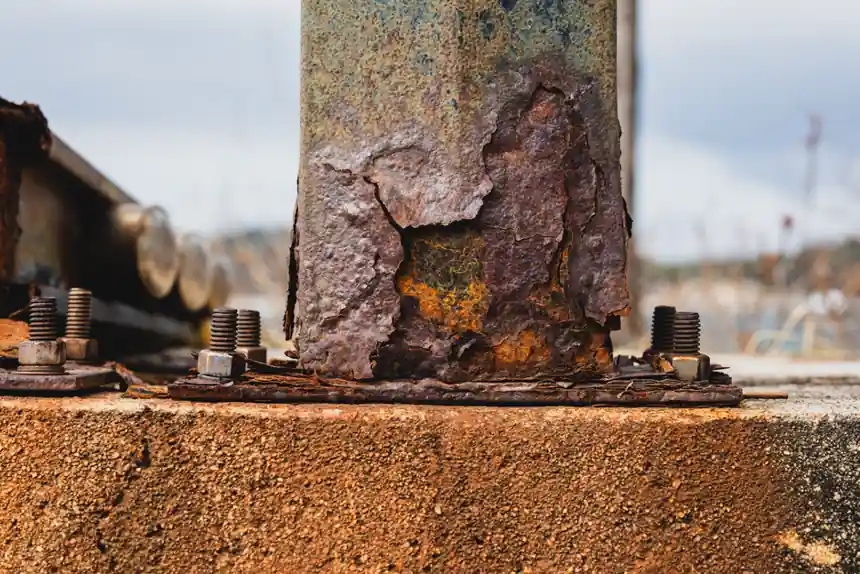
Wireless corrosion monitoring is now a multi-technology market, with battery-powered Linear Polarization Resistance (LPR) and ultrasonic thickness nodes deployed in process water and live piping, while passive LC resonator and chipless RFID tags are being researched for high-temperature gas turbines, nuclear reactors, and reinforced concrete [S1][S5][S7][S8].
Pick a measurement principle that matches the corrosion mechanism you actually have: generalized wall loss wants ultrasonic thickness or Electrical Resistance (ER), pitting and inhibitor response want LPR or Electrochemical Noise (EN), and high-temperature oxidation in turbines wants passive LC sensing [S1][S4][S5].
Active battery-powered nodes: LPR and ultrasonic thickness
Active wireless nodes carry their own battery or harvested power and stream data to a gateway, which lets them support electrochemical techniques that need excitation current and high-resolution thickness time-of-flight measurement [S2][S3][S4]. The Pyxis Lab CR-200, a Bluetooth 5.0 LPR rate sensor, specifies a generalized corrosion range of 0.001 to 10.000 MPY (default metallurgy) and a maximum range up to 995 MPY via the uPyxis app, with resolution of 0.001 MPY, conductivity compensation from 10 to 10,000 µS/cm, and a 3.6 V ER26500 battery rated for up to one year of service [S4].
Ultrasonic-thickness wireless transmitters from Emerson (Rosemount Wireless Permasense and related lines) clamp non-intrusively on pipe elbows and similar high-loss locations, and read remaining wall thickness continuously so corrosion or erosion trends surface before a leak path opens [S2][S3][S6]. The April 3, 2024 Emerson Automation Experts post places these ultrasonic nodes specifically at pipe elbows and other geometry-driven hot spots where corrosion and erosion concentrate, a placement that maps directly to where thickness loss first shows up in service [S6].
Passive wireless tags: LC resonators and chipless RFID
Passive wireless sensors need no battery and no wired excitation: the reader's near-field or far-field RF interrogates an LC tank or a chipless RFID structure, and corrosion or temperature is inferred from the shift in resonance frequency, quality factor, or backscattered signature [S1][S5][S8]. The WVU MS&T24 study designed LC passive wireless sensors operating at 70 to 100 MHz in ANSYS HFSS, targeting simultaneous temperature and corrosion measurement in 500 to 1500 °C gas turbine, engine, and reactor environments, with sodium, vanadium, and sulfate-bearing gases and pressures up to 1000 psi as the reference envelope [S1].
Chipless RFID corrosion sensors extend the same idea to even harsher or cost-sensitive deployments, with early work (Yasri et al., 2014/2016) demonstrating zinc microstrip line structures whose electromagnetic response changes as the metal corrodes, readable without a silicon IC on the tag [S5]. On civil structures, the CorroDec 2G wireless embedded system continuously monitors corrosion in reinforced concrete, with the same "no battery at the sensor head, gateway does the reading" topology [S7].
Selection criteria: principle, environment, power, and backhaul
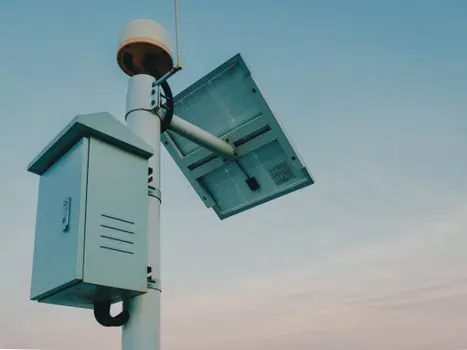
Five criteria decide which wireless corrosion technology fits an application: measurement principle, environment, power budget, data backhaul protocol, and data storage or local display [S2][S4][S5][S7]. For cooling and process water with conductivity between 10 and 10,000 µS/cm and operating temperature from -10 to 50 °C, an LPR node with Bluetooth 4.1 and an IP65 304 stainless steel body covers most chemical-treatment monitoring jobs [S4].
For live pipework and pressure equipment, a battery or harvested-power ultrasonic thickness transmitter reporting over WirelessHART or a comparable industrial gateway is the standard pattern, since the sensor must read metal that is itself in service and cannot be opened up for coupons [S2][S3][S6]. For embedded concrete or for retrofit on structural steel, a passive embedded reader plus a network of battery-backed long-life nodes is the pattern shown by CorroDec 2G, while for very high-temperature or inaccessible locations the right answer is still a passive LC or chipless RFID tag read by a handheld or fixed RF interrogator [S1][S7][S8].
Who it is for, and where it falls short
Wireless corrosion sensors are a fit for plants that already have a condition monitoring system or a wireless module infrastructure, where cable tray runs to coupon racks or ER probes are impractical, and where inspectors can no longer reach the asset safely [S2][S3][S6][S7].
They are not a replacement for a scheduled coupon retrieval program where regulatory or insurer rules still demand a weighed mass-loss coupon, and they are not a fit for media that foul the LPR electrodes faster than the operator can clean them [S4][S6]. Battery chemistry sets the real maintenance interval, not the marketing literature: a CR-200-class LPR node is rated at 1 year on a single 3.6 V ER26500 cell at the default reading interval, and that interval drops as the reading cadence is shortened toward the 3-minute minimum [S4].
Comparison: LPR, UT thickness, ER probe, and passive LC tag

Four practical options line up against four decision criteria: measurement type, environment, power source, and backhaul. (1) LPR active node, e.g. CR-200: real-time generalized and pitting rate, water service at -10 to 50 °C and up to 100 psi, 3.6 V lithium battery with about 1-year life, Bluetooth 4.1 plus RS-485 Modbus and 4 to 20 mA [S4]. (2) Ultrasonic thickness active transmitter: remaining wall thickness in mm or in, live pipework and elbows, battery or line-powered with WirelessHART-class gateway, vendor wireless infrastructure [S2][S3][S6]. (3) Passive LC resonator tag: resonance-frequency shift tied to corrosion layer growth, 500 to 1500 °C high-temperature gas path with corrosive sodium/vanadium/sulfate gases, fully passive, near-field RF read at 70 to 100 MHz [S1][S8]. (4) Chipless RFID or embedded node: signature change from corroding microstrip or embedded rebar, atmospheric or concrete-pore environment, fully passive or long-life battery, fixed or handheld reader [S5][S7].
Standards, sourcing, and integration notes
Corrosion rate and ultrasonic thickness data from these wireless nodes are typically ingested into a vibration condition monitoring or plant asset management platform, with WirelessHART (IEC 62591) being the common industrial backhaul for active transmitters and Bluetooth Low Energy or RS-485 Modbus for water-service LPR sensors [S2][S3][S4]. For hydrocarbon and sour-service applications, material selection of the sensor body and any wetted electrodes must respect NACE MR0175 / ISO 15156 limits, although the wireless corrosion sensor itself is normally a non-intrusive or in-line accessory, not a pressure-bearing part [S6].
For cross-referencing the metallurgy of coupons and LPR electrodes against common industrial alloys, see the comparison of 303 vs 304 stainless steel for machinability and corrosion and the 201 vs 304 nickel-cut case study; both are relevant when picking the UNS-coded alloy factor the CR-200 firmware is configured against [S4].
Limits, failure modes, and what to track next

Failure modes to spec in: electrode fouling on LPR probes, signal loss on ultrasonic nodes when the couplant dries out, false reading on LC resonators when the corrosion layer spalls off the tag and changes the geometry all at once, and battery expiration as a scheduled-maintenance event rather than an unplanned outage [S1][S4][S6][S9]. The SwRI corrosion monitoring sensor technology brochure flags exactly this maintenance-cost rationale, with real-time material-loss monitoring positioned as the lever that reduces routine inspection burden [S9].
Track two signals over the next planning cycle: (1) publication of field validation data for passive LC tags beyond 800 °C and in sodium/vanadium/sulfate-bearing gas streams, since the WVU MS&T24 work is still at simulation and lab stage as of October 2024 [S1][S8]; (2) IECEx and ATEX certification statements on the wireless transmitter families being installed in Zone 1 and Zone 2 hazardous areas, since the product pages reviewed do not state the exact hazardous-area rating in the public material [S2][S3].