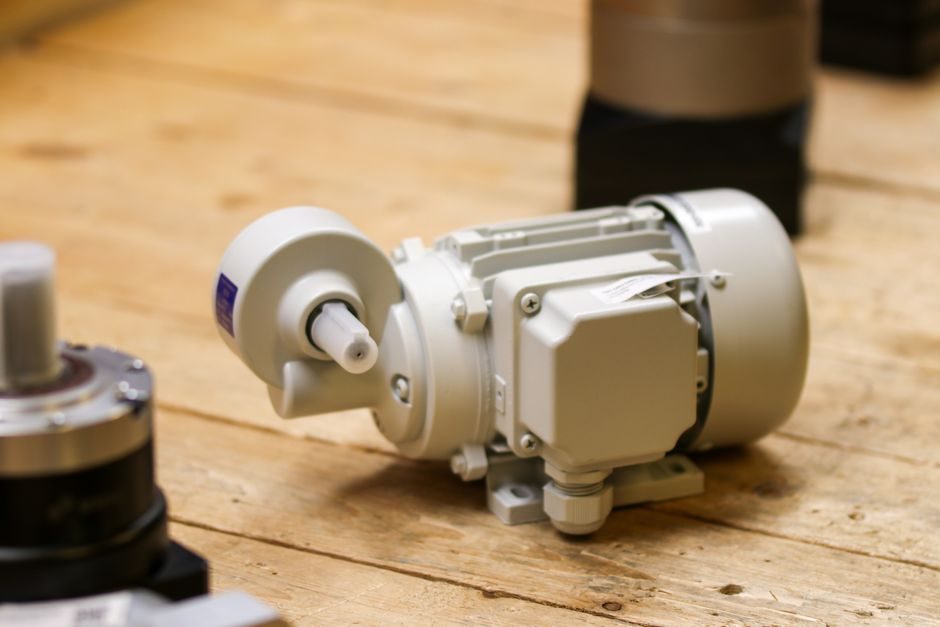
The TCO math for a worm-gear box is governed by four cost drivers: first cost, energy, lubricant, and seals/bearings — and the first item is usually the smallest of the four on any duty cycle above ~4 hours/day [S1][S2].
Where the Money Goes: Cost-Driver Map for Worm-Gear Boxes
On a 7.5 kW, 16 h/day, 300 day/yr conveyor running for 10 years at €0.10/kWh, each 10 percentage points of efficiency gap between two candidate units represents roughly €25,920 of electricity — about 8x the purchase price of a small worm reducer [S1]. A second hard driver is lubricant: the S-series specifies 0.18-22 kW ratings with a 90-4000 N·m torque envelope, and the oil-seal service interval is the practical governor on fill life [S3]. The Tsubakimoto EW series targets this with a filter-integrated oil seal, which the OEM documents as a wear-debris exclusion feature intended to extend seal service intervals on units sized from 10-20 Nm up to 2-5 kNm [S1].
Comparison: Single-Stage Worm vs Helical-Worm vs Planetary on TCO Criteria
Lining the three main worm-equivalent architectures up against four decision criteria, a spec engineer can read the trade directly: single-stage worm units like the Tsubakimoto EW and Tulsa Winch G300S deliver low first cost and the highest ratio in one stage (EW ratio 10:1 to 60:1, max output speed 150 rpm) but post the lowest efficiency [S1][S2]. Helical-worm combinations such as the kngear S series add a helical pre-stage, push efficiency higher and reach wider ratios (10.27-230.48) at 0.18-22 kW, with hollow-shaft, foot, flange and shaft-mount options that cut installation cost [S3]. On heavy-load, shock-loaded, intermittent duty — crane winches, indexing tables, gate operators — single-stage worm is still specified because its self-locking trait removes the brake cost, as seen in Tulsa Winch's G10S to G70S right-angle family spanning 1-2 kNm up to >10 kNm [S2].
Selection Criteria That Move the 10-Year Spend
Three engineering numbers decide the lifecycle bill: rated torque class, duty cycle (hours/day), and ambient/seal environment. For a baseline 200-500 Nm, foot-mounted, right-angle application with <8 h/day duty, a single-reduction worm such as the EW (sizes 10-20 Nm through 2-5 kNm) at 10:1-60:1 ratios is the cost-minimising choice [S1]. For continuous three-shift duty at the same torque, the helical-worm S series at 0.18-22 kW pays back its higher first cost inside the warranty period on energy alone, and offers hollow-shaft mounting with keyed, shrink-disk, or torque-arm connections that remove coupling inventory [S3]. Heavy-load, shock, and winch service points to ductile-iron-housed units with bronze gearing and ground-and-polished worms, the build pattern documented on the Tulsa Winch G300S (200-500 Nm, 100-200 Nm) which is also offered in upright, low, and flange mount [S2].
Total-Cost Stack: Purchase, Energy, Lubricant, Seals, Downtime
The helical-worm S series at up to 22 kW (29.91 hp) is the only architecture in the research sample that explicitly offers modular combination with other gearbox types, which lets a buyer standardise one lube spec, one seal kit, and one spare-parts pool across a plant [S3]. Lubricant selection and fill-life math is the second-largest TCO lever after efficiency, and is the practical link between the worm unit's mesh-generated heat and its oil-seal replacement frequency.
Failure Modes and Limits That Inflate the Spend Stack

Three failure modes account for most unplanned TCO on worm reducers: oil-seal failure from wear-debris ingestion, oil breakdown from elevated sump temperature, and tooth-surface pitting from shock overload. The EW series counters seal failure with an internal filter inside the oil seal lip, which the OEM publishes as an extension feature for seal life [S1]. The S series counters the thermal/overload path with helical pre-stage gearing that drops the specific sliding load at the worm mesh, and publishes a low-noise certification as part of the spec [S3]. The Tulsa Winch heavy-load family (G10S through G70S, 1-2 kNm to >10 kNm) counters shock by using ductile iron housings, bronze worm gears, and heat-treated, ground, polished worms on heavy-duty bearings [S2]. Outside these published limits — typically ambient above 40°C without derating, dust ingress above IP55, or cyclic shock above 1.5x rated torque — TCO rises non-linearly, and a helical or planetary alternative becomes the lower-cost option.
Use Cases Where Worm Is Right — and Where It Is Wrong
Worm-gear reducers are the right pick for: right-angle packaging conveyors, indexing tables, small winches, gate operators, mixers with low daily hours, and any application that needs self-locking to drop the brake — the same use-case family that the Tulsa Winch G10S-G70S winch and right-angle range is built for [S2]. Worm is the wrong pick for: continuous three-shift conveyors, high-cycle indexing above ~30 cycles/min, elevator drives, and any application where the driven load can back-drive the motor at speed — these are the applications where the planetary reducer trade-off map shows the efficiency and torque-density gap closing the TCO in favour of helical or planetary units. The Tsubakimoto EW (10-20 Nm to 2-5 kNm, 10:1-60:1) sits in the right-pick zone for small shaft-mounted, foot-mounted, and base-mounted transmission at low-to-medium duty [S1]. The kngear S series (0.18-22 kW, 10.27-230.48) is the crossover option for moderate-to-continuous duty at moderate ratio, and the only architecture in the research sample that explicitly combines with other gearboxes to extend the TCO envelope [S3].
Procurement Signals Worth Tracking

Three signals are worth watching through the rest of 2026: published efficiency curves at the operating point (not the catalogue peak), oil-seal service interval in hours — the EW filter-seal feature is the kind of published spec to look for [S1] — and modular mounting options that let one unit replace two, which the kngear S series documents with hollow output shaft (keyed, shrink disk, torque arm) plus foot, flange, and shaft mount [S3]. Also track the industrial lubricant TCO map for the fill-life assumptions that pair with each reducer spec, because the lube cost line is the second-largest TCO driver and the easiest to over-engineer with the wrong viscosity grade.
For component-level specifications, see worm reducer, total station, and helical gear reducer.