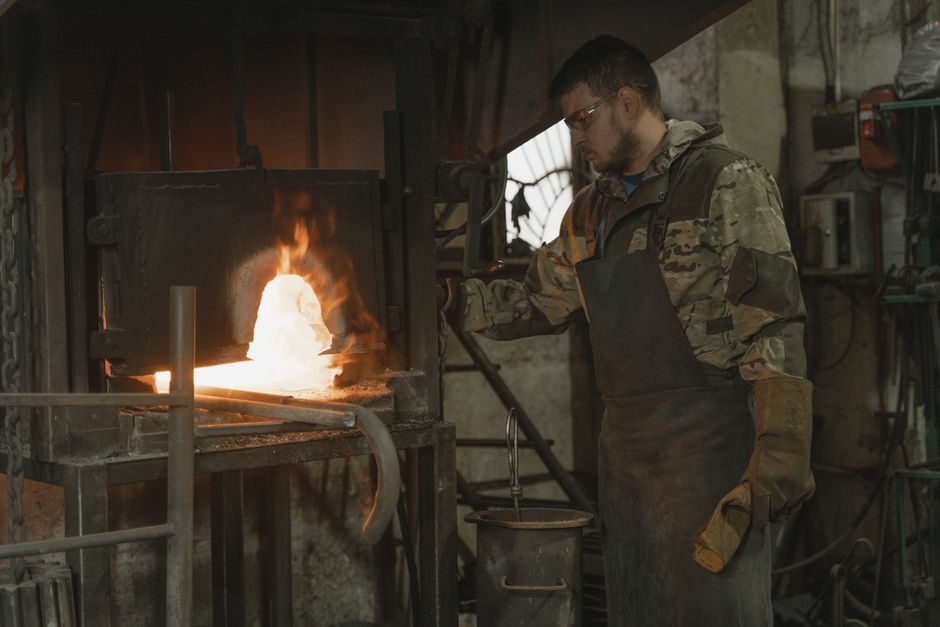
Zinc die casting is a process and alloy family, not a machine class; the equipment that runs it is the hot-chamber die casting machine in the 16 T to 180 T clamp range, with shot weights tied to the zinc-alloy (Zamak) melt sitting around 420-430 °C [S1].
When buyers search "die casting machine" on industrial catalogs, they get a much wider pool — both hot-chamber zinc/lead units and cold-chamber aluminum/brass units from 25 T up to 1300 kN (≈130 T) class — so the first spec decision is always alloy, then clamp tonnage, then shot volume [S1][S3].
Process Scope: What Zinc Die Casting Actually Covers
Zinc die casting is dominated by the Zamak family (Zamak 2, 3, 5, 7) and ZA-series alloys, poured into a hot-chamber machine where the gooseneck and shot cylinder stay immersed in the molten bath — a configuration that is mechanically impossible above roughly 420 °C without severe metal attack on the plunger [S5][S10].
General die casting machine supply covers two distinct equipment families: hot-chamber (zinc, lead, tin-zinc, small magnesium) and cold-chamber (aluminum ADC12/A380, brass, magnesium AZ91D), with cold-chamber designs required wherever melt temperature climbs past the hot-chamber survivable limit [S1][S8]. Ningbo Dongfang's catalog illustrates the split: hot-chamber 16-180 T, cold-chamber 25-280 T, with a separate brass-copper-zinc 90 T line [S1].
Clamp Tonnage and Price Bands: A Side-by-Side Comparison
Across the 2026 Alibaba and Made-in-China listings, entry zinc hot-chamber machines (25-40 T class) cluster in the US$10,000-20,000 band per set, while 80-180 T aluminum cold-chamber units sit in the US$17,000-32,000 band; 280 T cold-chamber aluminum climbs to roughly US$43,500-50,000 per set [S1][S8].
For deeper alloy and process selection — including Zamak vs ZA trade-offs and surface-finish expectations — the Zinc Die Casting Suppliers and Manufacturers: 2026 Sourcing Map is a complementary read, and the How to Choose Zinc Die Casting: Alloy, Process, and Sourcing Map page walks alloy grade by grade.
Equipment Suppliers: Who Builds What in 2026
Alibaba's hot-chamber supplier index lists 1,246 China-based vendors, with top exporters reporting US$10-50 million annual revenue and a 91.6% response rate [S3]. Ningbo Dongfang (Zhejiang) operates a 40,000 m² facility on 40+ years of history, producing 300-500 sets per year across hot-chamber 16-180 T and cold-chamber 25-280 T [S1].
On the job-shop side — companies that buy these machines and run them — Bardane Manufacturing (Jermyn, PA) runs 23 die casting machines in a 93,000 sq ft ISO 9001:2015 (TUV-Rheinland) facility dedicated to aluminum and zinc [S6]. ADAMS Die Cast and Ashish Die Casting similarly pair aluminum and zinc pressure die casting under one roof, with Ashish adding gravity casting for hybrid part families [S2][S7]. For a machine-buying perspective distinct from the alloy side, the How to Choose an Aluminum Die Casting Machine: 2026 Spec Map breaks down cold-chamber selection by kN and shot weight.
Selection Criteria: When Zinc Hot-Chamber Is the Right Call
Zinc hot-chamber wins on cycle time (typical hot-chamber cycles land in the 1-3 second injection window for small parts), tool life (Zamak's low melt temperature is gentle on H13 dies — often 1 million+ shots vs. the 100,000-300,000 typical for aluminum), and as-cast surface finish suitable for decorative plating [S1][S10].
On Made-in-China's 2026 listings, zinc Zamak valve-flange blanks sell at US$0.99-10.99 per piece at 500-piece MOQ, and zinc-alloy smart-lock housings at US$0.50-1.00 per piece at 100-piece MOQ — price points that depend on hot-chamber productivity to remain viable [S5][S9]. A separate listing of heavy-duty zinc-alloy die-cast lock nuts for cable entry sits at US$0.09-1.99 per piece with 1,000-piece MOQ, demonstrating the cost-down achievable at volume [S9].
Selection Criteria: When Cold-Chamber or Gravity Beats Zinc
Pick a cold-chamber aluminum die casting machine when the part needs the strength-to-weight ratio of ADC12 or A380, when section thickness pushes beyond what Zamak fluidity supports, or when end-use temperature exceeds zinc's roughly 95 °C creep-sensitive regime [S1][S5].
For purely structural or large-housing work, an aluminum die casting machine in the 800-1300 kN class — exemplified by Bengbu Long Hua's LH-800T CE-certified cold-chamber line for LED heat sinks and lamp shells at US$147,200-147,300 per set — is the equipment category buyers actually need [S8]. Where cosmetics are secondary and section size is large, a gravity die casting machine setup remains a credible lower-volume alternative, as Ashish's hybrid aluminum-zinc-gravity offering demonstrates [S2].
Real Use Cases Pulled From 2026 Listings
Zinc die casting in 2026 is concentrated in three part families: architectural and furniture hardware (lock bodies, hinge plates, cable glands), consumer electronics and smart-home enclosures, and small automotive connectors [S5][S9]. A 2026 export listing for OEM custom Zamak valve-flange parts in Ningbo specifies US$0.99-10.99 per piece, while a separate RoHS-certified aluminum-alloy smart-lock housing lists at US$0.50-1.00 per piece — both running on hot-chamber equipment [S5][S9].
Aluminum cold-chamber work, by contrast, shows up in LED heat-sink bodies, automotive cylinder housings, and lighting reflectors — the 800 T CE-certified cold-chamber line is purpose-positioned for these jobs at US$147,200+ per set [S8]. For magnesium or thin-wall complex geometries where porosity control matters, a vacuum die casting machine class would be the next step up, though none of the 2026 supplier listings surveyed name a vacuum unit explicitly.
Limitations, Failure Modes, and Sourcing Constraints
Zinc hot-chamber is not a universal answer: high-temperature service (above ~150 °C sustained) creeps Zamak alloys and is a hard disqualifier, and any part with cross-section above roughly 6 mm starts showing center porosity without process intervention [S10]. Buyers should also note that "zinc die casting" on Alibaba occasionally conflates Zamak and ZA alloys with zinc-coated steel or Zamak substitutes; alloy certification (e.g., ASTM B240 for ingot) is a fair pre-shipment ask.
Cold-chamber aluminum avoids the temperature ceiling but inherits its own constraints — die life measured in hundreds of thousands of shots rather than millions, higher熔損-related downtime, and shot-weight capacity that scales roughly with clamp tonnage in a 1:1 relationship for thin-wall parts [S1][S8]. Buyers specifying CE-marked equipment in 2026 should verify certificate validity directly with the issuer — the Made-in-China listing for the LH-800T unit explicitly notes "CE certified valid since 2024-08-28 (contact issuer for current status)" [S8].
Two trackable signals for the next sourcing cycle: monitor Ningbo Dongfang's annual output (300-500 sets/year) against Alibaba's hot-chamber supplier growth (1,246 vendors as of 2026-06-28), and watch for any new magnesium die casting machine capacity additions from Chinese OEMs — magnesium sits in a hot-chamber-vs-cold-chamber grey zone that 2026 catalogs have not yet resolved.