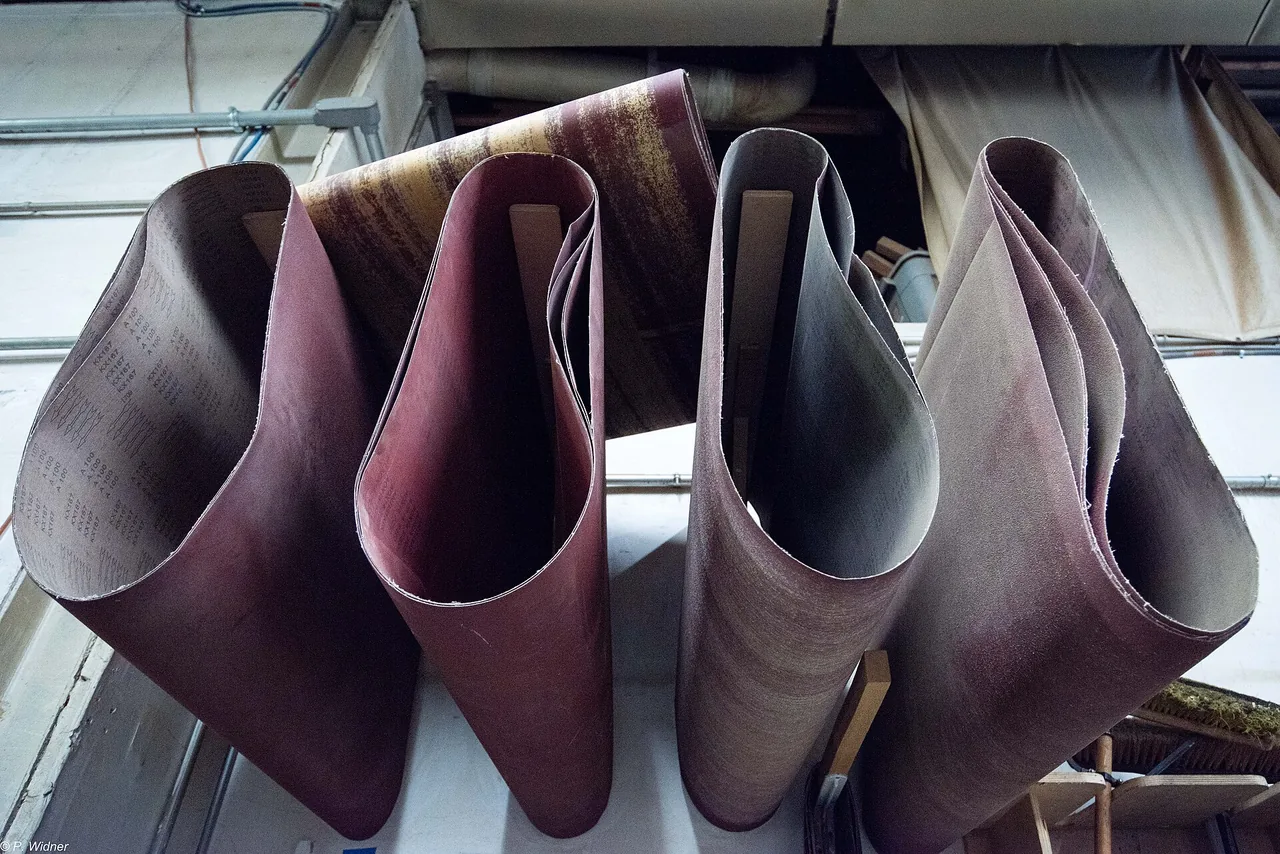
An abrasive belt, also called a sanding belt or a coated abrasive belt, is a loop of flexible backing on which a layer of abrasive grain is held by resin. The backing is paper, cotton or polyester cloth, or a thin film for fine finishing. The belt runs over a drive wheel and a tensioning idler of a belt sander, a backstand grinder, a flat-bed sander or a wide-belt sanding machine, and it grinds, deburrs, finishes and polishes metal, wood, plastics and composites. A belt is specified by five things: its size, meaning width and circumference, its mineral, its grit, its backing and its joint. The loop also carries the tensile load of the machine, so the backing and the joint are structural parts and not only a base for the grain.
The belt is the purchased consumable and the machine is its operating environment, and the two cannot be specified apart: a belt that is right on a hard serrated wheel at one speed glazes on a soft smooth wheel at another, and a joint that passes a platen on one machine tears on the next. That is why an order for belts states not only grit and size but also mineral, backing, coat, bond and joint, and why a new belt is judged on a machine that has been checked first. A belt also ages in the store and tears at speed when it is mounted wrongly, so storage and the trial run belong to the specification as much as the grit does.
Photo: P. Widner (Wikimedia Commons user LGhelpme), CC BY-SA 4.0, via Wikimedia Commons
Five decisions concentrate the purchase of an abrasive belt. First the mineral and the grit, which set the stock removal rate and the finish. Second the backing and the joint, which decide how the belt runs on a platen, over a contact wheel or in coolant. Third the size, which must match the machine. Fourth the running conditions, meaning belt speed, contact wheel hardness and pressure, because a belt performs only as its machine lets it. Fifth storage and safety, since a belt ages in the store and can tear at speed. A sixth question, the grading system behind the grit number, keeps two quotations on the same scale.
Chapter 1 / 06
What an Abrasive Belt Is and How It Works
A coated abrasive belt is built as a stack of layers, and each layer has one job. The backing carries everything else: paper in weights A to F, cloth in flexibility grades, or polyester. The make coat is the first bond layer, and it anchors the grains to the backing. The grains are planted in an electrostatic coating line that pulls them upward into the adhesive with their sharpest edge exposed. The size coat is the second resin layer, applied over the grains to anchor and stabilize them. A supersize coat, a thin third layer of lubricating material, is added where soft workpiece material would otherwise stick between the grains. Resin over resin bonding is the construction stated in the VSM manual.
Four man-made minerals do most of the work on belts: aluminum oxide, silicon carbide, zirconia alumina and ceramic alumina. Aluminum oxide is the general-purpose grain for metal and wood. Silicon carbide is sharper and more brittle, and it is chosen for non-ferrous metal, glass, stone, rubber, plastics and the cured finishes on wood. Zirconia alumina and ceramic alumina are the tough grains for high stock removal on steel, both grown for coarse and medium grits in which a grain can fracture and keep new edges. Garnet, a natural mineral, is the classic grain of paper belts for wood. The superabrasives, diamond and cubic boron nitride, are plated or bonded onto belts to grind industrial ceramic, cemented carbide, glass and hardened steel.
A belt cuts with thousands of small edges, and three things can happen to those edges in service. The grain can fracture on a small scale and show new edges; a ceramic grain does this continuously. The grain can also wear flat, so that the edges rub instead of cutting; the belt is then glazed and the workpiece heats. Or the spaces between the grains fill with removed material, which is called loading. A serrated contact wheel raises the local force and helps the grain break down at the rate the process needs; the Klingspor contact wheel guidance names this grain breakdown as the answer to glazing on hard steels. The FEPA leaflet adds that the operator is not to exert excessive pressure or overheat the belt.
Three basic designs of belt machine exist, and they differ in what backs up the belt at the workpiece. In a slack-of-belt machine the belt runs over a drive wheel and an idler, and the workpiece is pressed on the open, unsupported span; the method deburrs and polishes contoured parts at light to medium pressure. A platen machine puts a fixed flat plate of steel behind the belt and is used for dimensioning and truing flat work. A contact-wheel machine supports the belt on a wheel faced with rubber, cloth or steel; it is the most common and most versatile design. On every design the drive wheel sets the speed, the idler sets the tension and the tracking, and the contact element sets the finish.
Belt speed is the distance the abrasive surface travels in a minute. With the contact wheel diameter in inches and the shaft speed in revolutions per minute, surface feet per minute (sfpm) equal 3.1416 times the diameter times the revolutions per minute, divided by 12. The metric form takes the diameter in millimeters and divides by 1000 times 60. To convert surface feet per minute to meters per second the VSM manual says to divide by 196.8. A tachometer on the wheel confirms the shaft speed before the sum is trusted. The speed guideline for carbon steel is 4000 to 5000 sfpm (20 to 25 m/s), and titanium is run at 2000 to 2500 sfpm (10 to 13 m/s).
Force decides how a belt cuts. In the VSM manual the force applied to the workpiece is the primary factor behind the grinding efficiency and the finish of a belt on a contact wheel. The same force spread over a narrow wheel gives a higher local pressure than over a wide platen or a slack span. Three machine settings replace most of the push an operator would otherwise apply: a harder wheel, a serrated face and a faster belt. The belt must be at full speed before cutting; the FEPA leaflet says to start the machine and wait until the belt has reached its full operational speed before grinding. It is offered to the center of the belt, because edge grinding damages the belt.
Chapter 2 / 06
Abrasive Belt Types and Structural Variants
Belts are first sorted by mineral, because the mineral sets the group of workpieces the belt serves. Aluminum oxide belts cover carbon steel, cast iron, tool steel and wood and are the stock item of every maintenance store. Zirconia alumina belts are bought for heavy stock removal on steel and for cleaning castings on a fettling grinder. Ceramic alumina belts are bought where a hard grade of stainless steel or a heat resistant alloy has to be removed at a steady rate. Silicon carbide belts serve aluminum alloy, brass, copper, glass, stone, rubber, plastics and the sealers and lacquers of woodworking. Diamond and cubic boron nitride belts form the superabrasive type, sold for industrial ceramic, cemented carbide and hardened steel and for the fine finishing of rollers.
The backing decides stiffness, strength and the smallest radius a belt will wrap. Paper is the lightest and least expensive backing and is made in weights A to F, from 70 g/m2 at A to 300 g/m2 at F in the VSM scale; light papers follow a profile and the heaviest papers run on flat platens. Cloth, cotton or polyester, is graded by flexibility: J is flexible, X is sturdy and Y is very sturdy, with softer grades below J. A drill weave gives the sturdy grades and a lighter weave the flexible ones. Polyester cloth is stronger than cotton and is fully waterproof, which is why wide belts use it. Film, a thin polyester sheet, holds the most even scratch and carries microfinishing belts.
Two further choices are made inside the backing and the bond. The first is flex. The coated product is run through rollers that crack the bond in a controlled pattern, as a single, double or full flex, and the VSM manual notes that flex is inversely related to product life; its rule is therefore to use the stiffest product an application allows. The second is the bond. A glue bond gives the traditional paper belt for wood, and it is not waterproof. Resin bonds resist water, and a wet or dry paper belt is resin bonded throughout. The FEPA leaflet adds the rule for the user: belts are used dry unless they are specified as suitable for wet grinding, and the maker is consulted in doubt.
The second sorting is by coat, meaning the density of grain on the backing. In a closed coat the grain covers 100% of the backing; in the traditional open coat it covers approximately 60%, and coating densities in the VSM manual now run from 30% to 100%. A closed coat has more cutting edges per unit of area, so it removes material faster and lasts longer on hard and clean materials. An open coat leaves room for the swarf, cuts cooler and resists loading on soft or gummy material such as aluminum, paint, adhesive and some woods. An antistatic coat is a related option on belts for wood and plastics: it lets the dust leave the belt toward the extraction instead of clinging to it.
Every belt except an endless one has a joint, the splice of the two ends of the coated strip. A lap joint overlaps the two ends, with the grain on the lower end thinned; it runs in one direction only and carries an arrow. A butt joint butts the two ends and holds them with a tape under the splice; it runs in either direction and passes a platen without a mark. A step joint is a lap joint with more grain removed. An endless belt is made without a splice, by coating a loop of backing, for work that no joint mark may touch. The FEPA leaflet asks the user to observe the direction of run marked on the belt and to check the joint for wear, because belts can tear.
The boundary of the product is easiest to draw from the word belt. A flat belt, a v-belt, a timing belt and a ribbed belt are power transmission belts: they carry no grain and only transmit torque. An abrasive belt transmits nothing to the workpiece; the drive of a belt sander may itself use such a transmission belt, and that is another part. Grinding wheels and cut-off wheels are bonded abrasives, with grain held through the full wheel, and they follow the wheel rules of UAMA B7.1. An angle grinder holds coated discs, not belts. A sand blasting machine throws loose grain at the surface. The abrasive belt sits between the machine that powers it and the extraction equipment around it.
Chapter 3 / 06
Abrasive Belt Key Specification Parameters and Standards
The datasheet of an abrasive belt is short, and the key specifications table lists what a buyer finds on it. Size is width and circumference, stated in millimeters or inches, and it must match the machine: a portable belt sander commonly takes belts of 75 x 533 mm (3 x 21 in) or 100 x 915 mm (4 x 36 in), and a wide-belt sander takes belts as wide as its drum. Mineral, grit, backing, coat, bond and joint complete the identification. A direction arrow is the one marking the FEPA leaflet mentions, and it must be followed when a belt with a lap joint is mounted. The size is taken from the machine manual or from the old belt measured flat.
Grit is the number most often misread, because three grading systems are in use. FEPA grades, written with the letter P, are the European standard for coated abrasives. The American grades, once called CAMI grades and now graded under UAMA B74.18, and the Japanese JIS grades use the same numbers for coarse grits and then diverge. The numbers agree from 16 to 220 and split below that: FEPA P280 and P360 correspond to American 240 and 280, and FEPA P500, P1000 and P1200 to American 320, 500 and 600, while the chart leaves the American cell empty for P240, P320 and P400. The VSM conversion chart gives the average grain diameter behind the P scale: 262 micron at P60, 122 at P120, 66 at P220, 35 at P400 and 15 at P1200. A bare number on an order can mean either scale.
Four documents govern an abrasive belt; a fifth is sometimes cited although its scope does not list belts. UAMA B74.18 is the American National Standard for grading certain abrasive grain on coated abrasive material, and UAMA B7.7 is the American National Standard for safety in abrading materials with coated abrasives systems. FEPA publishes the P grain sizes and a safety leaflet for belts. In the United States the occupational rule 29 CFR 1910.243 requires guards at each nip point where a sanding belt runs onto a pulley and a hand pressure control on hand-held belt sanders. EN 13743, the European safety standard for coated abrasive products, applies to flap wheels, flap discs, vulcanized fiber discs and spindle mounted flap wheels; its scope does not list belts, so a belt is not tested against it.
Parameter
Typical range
What it decides
Width and circumference
75 x 533 mm (3 x 21 in)
Fit on the wheels
Grit, FEPA P scale
P16 to P1200
Cut rate; finish level
Coat density
30% to 100% coverage
Loading; cut rate
Belt speed, carbon steel
4000 to 5000 sfpm (20 to 25 m/s)
Heat; belt life
Belt speed, lumber
6500 to 10000 sfpm (33 to 51 m/s)
Output; dust load
Contact wheel hardness
20 to 90 durometer
Grinding force; finish
Serration angle
45 degrees typical, 7 degrees minimum
Aggressiveness
Storage climate
18 to 22 degrees Celsius (64 to 72 degrees Fahrenheit), 45% to 65% RH
Bond and backing condition
Wide belt acclimatization
at least 48 hours
Flatness; stable tension
Trial run after mounting
at least 30 seconds
Tracking; joint condition
Chapter 4 / 06
Abrasive Belt Selection and Duty Calculations
Selecting a belt is a sequence of five choices: the speed the material allows, the speed the wheel and the shaft produce, the contact wheel under the belt, the contact element the shape of the work needs, and dry or wet running. The paragraphs below take them in that order.
Selection starts with the material and the operation, and the VSM speed guideline sorts them by belt speed. Mild and carbon steel, stainless steel, tool steel, gray cast iron and copper are run at 4000 to 5000 sfpm (20 to 25 m/s); brass and bronze at 5000 to 6000 sfpm (25 to 30 m/s); aluminum at 4500 to 5000 sfpm (23 to 25 m/s); and titanium at 2000 to 2500 sfpm (10 to 13 m/s). Within a material the operation sets the mineral and the grit. A coarse belt of a tough grain takes off a weld bead or a skin of scale, a medium belt removes the scratch of the coarse belt, and a fine belt produces the finish, each step finer than the last.
The second calculation is the speed the machine will actually produce, since a belt has no speed setting; it runs at whatever the wheel and the shaft give it. The sum is surface feet per minute equals 3.1416 times the contact wheel diameter in inches times the shaft revolutions per minute, divided by 12; in metric units meters per second equal the same product with the diameter in millimeters, divided by 60,000. Where one machine serves several materials, a variable frequency drive on the motor that drives the wheel, a three-phase asynchronous motor, gives a speed that can be set, and a tachometer reading confirms it before the first belt is mounted.
The third lookup is the contact wheel, and its hardness is read on a durometer scale from 20, the softer end, to 90, the harder end. Rubber is the most common facing, and its hardness is given by that number. Soft wheels conform to a profile and give the softer scratch; hard wheels cut faster and give a coarser finish; faster speeds make a wheel act harder. A serrated face adds cutting force, since the raised lands carry more load than a smooth face. A general purpose wheel in the Klingspor guidance is 14 in (356 mm), of 50 to 60 durometer, with a 3/8 in to 3/8 in groove-to-land ratio, a 3/8 in groove depth and a 45 degree serration angle. The angle runs from a minimum of 7 degrees toward 90 degrees.
The fourth choice is the contact element and the force on it. Slack of belt suits the deburring and polishing of contoured and cylindrical parts at light to medium pressure. A platen suits flat work that has to be dimensioned and trued, and platen pressure is kept to what flatness needs, because platen pressure is friction and heat in the belt. A contact wheel suits stock removal and finishing alike, and it allows proper cooling and a more efficient grain breakdown, which matters on hard steels where glazing is a problem. Across all three the operator gives as little pressure as the machine allows. A wheel that is worn is resurfaced or replaced before a new belt is blamed for a poor finish.
The fifth choice is dry or wet running, and the belt decides it before the process does. The FEPA leaflet is explicit that belts are used dry unless they are specified as suitable for wet grinding. On a belt made for coolant, the VSM charts list the grinding aids as water, a soluble oil, a neat oil and a grease. A soluble oil is the common industrial lubricant for wet belt grinding of steel, where it carries heat away and protects the machine from rust. Wet running suppresses dust and loading, but it turns the hazard from dust into mist, which the extraction must then capture, and the coolant is filtered so that swarf is not fed back through the belt.
Situation
Belt and setting
Reason
Scale, weld bead on carbon steel
Zirconia or ceramic belt, 4000 to 5000 sfpm (20 to 25 m/s)
A tough grain keeps fresh edges
Stainless steel, hard chrome
Ceramic belt on a serrated wheel of 50 to 60 durometer
Grain breakdown against glazing
Aluminum alloy, brass, copper
Open coat, 4000 to 6000 sfpm (20 to 30 m/s)
Room for swarf; moderate speed
Titanium
2000 to 2500 sfpm (10 to 13 m/s)
Low speed against heat
Plastics
Open coat, 2000 to 2500 sfpm (10 to 13 m/s)
Against melting and loading
Glass
Silicon carbide belt, 2500 to 3500 sfpm (13 to 18 m/s)
A sharp hard grain
Lumber
6500 to 10000 sfpm (33 to 51 m/s)
Stock removal for planing
MDF and particleboard
6000 to 7000 sfpm (30 to 36 m/s)
Calibrated panel surfaces
Flat plate
Platen contact, stiff heavy backing
Flatness; size
Contoured part
Slack of belt, flexible backing
Shape following at light pressure
Chapter 5 / 06
Abrasive Belt Installation, Maintenance, and Typical Failure Modes
A belt gives most of its life between the store and the first cut, and the machine decides the rest. The paragraphs below follow a belt through storage, mounting, the trial run and the checks in use, and the table after them lists the signs of a belt at the end of its life.
Storage is the first maintenance task, and it has a climate. The FEPA leaflet gives the preferred conditions as 18 to 22 degrees Celsius (64 to 72 degrees Fahrenheit) and 45% to 65% relative humidity, away from heat, sun and moisture. Belts may stay flat in the maker's sealed box; unpacked belts are hung on a rod or peg of at least 50 mm (2 in) diameter. Wide belts are unpacked and stored near the machine for at least 48 hours before mounting, so that they stabilize to the ambient conditions. Shelf life follows the bond and the store: glue-bonded paper belts are the shortest lived and resin-bonded cloth belts the longest. A temperature humidity recorder on the wall completes it.
Mounting is a short sequence whose objective is tracking. The belt goes on with its direction arrow agreeing with the rotation of the drive wheel, the take-up idler is set so the belt just does not slip, and the tracking is centered before the tension is made final. The guards go back and are adjusted, the locking mechanism of the machine cover is checked, and the belt is run at full operating speed for at least 30 seconds. Vibration or an unusual sound in that trial run means a damaged belt, a crooked joint or a rough wheel, and it is corrected before grinding. The FEPA leaflet asks for periodic checks for edge cracks and for strong wear in the joint.
The belt also reports the condition of the machine. A rough or glazed contact wheel marks every belt on it, and the Klingspor guidance says that worn wheels are resurfaced or replaced. Play in a wheel bearing shows as a belt that knocks once per revolution, and a dry bearing heats the wheel. The extraction keeps its capture at the hood, and a dust particle meter at the operator position shows when capture has fallen. The FEPA leaflet warns that belt grinding can produce high concentrations of dust, gas or mist. A cool belt keeps its grain, and a clean machine keeps the belt cool.
Five failure modes account for most belts taken out of service. Glazing is a belt that has worn smooth and now rubs; it follows a wheel that is too soft for the grain, too much speed or too little force. Loading is swarf packed between the grains; it follows sticky material, a closed coat where an open coat was needed, and dry running where coolant is allowed. Joint failure is a tear or a knock at the splice; it follows a wrong running direction, a crooked belt or a thick lap joint over a hard platen. Edge wear is a ragged edge; it follows edge grinding and sharp-edged workpieces. Tracking problems, a belt that runs to one side, follow a misaligned idler, a worn wheel face, a stretched belt or a damp-stored backing.
The safety rules for a belt machine are written around the nip point, where the belt runs onto a pulley. The portable tool rule 29 CFR 1910.243 requires guards at each nip point, requires the unused run of the sanding belt to be guarded, and requires belt sanders to have a control that stops when hand pressure is released. The rule is for portable tools; a stationary grinder keeps its guards on under the general machine guarding rule. Where the guard is not completely closed, the FEPA leaflet requires protective gloves, a leather apron, a face shield and a dust mask; safety glasses, a respirator and a hearing protector follow dust and noise. An emergency stop is within reach, and the guard stays closed until the belt has stopped.
Sign
Likely cause
Action
Belt cuts slowly, work heats
Grain glazed; wheel too soft
Change the belt; harder or serrated wheel
Belt loaded with swarf
Sticky material; closed coat; dry running
Open coat; coolant if the belt is rated for it
Knock once per revolution
Damaged joint; wheel bearing play
Replace the belt; check the bearings
Belt tears at the joint
Wrong running direction; thick lap joint
Follow the direction arrow; butt joint
Ragged belt edges
Edge grinding; sharp workpiece edges
Work at the belt center; secure the workpiece
Belt runs to one side
Idler misaligned; worn wheel face
Reset the tracking; resurface the wheel
Belt stiff or limp in storage
Humidity outside 45% to 65% RH
Store at 18 to 22 degrees Celsius (64 to 72 degrees Fahrenheit)
Dust or mist at the operator
Blocked hood; fallen capture
Clear the extraction; dust particle meter; respirator
Vibration in the trial run
Uneven joint; rough wheel; loose guard
Stop the machine; find the cause
Chapter 6 / 06
Abrasive Belt Industry Applications and Procurement Checks
Metal fabrication is the heaviest user of belts. Backstand grinders take scale, weld beads and parting lines off carbon steel and stainless steel fabrications; the bead of a TIG weld is removed with a coarse zirconia or ceramic belt and blended with two finer belts. Foundries clean castings on a fettling grinder, where a ceramic belt on a hard serrated wheel removes the gate and riser stubs and a softer wheel blends the surface. Abrasive planing and finishing lines grind stainless sheet and strip with wide belts on contact rollers, and belt polishing lines bring sanitary tube to a measured finish that a surface roughness tester confirms. In a machine shop a belt takes the mill marks off a die cast housing.
Woodworking runs belts at the highest speeds in the guideline. Wide-belt sanders plane and calibrate lumber at 6500 to 10000 sfpm (33 to 51 m/s), sand MDF and particleboard at 6000 to 7000 sfpm (30 to 36 m/s), and sand plywood and fiberglass at 5000 to 7000 sfpm (25 to 36 m/s). The grit sequence is wide on wood: a belt that planes at one grit is followed by two or three finer belts in the same pass, and coat and antistatic treatment matter as much as the mineral, because resinous softwood loads a closed belt quickly. Wood dust is combustible, so the extraction of a woodworking shop is built as a dust collector and not as an open fan.
The remaining industries follow the material guideline. Shops that finish plastics run at 2000 to 2500 sfpm (10 to 13 m/s) to keep heat out of the resin, and glass is ground at 2500 to 3500 sfpm (13 to 18 m/s). Stone, industrial ceramic and hardened tooling are cut and polished with silicon carbide and diamond belts. The belt is managed as a stock item: belts are bought by grit sequence, the bin of each machine carries its belt size, and a monthly count of belts per machine is the earliest signal of a machine out of adjustment. Grinding aluminum and other light metals adds a fire and explosion risk, which the FEPA leaflet names, so the extraction of such a line needs an explosion proof motor on its fan.
A purchase order for an abrasive belt states eight items. Size as width and circumference in millimeters, with the machine model. Mineral, with the maker's product grade where a ceramic or zirconia grade is required. Grit with its grading system, FEPA P or the American grade of UAMA B74.18, and the full grit sequence where a finish is bought. Backing with its weight or flexibility letter, and the coat, open or closed. Joint, lap or butt, with the running direction for a lap joint. Bond and whether the belt must be suitable for wet grinding. Speed as the surface speed the process runs at, so that the supplier confirms the belt for the machine. Quantity split by grit, with delivery in the maker's packaging. Two documents are asked for: the safety data sheet and the statement of conformity with UAMA B7.7 or the FEPA safety recommendations. A first batch is trialed on one machine for belt life and finish before the item is released to the store.
FAQ
How does an abrasive belt cut?
An abrasive belt is a loop of backing coated with layers that hold the grain. The make coat anchors the grains to the backing, an electrostatic field stands them with their sharpest edge outward, and the size coat locks them in place. Each exposed edge takes a chip as the belt passes the workpiece at speed, and a grain fractures a little as it dulls, so that fresh edges appear. The backing bends around the contact wheel or platen. A worn belt has edges gone flat, so it rubs and heats instead of cutting; the cure is a new belt or a harder or serrated wheel, not more hand pressure.
What types of abrasive belt are there?
Belts are typed by mineral, backing, coat and joint. The minerals are aluminum oxide for general work, silicon carbide for non-ferrous metal, glass and stone, zirconia alumina and ceramic alumina for heavy metal removal, garnet for wood, and diamond or cubic boron nitride for industrial ceramic and hard steel. Backings run from light paper at 70 g/m2 to heavy paper at 300 g/m2, cotton cloth from flexible J to very sturdy Y, and polyester and film for wet and fine work. A closed coat covers 100% of the backing; an open coat covers about 60% and resists loading. Joints are lap, butt with tape, or none on an endless belt.
Which specifications matter most when ordering an abrasive belt?
Six specifications define an order. Size as width and circumference in millimeters. Mineral. Grit with its grading system, FEPA P or the American grade of UAMA B74.18, because the two agree only down to 220. Backing with its weight or flexibility letter, and the coat. Joint, lap or butt, and whether the belt must take coolant. Running speed, so that the supplier confirms the belt for the machine; carbon steel is ground at 4000 to 5000 sfpm (20 to 25 m/s) and lumber is sanded at 6500 to 10000 sfpm (33 to 51 m/s). The safety data sheet and the direction arrow on the belt complete the delivery.
How is the right grit and belt speed chosen?
Start from the material guideline and the finish required. Coarse grit removes scale, weld beads; each later step uses the finest grit that removes the last scratch. Belt speed follows the material: carbon steel at 4000 to 5000 sfpm (20 to 25 m/s), aluminum at 4500 to 5000 sfpm (23 to 25 m/s), titanium at 2000 to 2500 sfpm (10 to 13 m/s), and lumber at 6500 to 10000 sfpm (33 to 51 m/s). Check the speed the machine produces from the wheel diameter and the shaft revolutions per minute. The contact wheel then sets the finish: soft and smooth for fine work, hard and serrated for fast removal.
How should abrasive belts be stored and mounted?
Store belts at 18 to 22 degrees Celsius (64 to 72 degrees Fahrenheit) and 45% to 65% relative humidity, and hang unpacked belts on a peg of at least 50 mm (2 in) diameter. Let wide belts stand near the machine for at least 48 hours before mounting. Mount with the direction arrow agreeing with the wheel rotation, set the idler so the belt just does not slip, and center the tracking. Refit and adjust the guards, then run the belt at full speed for at least 30 seconds and listen for knocking. Do not open the guard or put the machine down until the belt has stopped.
What drives the cost and lead time of an abrasive belt?
Cost follows the mineral first: ceramic and zirconia grains cost more than aluminum oxide and far more than garnet, and a diamond belt is another class. Polyester cloth and film backings cost above paper. The joint and the size drive lead time: common portable sizes and wide-belt widths are stocked, while an unusual circumference or a special joint such as an endless belt is made to order. Quantity per grit changes the price per belt, and the grit sequence of a line decides how many of each are needed. A trial batch on one machine, counted as pieces finished per belt, is the honest way to price a belt.
Which standards and safety rules apply to abrasive belts?
In the United States, UAMA B74.18 grades the abrasive grain on coated abrasives and UAMA B7.7 is the American National Standard for safety in abrading with coated abrasives systems. FEPA publishes the P grain sizes used in Europe and a safety leaflet for belts. The occupational rule 29 CFR 1910.243 requires guards at each nip point where a sanding belt runs onto a pulley and a control held closed by hand pressure on hand-held belt sanders. EN 13743, the European safety standard for coated abrasive products, covers flap wheels, flap discs and vulcanized fiber discs; its scope does not list belts.