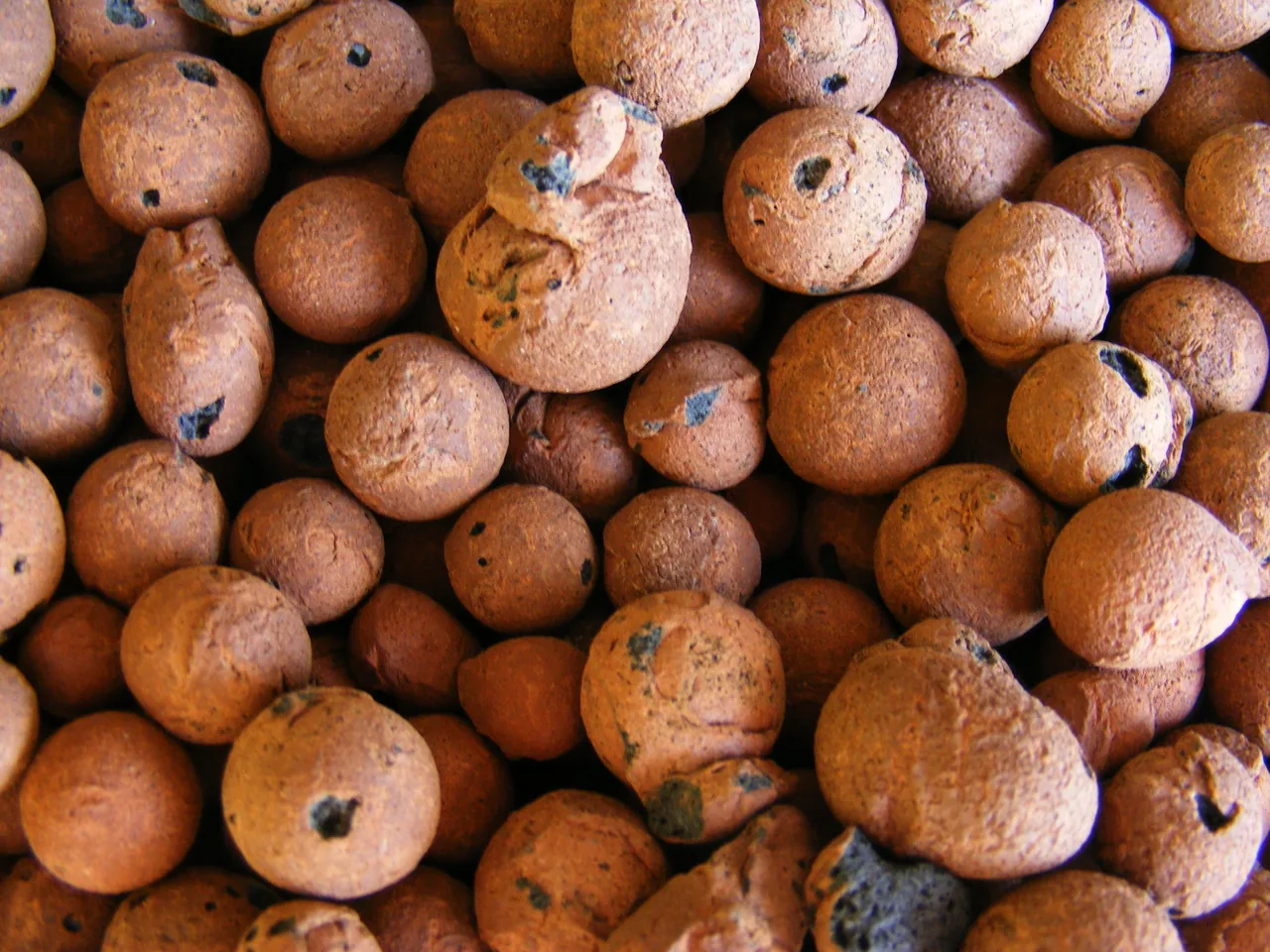
Artificial aggregate is mineral aggregate that a plant makes rather than one it extracts. Natural sand and gravel, building stone and crushed rock are won from a pit or a quarry and used as they come, with washing, crushing and sizing. Artificial aggregate starts from clay, shale or slate, or from an industrial residue, and a thermal or agglomeration step turns the feed into a granular solid with new properties. The group that matters commercially is the lightweight one, made by expanding the raw material to about twice its volume, and it is bought for two reasons: it makes a lighter concrete, block or fill than natural aggregate can, and in several uses it insulates as well.
This page treats the material as a purchased product. It sets out what happens inside the kiln that makes a dense clay into a light pellet, which types are on the market and how they are graded and densified, which parameters a specification fixes and what the product standard covers, how the aggregate is chosen and corrected for the water it carries, how it is stored, batched, placed and where it fails, and what an inquiry has to state. Manufacturing facts come from the United States emission factor handbook and its background document and from the European reference document on the ceramic industry; the specification facts come from the standards body's page for the structural concrete standard.
Where the buying decision concentrates: in density against strength, and in water. The buyer names a use, fixes the grading and the loose bulk density that serve it, and then deals with the fact that a dry lightweight pellet takes in mix water faster than any natural aggregate. Five things decide most purchases: the raw material and its plant, the grading, the loose bulk density, the water absorption with the wetting practice that goes with it, and the test report that proves the first four.
Chapter 1 / 06
What Artificial Aggregate Is and How It Works
Artificial aggregate is a manufactured mineral filler for concrete and for fill. The United States environmental agency, in its emission factor handbook, defines lightweight aggregate as a type of coarse aggregate used to make lightweight concrete products such as concrete block, structural concrete and pavement. Most of it is produced from clay, shale or slate; blast furnace slag, natural pumice, vermiculite and perlite can be used as substitutes. To make it, the raw material, with the exception of pumice, is expanded to about twice its original volume. The expanded material has properties similar to natural aggregate but is less dense, and a concrete made with it is therefore lighter than one made with sand and gravel of the same volume.
The expansion is a reaction that a clay undergoes when it is fired fast enough. Expanded clay is described in the European reference document on ceramics as a porous ceramic product with a uniform pore structure of fine, closed cells and a densely sintered, firm external skin. Only raw materials that first form a pyroplastic, dense sinter or melt coat when heated are suitable, because the body has to soften at the same time as gases form inside it. Water vapor, oxygen, carbon dioxide and sulfur dioxide are released in the range of approximately 750 to 1300 degrees Celsius, the pores at the surface begin to close, and the trapped gas expands the softened granule. Firing takes place between 1100 and 1300 degrees Celsius, and the volume grows until the skin sets.
The rotary kiln route is the common one. Production begins with mining or quarrying the raw material, which is crushed with cone crushers, jaw crushers, hammer mills or pugmills and screened for size; oversized material goes back to the crushers and what passes through the screens is stored in hoppers. From the hoppers it is fed to a rotary kiln fired with coal, coke, natural gas or fuel oil at about 1200 degrees Celsius (2200 degrees Fahrenheit). As the material heats it liquefies, carbonaceous compounds in it form gas bubbles that expand it, and volatile organic compounds are released. The expanded product, called clinker, leaves the kiln on a conveyor into a clinker cooler, where air cools it into a porous material. It is then screened for size, crushed if necessary, stockpiled and shipped.
Two preparation routes feed that kiln, and the moisture of the clay decides between them. Moist clay takes the wet route: it is homogenized in storage, mixed and kneaded with its additives, and fed to a rotary dryer in which chains and bars break the lumps down. Rather dry clay takes the semi-dry route: a primary crusher reduces it to less than 100 mm (4 in.), a dry grinding unit powders it, and a slanting dish granulator with added water rolls the powder into spherical granules, which pass through a powder drum that coats them with limestone powder. In the kiln itself the material and the hot gas move in opposite directions, the feed entering at the cold end after a drum preheater; tube lengths run from 4 to 80 m (13 to 262 ft) and diameters from 1.0 to 4.5 m (3.3 to 14.8 ft).
Not every plant uses a rotary kiln, and not every lightweight aggregate is artificial. The environmental agency estimates that approximately 90 percent of plants use rotary kilns, that traveling grates are also used to heat the raw material, and that a few plants process a natural lightweight aggregate, pumice. On a traveling grate the prepared granules pass through a hot zone on a moving bed rather than tumbling through a drum. Blast furnace slag, vermiculite and perlite are named as substitutes for the clay-based product, and slag, fly ash and glass are each expanded by their own heat or foaming step. The differences between the routes matter less to the buyer than what they have in common: a pellet whose density was set in the plant and can be set again to a different value.
The finished particle carries its history in its shape and its density. Movement in a rotary kiln leaves expanded clay approximately round or oblong, and it is sold in size fractions from 0.1 mm (0.004 in.) up to 25 mm (1 in.), commonly 0 to 4 mm, 4 to 10 mm and 10 to 25 mm. Loose bulk densities are quoted at 250, 280, 330 and 510 kg/m3 (about 16 to 32 lb/ft3) for one expanded clay product line, with boulders of 100 to 500 mm (4 to 20 in.) at 500 kg/m3 for fill. The closed cells keep water out of the core, the hard skin resists crushing, and the low thermal conductivity, quoted as low as 0.097 W/(m K), makes the same pellet a useful insulator. It is these four properties, shape, low density, closed pores and low conductivity, that a specification tries to fix.
Chapter 2 / 06
Artificial Aggregate Types and Structural Variants
The largest family is made from clay, shale and slate, and its members differ in raw material more than in behavior. Most lightweight aggregate is produced from those three rocks. Expanded clay is sold under several trade names; expanded shale and expanded slate come from plants that quarry a different rock and fire it on the same kind of line. A usable raw material is an early sintering clay with a high content of layered silicates, and the published composition ranges for expandable clays are wide: alumina 12 to 25 percent, silica 47 to 78 percent and fluxing oxides 8 to 29 percent by weight. The oxide mix is only a guide, since the reference document notes that the expansion characteristics of a clay cannot generally be derived from its analysis, so a deposit is proven by trial firing.
The manufacturer adjusts the material before it reaches the kiln. Clays that do not expand well enough on their own are made expandable with additives, and the reference document groups them by role. Fluxes, such as iron oxides, lime compounds, dolomite and illitic clays, lower the temperature at which the body softens. Expansion aids, such as lignosulfonates, ultrafine coal and bituminous clays, supply gas inside the granule. Release agents keep the unfired granules from bonding together and protect them in the expansion kiln. The dose is usually between 0 and 10 percent by weight, and it is chosen for the raw material, the process, what is available and what the mixture will emit. For the buyer this is the reason two expanded clays with the same grading can behave differently in a mixer.
Types are sold by grading before they are sold by anything else. After firing, the expanded material goes through a sieving and crushing process to obtain the desired granulometry, with dry sieving and sand crushers as the normal equipment. The rounded fractions come straight from the kiln, and the crushed ones, usually the finer sizes, carry angular faces. The usual splits are a fine fraction of 0 to 4 mm, a medium fraction of 4 to 10 mm and a coarse fraction of 10 to 25 mm, and the fine material is often used as the lightweight sand of a mix while the two coarser ones are its coarse aggregate. Because each fraction comes from one kiln run, the grading is narrow, and a supplier blends fractions to meet a specified grading envelope.
Density is the second axis of the product range, and the plant sets it with heat. The reference document states that the optimal temperature curve for reaching a desired density depends on the raw material mixture and its additives, and that time in the kiln has a significant influence on the product characteristics. One expanded clay line is listed at loose bulk densities of 250, 280, 330 and 510 kg/m3, so a buyer can choose a light fill or a denser aggregate for structural concrete from the same raw material. The lighter the pellet, the more void it carries, the more water it can absorb and the lower its crushing resistance will be. Density is therefore the number that ties a type to its use, and it is the first figure to put on an order.
What artificial aggregate is not is as important. Natural sand, gravel and crushed rock, and recycled concrete, are aggregates that are won or recovered rather than made, and a mix can combine them with the artificial kind. Autoclaved aerated concrete is a block in which air is entrained in the cementitious mass; it is a wall product such as an AAC block or an ALC panel, not an aggregate, although it serves the same aim of low weight. Artificial aggregate is one of three components that make lightweight concrete: the aggregate, the cement that binds it and a concrete admixture that controls water and air. In North America the product specification for structural use is ASTM C330/C330M, whose active edition on the standards body's page covers lightweight aggregates for structural concrete in which the prime considerations are reducing density while maintaining compressive strength.
The product reaches the site in three forms. Most of it is stockpiled at the plant and shipped in bulk by truck, rail or vessel, and transferred by belt conveyor, bucket elevator and screw conveyor on its way to a silo. Smaller quantities travel in a bulk bag or in small sacks, which suits batching plants that use only a few cubic meters at a time and builders' merchants. A plant that makes several products from one raw material, lighter and denser grades, rounded and crushed fractions, keeps them in separate bays, because mixing two gradings or two densities at the stockpile cannot be undone. The last step named in the European description of the process is recovery and preparation for transport, bagging and loading, and it is where a certified product most easily loses its identity.
Chapter 3 / 06
Key Specification Parameters and Standards
ASTM C330/C330M is the product specification that a North American buyer names for structural use, and its scope states the purpose precisely: lightweight aggregates for structural concrete in which prime considerations are reducing the density while maintaining the compressive strength of the concrete. The same scope warns that its procedures are not intended for job control of the concrete. The standard's abstract names the properties it governs: friable particles, loose bulk density, compressive strength, drying shrinkage, popouts, and resistance to freezing and thawing. It states values in SI and in inch-pound units separately and requires one system to be used on its own, so an order should say which units its figures are in.
Around that specification sit the parameters a mix designer needs, whether or not the standard sets a limit for each. Grading is the split of a delivery over sieve sizes. Particle density is the mass of the solid with its pores, and loose bulk density is the mass of a loose volume, the figure on which transport and storage are planned. Water absorption is the share of water a dry pellet takes in, and it decides how much batch water the aggregate will steal. Crushing and impact strength show how much fine material the pellet makes under load. Limits on chlorides, sulfates and alkalis protect reinforcement and keep the aggregate from reacting with cement. Freeze-thaw resistance and thermal conductivity decide how the material behaves outdoors and how it insulates.
Figures for a named product come from its maker, and the values below are typical ones for expanded clay rather than limits. Expanded clay aggregate is made by heating clay to about 1200 degrees Celsius (2200 degrees Fahrenheit), and the commercial line quoted in the encyclopedia entry sells at loose bulk densities of 250 to 510 kg/m3 (about 16 to 32 lb/ft3) with a thermal conductivity quoted as low as 0.097 W/(m K). Its reaction in water is close to neutral, with a pH of nearly 7, which is why it is used as a growing medium as well as in concrete. The standards body lists ASTM C330/C330M as active in its latest published edition, so a specification that cites the standard by year should be brought up to date.
Parameter
Typical value or requirement
What it decides
Loose bulk density
250 to 510 kg/m3 (about 16 to 32 lb/ft3), expanded clay
Weight of the concrete or fill; transport volume
Size fractions
0 to 4 mm, 4 to 10 mm, 10 to 25 mm
Fine or coarse fraction of a mix
Largest particles
25 mm (1 in.); boulders 100 to 500 mm (4 to 20 in.) for fill
Sieve sizes and handling equipment
Firing temperature
1100 to 1300 degrees Celsius
Density and pore structure of the pellet
Volume increase
About twice the raw material volume
Yield of a plant per ton of clay
Particle shape
Round or oblong for kiln product; angular when crushed
Workability and water demand
Water absorption
Stated by the maker for each grade
Pre-wetting and moisture correction
Crushing and impact strength
Stated by the maker; lower for lighter grades
Amount of fines made under load
Freeze-thaw resistance
Property named in ASTM C330/C330M
Outdoor and pavement durability
Drying shrinkage
Property named in ASTM C330/C330M
Cracking risk of the concrete
Popouts
Property named in ASTM C330/C330M
Surface finish of slabs and precast
Thermal conductivity
As low as 0.097 W/(m K) for expanded clay
Insulating fills and screeds
Reaction in water
pH of nearly 7
Use in growing media and with cement
Product standard
ASTM C330/C330M, active
Acceptance testing for structural concrete
Chapter 4 / 06
Selection and Duty Calculations
Selecting an artificial aggregate is a short sequence: name the use, fix the grading and the density for it, then correct the mix for the water the pellet holds. The paragraphs below follow that order, and the table lists the decisions that recur.
For structural concrete the choice is a trade between density and strength. ASTM C330/C330M exists because the two pull against each other: the prime considerations are reducing the density while maintaining the compressive strength of the concrete. A lighter aggregate gives a lighter slab, beam or precast unit and lower loads on the structure below it, and it costs some strength and stiffness, because the pellet itself is weaker than a rock of the same size. The lighter grades of expanded clay, 250 to 330 kg/m3 (about 16 to 21 lb/ft3), belong in blocks, screeds and fill; the denser grades, around 510 kg/m3 (about 32 lb/ft3), in concrete that has to carry load. A ready mix concrete supplier proves the combination with trial batches before the grade is fixed.
Water is the second decision. A dry lightweight pellet absorbs mix water within minutes, and water that disappears into the aggregate is water that no longer lubricates the mix or hydrates the cement. Two practices prevent that loss. In pre-wetting the aggregate is wetted, by sprinkling in the stockpile or by soaking, before it is batched, so that it arrives at the mixer close to saturated. In vacuum saturation the air in the pores is drawn out and replaced by water in a vessel, which wets the pellets through in a short time. A wetted aggregate is heavier, the batch is corrected for the water it carries, and the workability of the mix then holds from the batching plant to the placement.
The correction itself is arithmetic on the moisture of the stock. Take a batch that needs 180 kg of dry lightweight aggregate and a stockpile whose moisture is 15 percent of the dry mass. The scale must batch 207 kg of wet aggregate, because 180 plus 27 is 207, and the added water must be reduced by the same 27 kg. A moisture analyzer on the fine aggregate or a drying test on a sample gives the percentage, and it is repeated when the weather changes, because a lightweight aggregate takes in and gives up water faster than natural sand. The water absorption stated by the maker is the long-term figure; the stockpile moisture is the short-term one; the mixer sees the sum.
Lightweight fill is chosen by unit weight. Where a fill would add more load than the ground below can carry, on soft clay, behind a retaining structure or over a culvert, a material with a loose bulk density of a few hundred kilograms per cubic meter replaces one of well over a thousand. Expanded clay is described as incompressible under permanent pressure and gravity loads, resistant to freezing and fire, and nearly neutral in water, so it does not soften the ground or attack concrete. It is placed and compacted with the same plant as any granular fill, an excavator to spread it and a road roller at low speed, and it is separated from the surrounding soil by a geotextile or an HDPE geomembrane so that fines cannot migrate into its voids.
The same pellet serves where weight and insulation are wanted together. Lightweight blocks are made with the fine and medium fractions, and they weigh less than a fired brick of the same size while insulating better, which is why a wall of lightweight blocks, like a lightweight partition panel, needs a lighter supporting structure. In a screed or a roof build-up the coarse fraction is used for its low conductivity, in the company of other insulators such as rock wool, an EPS board or an XPS board. The aggregate itself is incombustible, being fired ceramic, and it adds that property to a product that would otherwise burn. Where a stronger and tighter surface is needed, the lightweight material is paired with a special cement, a concrete fiber or a dry mortar topping rather than with a heavier aggregate.
Use
What to fix
Typical choice
Structural concrete, slabs and beams
Density and strength together; trial batches
Dense grade around 510 kg/m3; ASTM C330/C330M
Concrete blocks
Light weight with enough strength for a wall
Light grades 250 to 330 kg/m3; fine and medium fractions
Insulating screed or roof
Lowest conductivity that carries the load
Coarse light fraction; light grades
Fill over soft ground
Loose bulk density; drainage; separation from soil
Boulders or coarse light fraction with a geotextile
Wet or saturated site
Water held by the aggregate
Vacuum saturation before batching; moisture correction
Pumped concrete
Risk of segregation and blocking
Dense grade, pre-wetted, trial pump
Freezing climate
Freeze-thaw resistance of aggregate and concrete
Grade tested for freezing and thawing; air-entraining admixture
Growing medium
Chemical neutrality and drainage
Washed expanded clay; pH near 7
Long haul from the plant
Low density means many truckloads for a small mass
Compare delivered price per cubic meter, not per ton
Chapter 5 / 06
Installation, Maintenance, and Typical Failure Modes
An artificial aggregate is a consumable that has to be kept in the state in which it was tested. The points below follow the material from the gate to the placed concrete and name the check that catches each fault.
Storage is where the first fault occurs. Lightweight aggregate is delivered with a known grading and, in the case of a pre-wetted material, a known moisture; a stockpile that stands open in the rain or dries in the wind loses the second. The stockpile is kept under cover or well drained, on a clean hard surface, and in bays that separate gradings and densities. It is not dropped from height, because the lighter grades break and make fines. A supplier's delivery note is checked against the order for grading and loose bulk density, and a sample is kept from each load, so that a change in the material can be traced to the load that brought it.
Batching differs from ordinary practice in the weighing. The load cells of a batching plant are set to the mass of wet aggregate that was worked out from the moisture test, and the water is reduced by the amount the aggregate brings. Where the aggregate is pre-wetted, it is weighed on a platform scale or a belt weigher into a hopper, and a check with a moisture analyzer is made on each batch of fine material. Lightweight aggregate is added to the mixer early with some of the water, so that the surface is wet before the cement is added, and the batch is mixed longer than a normal weight one to bring the cement paste into the pores. The concrete batching plant records the batch weights, and they are what a later dispute is settled on.
Placing needs more care than a normal weight mix. The lightweight coarse aggregate is light enough to float in a wet mix, so a mix that is too wet or over-vibrated segregates, with the coarse pellets rising to the top and the paste and sand settling. A concrete vibrator is used in short insertions and never to move the concrete sideways, and the slump is kept at the low end of the workable range. Pumping is possible with a concrete pump truck but is proved by a site trial: a pre-wetted aggregate with a low absorption holds the mix together, while a dry one takes water at the pump pressure, stiffens and blocks the line. Finishing follows as soon as the bleed water is gone, which with a well-proportioned mix is almost immediately.
Curing and drying take longer than with normal weight aggregate. The water stored in a pre-wetted aggregate is released slowly, which helps the cement to cure inside a slab that would otherwise dry out, and it also means that a lightweight slab takes longer to reach the dry state that a floor covering or a coating needs. A concrete curing compound or a curing membrane is applied as soon as the surface can take it. Before a floor finish, a moisture analyzer or a drying test is made on the slab and compared with the limit set by the maker of the finish. Because lightweight concrete can shrink more as it dries, joints are placed at the spacing given for the mix and not at the spacing of a normal weight slab.
The failures that follow have one of three causes. The first is water that was not accounted for: the mix stiffens in the mixer or the pump, the placed concrete is harsh, and the wet slabs vary in density from batch to batch. The second is segregation, which leaves a coarse layer at the top and a dense layer at the bottom, with popouts where a pellet near the surface has softened or expanded. The third is drying: shrinkage cracks where joints were too far apart, and a floor finish that lifts because the slab had not dried. Freeze-thaw damage appears where a light grade was used outdoors without air entrainment. In every case the remedy is the same check: the grading, the loose bulk density, the absorption and the moisture of the delivered material.
Fault
How it shows
Cause and action
Stiff mix at the mixer or pump
Slump falls; line blocks
Dry aggregate taking water; pre-wet and correct moisture
Segregation
Coarse pellets at the top, paste at the bottom
Mix too wet or over-vibrated; lower slump, short vibration
Popouts
Pellets breaking away from the surface
Weak or damp coarse particles; change grade or pre-wet
Variable density
Unit weight differs between loads
Stockpile not uniform; test each load for loose bulk density
Excess fines
Dust in the stockpile; harsh mix
Breakage from dropping or over-compaction; handle gently
Shrinkage cracks
Cracking along joints and edges
High drying shrinkage; joints per mix design, longer curing
Floor finish failure
Coating lifts; high moisture reading
Slab not dry; dry longer and test before finishing
Freeze-thaw damage
Scaling outdoors
Grade not resistant or no air entrainment; tested grade plus admixture
Chapter 6 / 06
Industry Applications and Procurement Checks
The uses follow from low density and from neutrality in water. Structural lightweight concrete goes into slabs, bridges and precast elements where dead load has to come down. Blocks and panels made with the fine and medium fractions are the light wall materials of low and mid-rise building. Lightweight fill raises grades over soft ground, fills behind bridge abutments and insulates under floors. The same pellet is washed and sold as a growing medium, where its closed pores hold air and water around roots and a pH of nearly 7 suits most plants. It is also used as a drainage layer in green roofs and as a lightweight aggregate in insulation screeds, which is the same material sold by a different name.
An order for artificial aggregate states what the material is and what it has to do. It names the type, expanded clay, shale or slate, or a by-product aggregate, and the grading by sieve sizes. It gives the loose bulk density as a value or a range and the allowed tolerance. It states the water absorption and the crushing value, the limits on chlorides, sulfates and alkalis where the concrete is reinforced, and whether resistance to freezing and thawing is required. It names ASTM C330/C330M where the concrete is structural, and it says whether the material is to be delivered dry or pre-wetted, with the moisture range that applies. A producer tests each product against these figures and issues a test report with the delivery, and the buyer's own check is the loose bulk density and the grading of the delivered load.
Price is driven by fuel and by distance. A kiln that holds clay at about 1200 degrees Celsius (2200 degrees Fahrenheit) runs on coal, coke, natural gas or fuel oil, so the cost of the product moves with energy, and emission controls such as wet scrubbers, fabric filters and electrostatic precipitators add to the plant's fixed cost. Because the material is light, a truck or a rail car is full long before it reaches its weight limit, and the delivered price is therefore governed by transport and is better quoted per cubic meter than per ton. Production is concentrated: the environmental agency counted approximately 51 lightweight aggregate manufacturing plants in the United States in its 1993 review, so many sites are a long way from the nearest plant. A nearby natural aggregate is often cheaper delivered, and that is the alternative to price against.
For an inquiry, state the use and let the supplier propose the grade: structural concrete, block, insulating screed, fill or growing medium. Give the grading required, by the sieve sizes of the specification in force, and whether a fine, a medium or a coarse fraction is wanted. State the loose bulk density and its tolerance in kilograms per cubic meter, the water absorption, the crushing or impact value, and the limits for chlorides, sulfates and alkalis. State whether the aggregate must meet ASTM C330/C330M or another named standard, including its requirements for drying shrinkage, popouts and resistance to freezing and thawing. Say whether the material is to be delivered dry or pre-wetted and, if pre-wetted, the moisture range. Ask for the test report for the product and the delivery note showing grading and loose bulk density for each load, the bulk density used for transport pricing, the distance from the plant, and the method of loading, whether in bulk, in a bulk bag or in sacks. Finally agree who takes the sample, who tests it and what happens if a load falls outside the tolerance.
FAQ
What is artificial aggregate and how is it made?
Artificial aggregate is made rather than quarried. The raw material, most often clay, shale or slate, is crushed, screened and fed to a rotary kiln fired at about 1200 degrees Celsius (2200 degrees Fahrenheit). Inside the kiln the material softens, gases form within it, and it expands to about twice its original volume. What leaves the cooler is a pellet with a porous core of fine, closed cells and a hard, densely sintered skin, which is screened, crushed if necessary and stockpiled. In concrete it behaves like natural aggregate but weighs less, so the product made with it is lighter.
What types of artificial aggregate are available?
Most lightweight aggregate is produced from clay, shale or slate, each expanded in its own plant. Expanded clay is sold in fine, medium and coarse fractions and in several densities. Blast furnace slag, vermiculite and perlite are used as substitutes, and by-products such as slag, fly ash and glass are expanded by similar heat or foaming processes. About 90 percent of plants use rotary kilns, traveling grates are also used, and a few plants process a natural lightweight aggregate, pumice. The types differ in raw material; the buyer tells them apart by grading, loose bulk density and water absorption.
What specifications matter most on artificial aggregate?
Four figures describe a delivery. The grading, by sieve sizes, says which fraction it is. The loose bulk density says how much a cubic meter weighs and so what the concrete or the fill will weigh. The water absorption says how much batch water the aggregate will take, which sets pre-wetting and moisture correction. The crushing or impact value says how much fines it makes under load. For structural concrete in North America the product standard is ASTM C330/C330M, which also covers drying shrinkage, popouts and resistance to freezing and thawing. Reinforced concrete needs limits on chlorides, sulfates and alkalis as well.
How is artificial aggregate used in concrete mix design?
The aggregate is chosen for the density the concrete needs, and trial batches prove the grade. Because a dry lightweight pellet takes in mix water quickly, it is pre-wetted by sprinkling or soaking, or saturated in a vacuum vessel, before batching. The batch is then corrected for the water the aggregate carries: with 180 kg of dry aggregate at 15 percent moisture the scale batches 207 kg and the added water is cut by 27 kg. In the mixer the aggregate goes in early with some water, the batch is mixed longer than usual, and placing is done at a low slump with short vibration so that the light coarse particles do not float.
Can lightweight concrete with artificial aggregate be pumped?
Yes, with a mix designed for it. The light coarse aggregate tends to float in a wet mix, so pumping and placing call for a low slump, a well-graded fine fraction and a paste content high enough to hold the particles. The aggregate must be pre-wetted: a dry pellet draws water from the mix under the pressure of the pump, the mix stiffens and the line blocks. A site trial with the concrete pump truck and the aggregate to be used settles the question, and on the day vibration is kept to short insertions so that the coarse pellets do not rise to the top.
What affects the cost of artificial aggregate?
Fuel and distance. The kiln runs at about 1200 degrees Celsius (2200 degrees Fahrenheit) on coal, coke, natural gas or fuel oil, so the price follows energy, and emission controls such as wet scrubbers, fabric filters and electrostatic precipitators add to the plant's costs. Because the material is light, a truck is full before it is heavy, and the delivered price is set by transport more than by weight, so it is better compared per cubic meter than per ton. Production is concentrated: the environmental agency counted approximately 51 lightweight aggregate manufacturing plants in the United States in its 1993 review, so many sites are a long way from a plant.
Which standards apply to artificial aggregate?
For structural concrete in North America the product specification is ASTM C330/C330M, Standard Specification for Lightweight Aggregates for Structural Concrete. Its scope covers lightweight aggregates for structural concrete in which the prime considerations are reducing the density while maintaining the compressive strength of the concrete, and its abstract names friable particles, loose bulk density, compressive strength, drying shrinkage, popouts and resistance to freezing and thawing. It states that its procedures are not intended for job control of the concrete, so the concrete itself is checked against its own specification. Where another region's standard is required, it is named in the order together with the edition in force.