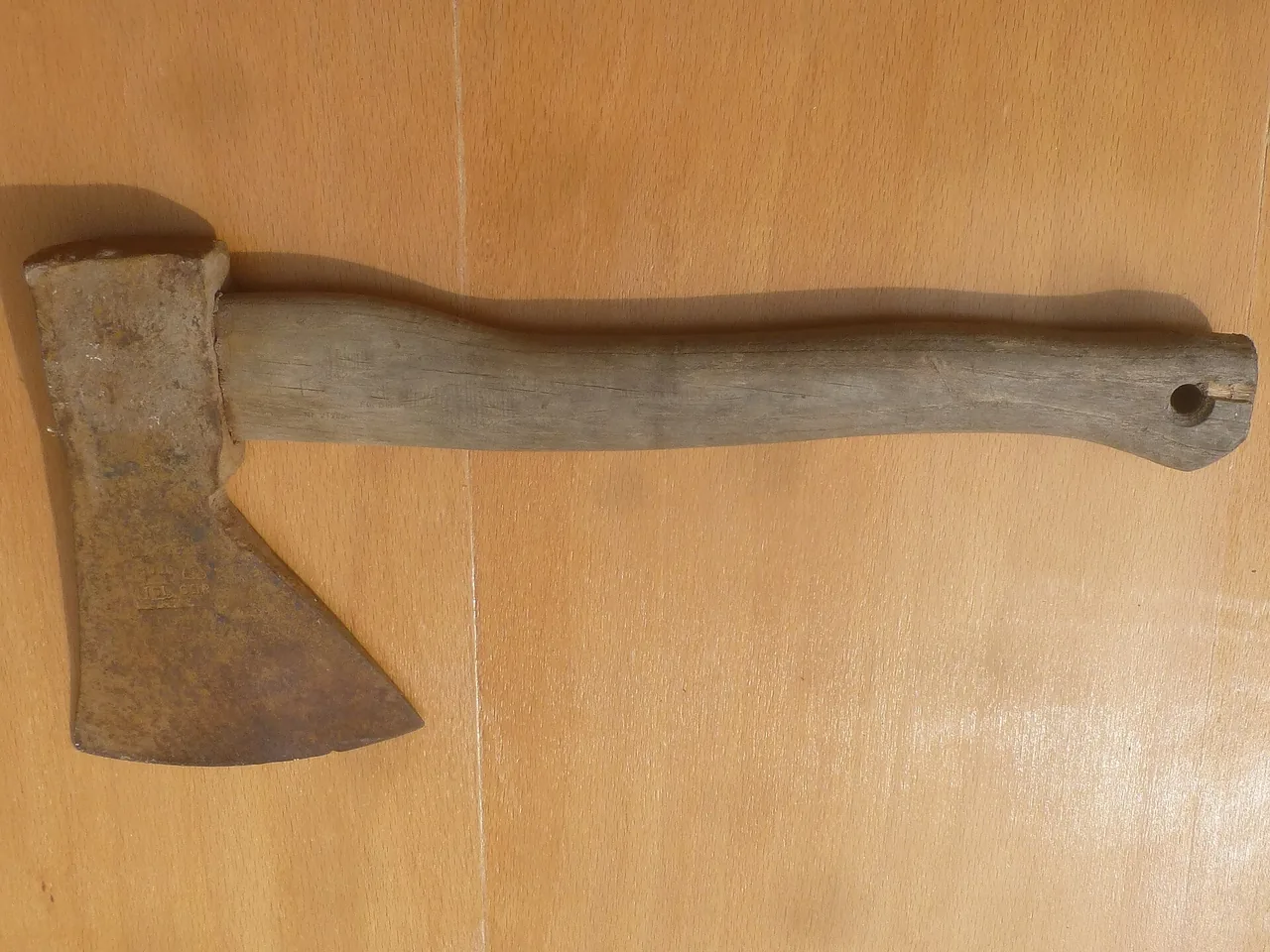
An axe (also spelled ax) is a hand tool that cuts with a blade set in line with the handle: the user swings the head so that its edge enters the wood. It fells, limbs and bucks timber, splits rounds, hews and dresses beams, and in firefighting and demolition breaks through doors and partitions. The head carries a bit with a sharpened edge between a toe and a heel, cheeks that thicken back from the bit, a poll at the rear and an eye that takes the handle. The handle, or haft, is traditionally of hickory, ash or another springy hardwood and is now also made of glass fiber in resin. Among hand tools the axe is the oldest woodworking tool still in daily use; the forms bought today are hatchets and fire axes, felling and splitting axes, mauls, and the carpenter's and shipwright's axes.
This page is written for the person who has to choose, specify, inspect or look after axes: a trail crew leader, a forester buying felling and splitting tools, a works manager issuing hatchets to carpenters, a fire officer replacing fire axes, or a buyer ordering heads and handles in quantity. It treats head and handle as one engineering assembly: a hard edge on a tough body, fixed to a springy lever. The figures come from United States Forest Service manuals on axes and trail tools, the process pages of two European forges, United States occupational rules and the German standards for steel axes. Figures that depend on the maker are given as typical ranges.
The buying decision for an axe concentrates in five places. First the form for the job, because a felling axe, a splitting maul and a hatchet differ in head weight, blade angle and handle length. Second the steel and its heat treatment, which decide whether the edge stays sharp or chips. Third the handle: its wood, its grain and how the head is hung on it. Fourth the finish of the edge as delivered. Fifth the care the tool will get, since a dull or loose axe is the one that injures.
Chapter 1 / 06
What an Axe Is and How It Works
An axe works as a wedge swung on a lever. The head is a wedge, so the force of the blow is concentrated on a line a fraction of a millimeter wide; the handle is a lever that brings the head up to speed along an arc. The blow must do three things: sever the wood fibers, displace the chip and release from the wood. Only the first is done by the edge itself. The cheeks, the sloping faces behind the edge, pry the cut open and push the chip out, and their shape decides whether the head binds or comes free. A cutting axe has a shallow wedge angle and a splitting axe a deeper one.
The parts of the head and handle have fixed names. The bit is the blade; its edge runs from the toe at the top to the heel at the bottom in a slight curve, and the bevel is the ground face at the edge. The cheeks are the sides of the head; a lip or lug around the eye adds wood to metal contact where the handle enters. The poll is the flat back of a single bit head, a counterweight for the bit. The eye is tapered, larger at the top, so that a wedge locks the handle in place. The shoulder of the handle seats against the eye, and the knob or swell at the end stops the hand slipping off.
Edge geometry is where axe design is most exact. The Forest Service manual gives a bevel of about 18 degrees for the clear wood side of a double bit axe and up to 28 degrees for the side used through knots; a racing axe may be sharpened to 14 degrees. Its figure shows the bevel as 17 to 21 degrees and adds a microbevel of 25 to 32 degrees at the very edge, a band about 1.6 mm (1/16 inch) wide that strengthens the edge against chipping. Both angles are taken from the plane of the head to one bevel face. Behind the bevel the cheeks are ground to a convex profile with a chisel grind.
In use the edge should meet the log at about 45 degrees. At that angle the head cuts in rather than glancing, and a properly ground head can strike shallower and still penetrate, because its cheeks thin out gradually toward the edge. A head that is too thick behind the edge needs a steeper angle and wastes force; one ground too thin enters deeply but cannot lift the chip and may roll or break. A flat profile enters deeper than a convex one but has less splitting power and grips harder on withdrawal. Knots defeat every profile, and a blow through a knot, into frozen wood or into the ground is the usual way an edge chips.
An axe head is a composite of two zones in the same steel. The bit is hardened so that it holds its edge; the cheeks, the eye and the poll are left softer so that they absorb the shock of the blow instead of cracking. Traditional heads were iron with a steel bit welded in. A modern head is one piece of carbon steel or alloy steel: hand forged at a drop hammer on open dies, stamped out fully formed by the industrial drop hammers the 1999 manual describes, or machined on machine tools, with the edge hardened afterwards. One German forge states that its edges reach 53 to 56 HRC (Rockwell C) within 30 mm (1.2 inch) of the edge and that the eye is left unhardened to prevent cracks.
The handle is chosen for its material as much as for its length. In North America hickory is preferred: a dense, straight grained hardwood that combines stiffness with resilience. Ash and oak are accepted alternatives, and softwoods such as pine are rejected. The growth rings must run parallel to the wedge slot, so that the grain runs the full length of the handle and parallel to the plane of the head; a handle whose grain runs across the head is the one that breaks, and runout and knots are weak points. A handle of glass fiber in resin is all but unbreakable, but it passes more vibration to the hands and cannot be reshaped.
Chapter 2 / 06
Axe Types and Structural Variants
Single bit felling axes carry one blade opposite a flat poll. Head patterns were once numbered in hundreds and named for regions; Jersey, Michigan, Dayton and Kentucky patterns were popular, and the Forest Service trail handbook lists Rockaway, Hudson Bay, Connecticut, Yankee and Puget Sound forms. The 1999 manual records that a full size American head weighed 3 to 6 pounds (1.4 to 2.7 kg) on a 30 to 36 inch (76 to 91 cm) handle; the trail handbook, updated in 2012, gives modern handles of 32 to 36 inches (81 to 91 cm) and heads of 2 to 4 pounds (0.9 to 1.8 kg). The single bit axe is the type used when safety is paramount.
A double bit axe has two blades set back to back and no poll. It is symmetrical about the handle, and it carries two edges in one head: the trail handbook keeps one razor sharp for clear wood and the other somewhat duller for chopping around rocks and dirt. So that either blade can be brought to the wood, double bit axes take straight handles only. The head is used for nothing but cutting: driving a stake with the flat side of it is almost sure to crack the eye. The long, narrow Puget Sound pattern is for felling large trees, with a 4 pound (1.8 kg) head on a 42 inch (107 cm) handle.
Splitting axes and mauls are made to run with the grain, not across it. Their blade has a much steeper angle than that of a felling axe, so the head acts as a wedge that opens the round along its rays instead of biting out chips. Weight matters more than keenness: the Forest Service manual cites a 5.75 pound (2.6 kg) single bit head on a 44 inch (112 cm) straight handle as a good splitting axe. A splitting axe takes the hardest blows an axe receives, and one forge fits its splitting axes with a steel wedge in the handle as well as a wooden one. No axe poll is made for striking steel.
Hewing and carpentry call for heads that shape rather than chop. A broad axe, or broad hatchet, is beveled on one side only, like a chisel, so that the flat cheek can run along the face of the timber and leave it true. It works with the grain, and because the beveled side suits one hand, patterns were made in left handed and right handed forms, while later American broad axes let the head be reversed on the handle. A carpenter's axe sits between a hatchet and a broad axe: small, with a beard below the edge and a finger notch for a close grip, and with a poll that serves as a hammer. Shipwright's mast broad axes and mortising axes are close relatives.
Hatchets and fire axes are the one hand and emergency branch of the family. A hatchet has a short head and a short handle; the Forest Service trail handbook gives weights from 1 to 3 pounds (0.45 to 1.4 kg) and handles from 10 to 16 inches (25 to 41 cm), and some are forged in one piece with a steel handle. Gripped in one hand, with little to stop a glancing blow, a hatchet carries hazards of its own and is not made for pounding. A fire axe breaks down doors to enter burning buildings; in demolition the same single bit form breaks through partitions and paneling. A Pulaski pairs an axe bit with a grubbing hoe blade.
The axe is bounded by its siblings. The adze is the nearest: its blade is set at right angles to the handle, like a hoe, and it dresses a hewn surface instead of cutting across it; an axe often scores the timber that an adze then finishes. A hammer is not covered here: its head strikes and is not meant to cut. For timber work by machine, a circular saw fells and crosscuts faster than any axe, and a demolition hammer breaks masonry where a fire axe would only dent it; an angle grinder belongs at the sharpening bench, where its speed can ruin a hardened edge.
Chapter 3 / 06
Key Specification Parameters and Standards
A buyer states an axe by its head weight, handle length, steel and hardness, handle material, and the fixings that hold head and handle together. Head weight is the first figure on any pattern, and it is often stamped on the cheek: a United States head stamped with a 3 and a small 2 weighs 3.5 pounds (1.6 kg), and the same table reads 3.25 and 3.75 pounds (1.5 and 1.7 kg) for the stamps with a small 1 and a small 3. Heads made for metric markets are stamped in kilograms, as 2.1 kg (4.6 lb). The table gives Forest Service ranges and, where stated, the figures of one forge.
The steel and its heat treatment set the quality of the edge. Heads are made of carbon steel with enough carbon to harden, in one case a recycled alloy steel, in another a grade the maker calls C50. Two forge pages describe the same sequence: steel is heated to about 1200 degrees Celsius (2192 degrees Fahrenheit) and forged; the bit is heated to about 820 degrees Celsius (1508 degrees Fahrenheit) and cooled quickly in water or oil; the head is then tempered in an oven, a heat treatment furnace, one forge reheating to 180 to 200 degrees Celsius (356 to 392 degrees Fahrenheit), the other holding at 195 degrees Celsius (383 degrees Fahrenheit) for 60 minutes, to relieve the stresses of quenching. Hardness depends chiefly on carbon content and tempering temperature.
Standards enter in three places. The product standards for the tool are national ones. DIN 7294 fixes the dimensions, weights and material properties of axes. DIN 7287 is the technical delivery conditions for steel axes and hatchets for working wood, splitting axes included: it sorts the tools into two quality classes, requires a suitable steel for the head and suitable handle materials, plastic handles among them, sets a minimum pull out force for the handle by weight class, fixes the position of the eye, prescribes marking with warnings against striking hardened steel or other axes, and standardizes tests for hardness, cutting and use. Wooden handles lie outside it. Hardness is measured by the Rockwell method of ASTM E18, a test method, not a product requirement. The third place is the rules for safe use at work, covered in Chapter 6.
Parameter
Typical value or range
What it decides
Head weight, general felling axe
1.4 to 1.6 kg (3 to 3.5 lb)
Working weight for general chopping
Head weight, heavy chopping pattern
2.0 to 2.5 kg (4.5 to 5.5 lb)
Deeper penetration in large logs
Head weight, hatchet
0.45 to 1.4 kg (1 to 3 lb)
One hand control and carry weight
Splitting axe
2.6 kg (5.75 lb) head; 112 cm (44 in) straight handle
Momentum for opening rounds along the grain
Handle length, felling axe
81 to 91 cm (32 to 36 in)
Swing radius and head speed
Handle length, hatchet
25 to 41 cm (10 to 16 in)
One hand reach; control of a glancing blow
Edge hardness, one forge
53 to 56 HRC within 30 mm (1.2 in) of the edge
Edge holding against chipping
Bevel angle, clear wood
About 18 degrees (17 to 21 degrees)
Penetration and ease of sharpening
Microbevel angle
About 25 degrees (25 to 32 degrees)
Strength at the very edge
Blunter edge for knots and dirt
Up to 28 degrees
Survival of the edge in knots
Chapter 4 / 06
Axe Selection and Working Calculations
Selection matches the mass and length of the tool to the user and to the wood in front of it. The geometry of each cut is then set so that the head lands where it was aimed and leaves the wood cleanly.
Head weight and handle length are the two choices that decide control. The Forest Service manual advises a working head of 3 to 3.5 pounds (1.4 to 1.6 kg) as a starting point, with a handle that reaches from the ground to the user's hip. A 2.25 pound (1.0 kg) head on a 26 inch (66 cm) handle makes a light camp axe for small firewood and limbing. Heavy chopping patterns from Australia and New Zealand run 4.5 to 5.5 pounds (2.0 to 2.5 kg) on 28 to 30 inch (71 to 76 cm) handles: more mass to drive deep, a shorter lever for accuracy.
The working calculation behind that advice is kinetic energy. The energy that reaches the wood is one half of the mass of the head times the square of its speed at impact. Energy therefore rises with the square of the speed and only in proportion to the mass: a longer handle lengthens the swing arc and raises the speed of the head, which gains more energy than the same proportional increase in head weight would bring. Length stops paying when the user can no longer control the head. The manual notes that moving a felling head from a 42 inch (107 cm) to a 44 inch (112 cm) handle, a difference of 2 inches (50 mm), made a significant difference to the accuracy of the swing.
The geometry of a chopping cut is simple. The head should strike at about 45 degrees to the surface of the log, and the stroke should come in at 45 to 50 degrees from the edge of the log rather than straight on. Strokes alternate forehand and backhand, top, bottom, then middle, so that each chip flies out instead of packing the notch. A notch chopped from one side only must be opened to twice the diameter of the log, or its sides converge before the center is reached; where cuts are made from both sides, each needs only the width of the diameter. One corner of the edge stays free of the wood so that a twist levers the chip out.
Felling with an axe alone follows a fixed arithmetic. A front notch is cut in the planned direction of fall to a depth of one third to one half of the tree's diameter. The back notch is cut on the opposite side at least 2 inches (50 mm) higher and stops about 2 inches (50 mm) short of the front notch's point, leaving a hinge of wood that steers the tree. First the user swings the handle in a full circle at arm's length to confirm that nothing obstructs the arc, clears an escape path at about 45 degrees away from the planned fall, and stands with both feet planted shoulder width apart, in stout safety shoes at least 200 mm (8 inches) high, where the outstretched axe just touches the cut.
Splitting and hewing use the grain instead of fighting it. Rounds are cut to stove lengths of 12 to 24 inches (30 to 60 cm) and stood on end on a block; the first blow is aimed at an existing check, and a slight twist of the handle as the bit lands throws the halves apart. Hewing reverses the order: the timber is scored with a single bit axe in strokes across the grain, 3 to 4 inches (7.5 to 10 cm) apart, down to a snapped line, and the broad axe then slices along the grain to the line. Hewing is done on green timber, and an adze gives the final dressing where a smoother face is wanted.
Job or condition
What to specify
Why
General felling, limbing and trail work
1.4 to 1.6 kg (3 to 3.5 lb) head; 81 to 91 cm (32 to 36 in) handle
Mass for daily work without early fatigue
Large or hard timber, experienced user
2.0 to 2.5 kg (4.5 to 5.5 lb) head; 71 to 76 cm (28 to 30 in) handle
Deeper penetration; a shorter lever for accuracy
Knots, roots, frozen wood
Blunt edge up to 28 degrees; warm the head in cold
A keen edge chips in hard or frozen wood
Splitting firewood
2.6 kg (5.75 lb) head; 112 cm (44 in) straight handle; secure wedge
Momentum and a head that stays fixed
Hewing beams; carpentry
Broad axe with a one sided bevel; carpenter's axe for close work
A flat cheek guides the cut along the line
One hand work; carried on a belt
Hatchet of 0.45 to 1.4 kg (1 to 3 lb); 25 to 41 cm (10 to 16 in) handle
Light enough to control a glancing blow
Learner or occasional user
A light head; add mass in half pound (225 g) steps
Accuracy comes before power
Chapter 5 / 06
Axe Hanging, Maintenance and Failure Modes
An axe is kept safe by three habits: it is stored sheathed, its edge is dressed by hand, and its head is inspected and kept tight. Fitting a new handle is short work for anyone with a bench and a few hand tools.
Storage and carrying come first. An axe is sheathed or boxed whenever it is moved, carried at its balance point near the head with the edge pointing down and away from the body, and never carried on a shoulder. For short periods on site a single bit axe may be stuck in a log or stump with its edge hidden; it is never laid in the open or leaned against a wall. Before each shift the handle is checked for soundness, tight fit and splinters, the poll for mushrooming and the edge for sharpness and shape, as the United States logging rule requires. After use the head is wiped with light machine oil and beeswax against rust.
Sharpening starts with a mill bastard file. The axe is clamped to a bench and the file is pushed toward the center of the head, never drawn from behind toward the edge, which rolls the edge over. The file cuts on the push stroke only and is lifted on the return; it is cleaned with a file card when it loads. Wood is removed in a fan shape, farthest back at the middle of the edge and tapering toward the toe and heel, which are left a little thicker because they are unsupported. The file carries a handle and a guard, and leather safety gloves are worn throughout.
Powered tools have one permitted role. The newer manual allows a belt sander with abrasive belts, among other motorized sanders, to remove metal from the cheeks when a head is reprofiled, but never at the edge; the older one allows only a slow pedal grindstone kept wet. A high speed dry grinder softens the edge for at least 4.8 mm (3/16 inch) back, visible as a blue or purple tint. The edge is honed by hand with a round ax stone of silicon carbide, coarse side then fine, with water or oil, until a burr forms and is worked off. A leather strop, used at 35 to 40 degrees, removes the last wire edge; a honed edge reflects no light.
Rehanging an axe, known as hanging, is the one repair worth learning. The old handle is cut off just below the eye, the wedge and part of the handle are drilled out from the top, and the remainder is driven out the same way, because the eye is larger at the top. The new handle is tried in the eye, rasped a little at a time, and driven home by striking the knob, so that its shoulder seats against the bottom of the eye. A head is well hung when its edge lies in an exact line with the end of the handle and, laid on a flat surface, touches it one third of the way along from the heel.
Cut a saw kerf down the center of the handle for about two thirds of the depth of the eye.
Drive a wooden wedge of seasoned hardwood until only 6 to 13 mm (1/4 to 1/2 inch) stands proud, and trim it flush.
Keep the wooden wedge as the only fixing: metal wedges split the grain, though one forge adds a steel wedge to its splitting axes.
Strip any varnish or paint, leave the lower 150 mm (6 inches) of the butt rough for grip, and oil the handle.
The failure modes of an axe follow from its two zone construction and from misuse. An edge rolls when the steel is soft or has been filed back past the hardened zone into the soft cheeks; it chips when it is too hard, or when it meets a knot, the ground or frozen wood, or a cold head. A poll used to drive steel wedges mushrooms, and the same blows bulge the eye. A head that breaks across or under the eye with an unbattered poll is probably defective; the same break behind a battered poll is the user's doing. A handle fails by loosening as the wood dries, by splitting along cross grain or at a knot.
Symptom
Cause
Action
Edge folds or rolls in use
Steel too soft, or edge filed into the unhardened cheek
Reprofile the head; retire it if the hard zone is spent
Chips out of the edge
Hard steel meeting knots, gravel or frozen wood; cold head
File out shallow chips; retire a deeply chipped head
Blue or purple tint at the edge
Overheating while grinding
Stop at once; remove metal back to tempered steel; use a wet stone or hand tools
Mushroomed poll; bulging eye
Poll used as a hammer on steel wedges
Grind the poll back if enough metal remains; check the eye for cracks
Cracks in or around the eye
Impact abuse of the head
Discard the head; it could break apart in use
Loose head on the handle
Dried or shrunken wood; failed wedge
Rewedge or rehang; soaking in oil is a temporary tightening only
Cracked or broken handle
Cross grain, runout, knots; paint hiding defects
Replace with straight grained hickory, rings parallel to the wedge slot
Chapter 6 / 06
Axe Applications and Procurement Checks
Axes are bought today by four kinds of user. Forest and trail services issue them for designated wilderness areas, where mechanized or motorized equipment is prohibited by law, for clearing trails, cutting firewood and managing fires; the 1999 manual records that chain saws had by the early 1960s taken over almost all felling, bucking and limbing. Fire and rescue services issue fire axes to break down doors and enter burning buildings. Builders, carpenters and shipwrights keep hatchets and carpenter's axes for work faster by hand than by setting up a machine, and restorers of timber buildings still use broad axes. A Swedish forge observed in 1997 that most axes were then used in small scale work by homeowners, firewood cutters and campers.
Two United States occupational rules govern the axe at work, and neither is a product standard. In logging, 29 CFR 1910.266 requires every hand tool to be kept serviceable and inspected before first use in each shift: handles sound, tight fitting, properly shaped and free of splinters, heads free of mushrooming, edges sharp and properly shaped. Tools are used only for their designed purpose, a chipped head is repaired or removed from service, and dull edges are sharpened to the maker's specification during the shift. The same rule requires a safety helmet where objects may fall, safety glasses or a face shield where eyes or face are at risk, stout footwear, and a first aid kit where trees are cut. On construction sites, 29 CFR 1926.301 forbids unsafe hand tools and loose or cracked wooden handles.
The checks on delivery follow from the way an axe is made. Read the stamp: weight in pounds or kilograms, the maker's mark, and on hand forged heads the initials of the smith. The eye should be symmetrical, with no bulge at the sides. Lay the axe on a flat surface to test the hang, and sight along the handle, which should run straight from knob to eye. On the end grain the growth rings should run parallel to the wedge slot; reject cross grain, runout, knots, twist and painted or stained handles. Verify hardness on a sample head with a Rockwell hardness tester, or a portable hardness analyzer for a quick check; examine hardened heads for hairline cracks with a dye penetrant kit or a magnetic particle tester, and an ultrasonic flaw detector for flaws inside a forging.
An order for axes should state what the maker is to deliver. Name the form: felling, splitting, carpenter's, hatchet or fire axe. State the head weight, the overall handle length, the steel and the edge hardness with its depth from the edge, the bevel angle, and whether the bit is to arrive honed. State the handle: hickory or ash, straight grain with rings parallel to the wedge slot, no knots or runout, oiled rather than painted, curved or straight. State the fixing: a wooden wedge of full width, and the pull out force required of the finished tool. Ask for the heat number and steel certificate, with composition and tensile results from a tensile testing machine, the heat treatment record and the hardness report. Ask which standards the head is made to, what is stamped on it, and whether a sheath or edge guard is supplied. Finally ask how heads and handles are packed, with every edge guarded.
FAQ
How does an axe cut wood?
An axe is a wedge swung on a lever. The thin edge concentrates the force of the blow onto a line and severs wood fibers; the cheeks behind the edge then pry the cut apart and push out a chip, which lets the head release. A felling axe has a shallow wedge angle so that it penetrates, a splitting axe a steeper one so that it opens the wood along the grain. The blow should land at about 45 degrees to the surface of the log. In a modern head only the bit is hardened; the softer cheeks, eye and poll absorb the shock.
What are the main types of axe?
The single bit felling axe, with one blade and a flat poll, is the general tool for felling and limbing. The double bit axe has two blades on a straight handle, one kept keen and one blunt for dirt and knots. Splitting axes and mauls have heavy heads and steep blade angles for opening rounds along the grain. Broad axes, beveled on one side, and carpenter's axes shape timber. Hatchets are one hand tools of 1 to 3 pounds (0.45 to 1.4 kg). Fire axes break down doors to enter burning buildings, and a Pulaski pairs an axe bit with a grubbing hoe blade.
Which specifications matter most when buying an axe?
State head weight, handle length, steel, edge hardness, bevel angle and handle material. Head weight decides the force of each blow and runs from under a kilogram for a hatchet to about 2.6 kg (5.75 lb) for a splitting axe; handles run from 25 to 41 cm (10 to 16 in) for a hatchet to about 112 cm (44 in) for splitting. An edge hardness of 53 to 56 HRC within about 30 mm (1.2 in) of the edge is the figure one German forge publishes. Add the fixing of the handle, the finish required and whether a sheath is supplied.
How should head weight and handle length be chosen?
Match the tool to the user and to the wood. A head of 3 to 3.5 pounds (1.4 to 1.6 kg) on a handle that reaches from the ground to the hip is a sound starting point for an adult in general work; skill is built on a light axe, and mass is added in half pound (225 g) steps. For large or hard timber, experienced users take heads of 4.5 to 5.5 pounds (2.0 to 2.5 kg) on shorter handles of 28 to 30 inches (71 to 76 cm). For splitting, weight matters more than keenness, so a heavy head on a long straight handle is chosen.
How should an axe be sharpened and maintained?
Clamp the head and use a mill bastard file, pushing toward the center of the head and lifting on the return stroke, until a burr forms on the far side; leave the toe and heel a little thicker. Hone with a round stone, coarse side then fine, with water or oil, and finish on a leather strop. Keep high speed dry grinders away from the edge, because a blue or purple tint means that the steel has been softened. After use, oil the steel and the wooden handle. Store the axe sheathed in a dry place, rewedge it at once if the head loosens, and check the handle for cracks.
What drives the cost and lead time of an axe?
Cost follows the steel, the forging and the amount of hand work. A head stamped out under a drop hammer needs little labor; a head forged by a smith on open dies takes time at the hammer. Steel of known composition, with a controlled hardening and tempering and a hardness test on every head, costs more than stock that is not verified. Handles are graded too: clear, straight grained hickory, air dried over many months, is scarcer and dearer than stained lower grades. Lead time depends on forge capacity, on the drying of handle stock and on marking, sheaths and inspection.
What safety rules and standards apply to axes?
Clear the swing zone of branches and brush, make sure of the footing, and keep other people out of reach of the swing. Wear stout boots, safety glasses and, where objects may fall, a hard hat; wear gloves for splitting and always for sharpening. Sheath the axe whenever it is carried and never carry it on a shoulder. Never strike the ground, steel wedges or another axe: the poll is a counterweight, not a hammer face. In the United States, 29 CFR 1910.266 requires serviceable tools, sharp edges and sound handles at each shift inspection in logging, and 29 CFR 1926.301 covers hand tools on construction sites. In Germany, DIN 7294 and DIN 7287 apply.