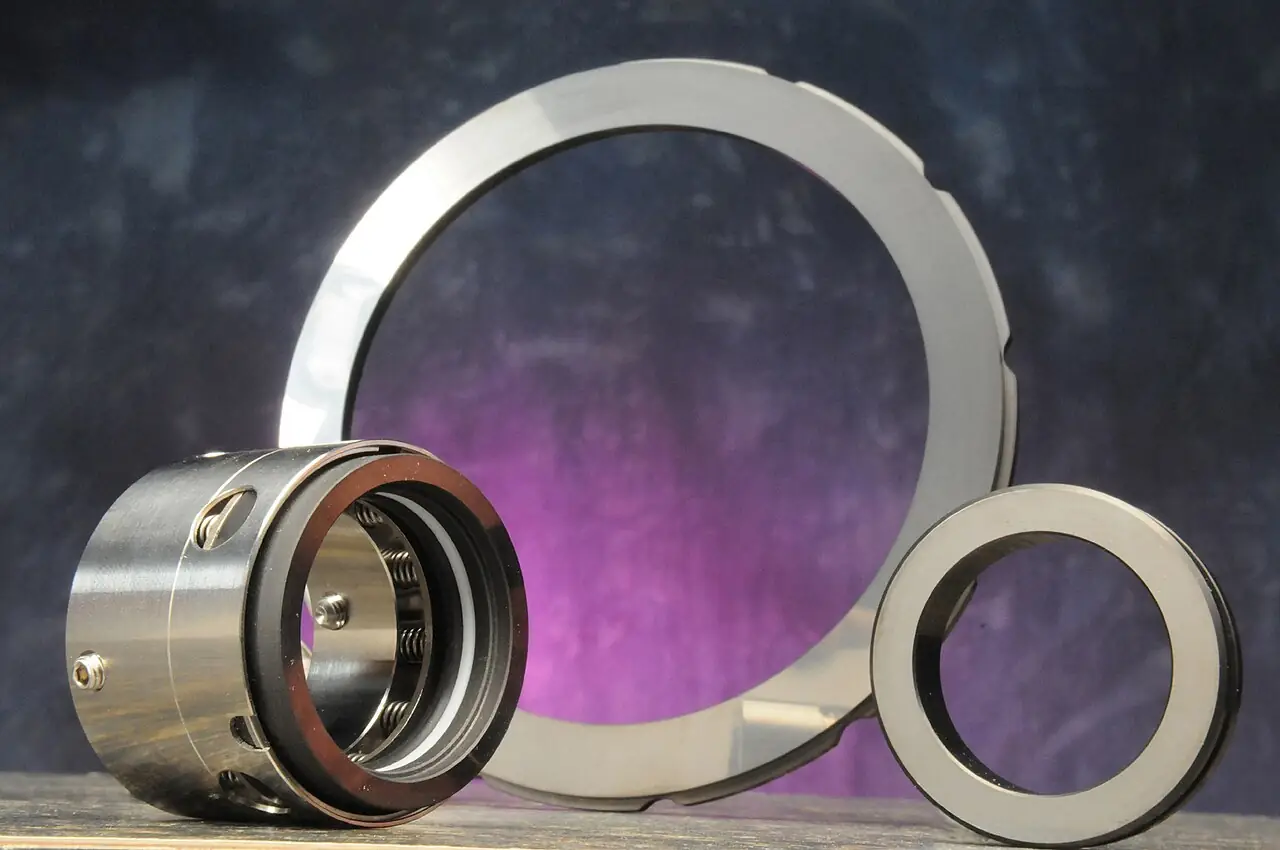
A rotary union, also called a rotary joint or rotating union, is a precision coupling that transfers fluid from a stationary supply line into a continuously rotating machine element, a dryer roll, calender, cooling drum, or machine tool spindle, and returns it where the circuit is closed, while containing the fluid across the rotating interface with a seal that must survive speed, pressure, temperature, and thousands of hours of rotation. The stationary half bolts or threads to the supply piping and carries the seal and bearings; the rotating half mounts to the shaft end or journals inside it; and the media cross the interface, steam, hot oil, water, coolant, air, or hydraulic fluid, monoflow in and out through separate unions or duoflow through one coaxial body. Operating envelopes run from coolant at 10 bar and 3,000 to 20,000 rpm on machining spindles to saturated steam at 16 bar and 350 deg C on paper dryer cans turning a few hundred rpm, with each envelope owned by a specific seal and bearing architecture.
Procurement engineers meet these couplings wherever rotation and fluid must coexist: paper and textile machine dryer sections feeding steam into Yankee and dryer cans and draining condensate out, plastics and rubber calenders and chill rolls on thermal oil and water, machine tool spindles through-spindle coolant, and rotary indexers and clutches on air and hydraulics. The decision this page settles is what the coupling must guarantee on paper: the seal technology and face materials against the media and speed, the passage count and flow geometry, the mounting fit to the shaft or roll journal, and the service model, whether seals are replaced on the machine or the whole unit returns for overhaul. The answer lands as an RFQ line set covering media, pressure, temperature, speed, passages, mounting, seal materials, and duty cycle, and every chapter below feeds that line set so the coupling is bought as an engineered component rather than guessed as a plumbing part.
This page treats the rotary union as a purchasing object: how the seal architecture survives rotation at speed and temperature, what monoflow and duoflow passage geometry mean for flow and installation, how bearings and balance decide envelope, and how media, speed, mounting, and serviceability combine into a defensible RFQ. It is written for engineers who issue purchase specifications, not for readers who want a brochure summary.
Chapter 1 / 06
What a Rotary Union Is and What Is Being Decided
The problem being solved is fundamental: a pipe cannot rotate with a shaft, and a shaft cannot stay dry when the process inside it needs fluid. Paper dries because steam heats the inside of a rotating can; rolls cool and heat because oil or water circulates through journals; spindles machine with coolant delivered through their own bore; and each of these machines needs a stationary supply coupled to a rotating consumer thousands of times per minute, day after day. A rotary union is the component built for exactly that interface: it is a short cylindrical assembly whose halves rotate relative to each other, joined by bearings that hold the geometry true and a seal that contains the media, with ports on the stationary side for supply and return and a journal fit or flange on the rotating side for the machine.
What is actually being decided in this purchase is four guarantees. First, containment: the seal must hold the media at pressure and temperature for a stated service life, thousands of hours, in the actual rotation and duty cycle, and the honest datasheet states the life as an expectation band against service, not as a warranty. Second, mechanical survival: the bearings that position the rotating half must carry the belt, gear, or roll loads that reach them and hold the seal faces in their designed alignment at speed; an under-bearinged union eats its own seal. Third, flow compatibility: the passage sizes and geometry must carry the required flow at the available pressure drop, and duoflow bodies must separate supply and return cleanly so the circuit does not shortcut. Fourth, serviceability: seals are consumables, and whether they are replaced on the machine in minutes or the unit is swapped out and overhauled is a maintenance model decision that belongs in the purchase, priced, not discovered.
Against its neighbors the rotary union occupies deliberate ground. A mechanical seal seals a rotating shaft where it enters a pump or mixer casing, stationary housing, rotating shaft, media inside: the same face-contact physics, a different product boundary, since the union is both the seal and the bearing housing and the coupling in one purchased body. An expansion joint or a flexible metal hose absorbs pipe movement between stationary points and never rotates continuously; a swivel joint on a loading arm articulates through partial arcs, not continuous rotation at speed, and is a neighbor to reference, not a substitute. Standard pipe fitting hardware, a camlock fitting, a grooved coupling, a flange, or a tube fitting, makes stationary connections; none of it rotates. The rotary union takes the narrow territory of continuous rotation with contained media, and it is bought from the few manufacturers who specialize in it because the duty sits beyond general plumbing catalogs.
Standards context is machinery practice rather than a component code. The union is a machine element purchased to the machine builder's specification, paper machine standards for dryer joints, machine tool builder standards for spindle coolant, and the manufacturer's own engineering data defining the envelope per model; pressure-containing parts within the body follow general pressure equipment practice where the jurisdiction reaches them, and materials certificates EN 10204 3.1 are routine on demand. Steam service pulls in the boiler house context, the supply station with its pressure reducing valve, the condensate side with its steam trap and steam separator, but the union itself is specified on media state and envelope, not stamped like a vessel. A datasheet that quotes no envelope, no seal materials, and no life expectation is a price tag, not a specification.
The RFQ should also name the station so the package checks out as a system. The supply side arrives through plant piping with its isolation ball valve and a pressure gauge near the union; steam stations include the reducing valve and, on the condensate return, the trap, sized with the union flow in the loop. The rotating side mounts by journal fit with a draw bolt, by flange, or thread, and the machine drawing fixes the fit, the length, and the interference with guards. Instrumentation where the duty is critical includes a temperature transmitter on the bearing housing of larger unions, the earliest warning of seal distress, a pressure transmitter or pressure gauge on the supply near the union to confirm the envelope the seal actually sees, and monitoring of the exhaust or drain, since visible media at the vent is the seal's confession. VFD driven machines note the speed range, because unions on variable speed rolls see the whole envelope, not one point. Stating the whole station in the RFQ lets one supplier check media state, mounting fit, and cycle in a single pass.
Chapter 2 / 06
How the Seal Contains Media Across Rotation
Three seal architectures divide the field. The mechanical face seal, the industrial standard for steam, hot oil, and high pressure, uses two lapped faces, one rotating with the shaft, one stationary in the housing, pressed together by springs and the media pressure, with the interface lubricated by a controlled film of the media itself or an external fluid; carbon against silicon carbide or tungsten carbide is the common pairing, and the faces run in a state of controlled near-contact that seals while wearing microns per thousand hours. The elastomeric lip or O-ring seal, the economy architecture for coolant, water, and air at moderate conditions, lets compliant rubber tracks ride the rotating surface, sealing by interference; it tolerates less temperature and speed but costs a fraction and suits the machine tool coolant population. The hydrostatic or clearance seal, used on high speed air and special services, holds a deliberately small clearance fed by the media pressure so no solid contact occurs at all; it consumes a small continuous leakage by design and demands clean, filtered media.
The face seal deserves the deeper look because it owns the hardest duties. Its two lapped rings are flat to light bands, and its secondary sealing, O-rings or bellows, flex to absorb every axial chase the bearings and thermal growth impose; spring compression sets the face load at assembly, and media pressure behind the faces adds hydrostatic and hydrostatic balancing so the load does not climb away with pressure. Balanced designs reduce the pressure closing force by area step, the same balance ratio logic as pump mechanical seals, and the ratio choice, along with face width and materials, is the manufacturer's envelope engineering: push a given model above its pressure temperature product and the film flashes or the faces touch dry, and wear goes from microns per thousand hours to millimeters per shift. Steam service compounds everything with heat: the faces must survive saturated steam to 16 bar family and the housing must tolerate thermal growth, and the best steam unions are those whose envelope was earned on paper machines, not adapted from water duty.
Passage geometry separates monoflow from duoflow and decides the station layout. A monoflow union carries one media stream, in or out, and a closed circuit uses two of them, one as the supply joint at the roll inlet end and one as the return or siphon joint at the outlet end, which is the classic paper dryer arrangement with a stationary siphon inside the can. A duoflow union carries both streams in one body, supply through an inner tube to the far end of the roll and return through the annulus, coaxial, with the seal package isolating the two: one mounting on the machine, double the sealing complexity, and the standard solution where the machine builder wants a single journal interface. The flow arithmetic matters on both: passage diameter sets pressure drop at the required flow, the annulus of a duoflow usually governs, and an undersized union starves the process the same way an undersized pipe does, while the return side of a steam duoflow or siphon system must pass condensate and flash steam together, a two-phase sizing problem the supplier owns when the condensate load is stated.
Bearings and balance hold the envelope together. Ball bearings position the rotating half in most industrial unions, sized for the radial loads that arrive from belt drives, roll weight, or piping strain, and for the speed; high speed spindle coolant unions ride precision angular contact pairs or, at the top of the range, hydrostatic or air bearings, because bearing heat and stiffness, not the seal, become the limit. Some lightweight designs are bearingless, letting the machine's own journal carry the rotating half and asking only the seal to follow, a construction that works where the host geometry is accurate and the loads small. Speed enters every row of the datasheet as rpm or peripheral speed at the seal diameter, and the pressure temperature speed envelope is the union's identity: a coolant union at 20,000 rpm and 10 bar, a steam joint at 300 rpm and 16 bar saturated, and a thermal oil joint at 350 deg C and 10 bar are three different products that happen to share a name.
A worked example fixes the arithmetic. A calender roll heated with thermal oil at 12 bar and 320 deg C, rotating at 60 rpm, needs 60 liters per minute through the roll and returns it at the far journal: a duoflow union with an inner supply tube and an annulus sized for 60 lpm at a modest pressure drop, face seals of carbon against silicon carbide, an elastomer package of fluoroelastomer or, at the top of the temperature band, metal bellows secondary sealing, and bearings rated for the journal loads with lubrication at temperature. The same roll on saturated steam at 13 bar instead becomes a two-union monoflow station with a siphon, because condensate removal inside a rotating envelope is its own discipline. Both are legitimate rotary union purchases; specifying one while running the other is how seal lives are halved before the first shift.
Chapter 3 / 06
Types, Construction, and Duty Boundaries
Catalogs organize by service first and passage count second. Steam joints for paper, textile, and corrugating dryer duty are their own class, monoflow with stationary siphons and duoflow variants, built for saturated and occasionally superheated steam to 16 bar and 350 deg C family, with carbon or graphite faces, hardened seats, and robust bearing cartridges. Hot oil and thermal fluid unions serve calenders, presses, and reactors, with high temperature elastomers or metal bellows and heat-tolerant bearings. Water and coolant unions serve chill rolls, machine spindles, and robotics, spanning economy lip-sealed bodies to high speed balanced mechanical designs for through-spindle coolant at 20,000 rpm family. Air and pneumatic unions serve clutches, brakes, indexers, and rotary tables, often small, high speed, and frequently multi-passage where several control circuits cross one interface. Hydraulic unions on high pressure fluid couplings close the family at hundreds of bar for clamping and actuation circuits.
Within each service class, construction choices carry the warranty. Face material pairs are matched to media and lubricity: carbon graphite against silicon carbide for steam and water, tungsten carbide against carbon or against coated steel for abrasive or poor-film media, silicon against silicon where both faces must be hard; the secondary elastomers follow the chemistry, nitrile for water and oil at moderate temperature, fluoroelastomer and perfluoroelastomer up the temperature scale, and metal bellows where elastomers quit entirely. Bearing cartridges carry the loads with grease, oil, or media lubrication by design, and the housing materials range from carbon steel and cast iron through stainless for food and chemical washdown duty. Multi-passage bodies stack seals and galleries with internal porting, and each added passage is an added seal train with its own life curve, so a five-passage union is priced and maintained like the precision manifold it is.
Boundaries are worth stating bluntly. A rotary union is not a swivel joint: loading arms and hoses articulate through partial cycles, and a swivel asked to rotate continuously at speed fails quickly, just as a union asked to swing a heavy arm side-loads its bearings to death. It is not a mechanical seal for a pump: that product seals a shaft into a casing and is bought per pump standard, while the union is self-contained with its own bearings. It does not substitute for gland packing on a slow valve or mixer stem, a different sealing philosophy for different geometry; and it cannot be chosen from envelope alone: a 10 bar 200 deg C duty with abrasive coolant and a 10 bar 200 deg C duty with clean thermal oil are different seal specifications that happen to share a pressure temperature point. The duty map below pairs the common stations with the construction that survives them.
Station
Construction to specify
Construction to avoid
Paper or corrugator dryer can, saturated steam
Steam joint monoflow with siphon, robust cartridge
General purpose water union pushed into steam duty
Calender or press roll, thermal oil 300 deg C plus
Hot oil duoflow, bellows or FFKM secondary sealing
Nitrile elastomer package at top of temperature band
The table below decodes the datasheet lines that decide whether a quoted union matches the station. Each row is a purchase defining parameter; the paragraphs after the table explain what to demand and what a weak answer looks like.
Attribute
Typical range or options
What it decides
Media and temperature
Steam to 350, oil to 400, coolant, air, hydraulic family
Seal architecture and elastomer or bellows choice
Pressure
Vacuum to 16 bar steam family; hydraulic to hundreds
Face balance and body rating at temperature
Speed
A few hundred rpm dryers to 20,000 plus spindle duty
Bearing class, balance, and face sliding velocity
Passages
Monoflow single, duoflow coaxial, multi-passage stacked
Station layout, flow geometry, and seal count
Flow and passage size
Liters per minute or Nm3 per h at stated pressure drop
Ball, angular contact precision, or bearingless designs
Load capacity, speed, and alignment hold
Service model
On-machine seal kit or unit exchange and overhaul
Maintenance cost per year of operation
Life expectation
Thousands of hours stated against the service
The number the spares plan is built on
The envelope rows deserve a paragraph of their own because they are where quotations hide. Pressure, temperature, and speed trade against each other, and the honest datasheet shows the envelope as a family of curves or a derating note, not as three independent maxima; a union quoted 16 bar and 350 deg C and 1,000 rpm does not necessarily run all three at once. Demand the envelope at your combination, and where the duty is variable speed, quote the range, since the worst point may be top speed at low pressure, dry-adjacent film, not the pressure maximum. The same discipline applies to life: thousands of hours is a service statement, and the strong supplier states the band against media, speed, and duty cycle, with the conditions readable in the quotation.
The mounting and flow rows decide whether the unit fits and feeds. The machine drawing fixes the journal diameter and fit, the projection into the roll, the fastening, draw bolt, flange, or thread, and the runout the seal must tolerate; a union bought without the drawing is a fit risk the buyer owns. Passage sizing is flow arithmetic: demand the pressure drop at the required flow for every passage, supply tube and annulus in duoflow, and on steam condensate duty state the condensate load so the return side is sized two-phase. The comparison table below compresses the evidence checks into the form a specification meeting can argue from.
Evidence demanded
Strong answer
Weak answer
Envelope fit
Derating family or point confirmation at duty
Three independent maxima, no derating note
Seal materials
Face pair and elastomers named per media
Standard seal with no materials named
Life statement
Hours band against media, speed, duty
Long life with no conditions
Fit evidence
Confirmation against journal drawing revision
Union ordered without machine drawing
Flow sizing
Pressure drop at flow per passage, two-phase noted
Nominal bore as the only sizing statement
Service model
Seal kit on machine or exchange program priced
Service left to a later conversation
The service model row closes the specification. Seals are the consumable and bearings the second consumable, and the purchase should price both paths: the on-machine seal kit with its tools and expected swap time, or the exchange unit with the overhaul program behind it. Paper mills standardize on exchangeable steam joints precisely because downtime is measured in production tons; a small shop may prefer a threaded water union replaced whole every few years. The quotation that quotes the unit and leaves the maintenance model, spares, and life statement as exercises is not a complete quotation.
Chapter 5 / 06
Selection Decision Factors and RFQ Language
The decision sequence is short enough to run as a checklist in a specification meeting, and each step eliminates a class of quotations before price comparisons begin.
Fix the media state first: fluid, pressure, temperature, and for steam the dryness and for condensate the load, because the seal architecture is chosen from the chemistry and heat before anything else.
State the rotation honestly: speed range including VFD turndown, direction, duty cycle, continuous or intermittent, and the runout the machine actually delivers at the journal.
Choose the passage plan: monoflow pairs or duoflow single body against the machine layout, with multi-passage only where the circuits genuinely cross one interface.
Size the passages: flow per stream, acceptable pressure drop, and two-phase notes on steam condensate return, then confirm the sizes against the machine drawing fit.
Match seal materials to media and film: face pair for abrasion and lubricity, elastomer or bellows for temperature, and filtration demanded upstream where the media is contaminated.
Check bearings against loads: radial loads from drives and piping strain, speed class, and lubrication at temperature, with precision bearings where speed demands.
Price the service model: seal kit on machine or exchange overhaul, spares holding, and the life statement the spares plan is built on.
Fix the evidence set: envelope derating at the duty point, materials named, life band, fit confirmation against drawing, and the pressure drop statement per passage.
Against neighboring connection hardware, the comparison a specifier actually needs runs as follows, and it belongs here in the selection chapter rather than in the page title. Stationary connections belong to the pipe fitting families, the flange, the tube fitting, the camlock fitting for hoses, the grooved coupling for pipe runs: none rotates, and none survives being asked to. An expansion joint or flexible metal hose absorbs stationary movement and fails as a bearing if rotated continuously, exactly as a union fails as an elbow if loaded with pipe strain. A swivel joint articulates a loading arm through arcs and is engineered for that duty. Gland packing seals slow rotating stems in valves and mixers and is a packing logic, not a high speed coupling. The rotary union wins when the interface rotates continuously and must stay contained, and every neighbor either does not rotate, does not contain, or does not survive. Choose from the envelope and the media, not from the coupling a distributor stocks.
The application map below turns that comparison into a table the project file can carry.
Application
Union to specify
Check before order
Corrugator or paper dryer can
Steam joint, monoflow with siphon
Condensate load and can speed range
Plastics calender on hot oil
Duoflow hot oil union, bellows sealing
Annulus pressure drop at oil flow
Through-spindle coolant, 15,000 rpm
Balanced mechanical seal, precision bearings
Speed derating and coolant filtration
Food chill roll, washdown
Stainless water union, food elastomers
Hose-down thermal shocks on faces
Rotary indexer, four air circuits
Four-passage air union
Cross-port leakage spec between passages
Rubber banbury or mixer door hydraulics
High pressure hydraulic union
Cycle count and pressure spikes on faces
Steam heated roll on VFD drive
Steam joint rated across speed range
Envelope at minimum speed, worst film
The RFQ block should be written once and reused. A complete block reads: media and its state, fluid, pressure, temperature, and steam dryness or condensate load where applicable; speed range and direction with duty cycle, continuous or intermittent, and the journal runout; passage count and plan, monoflow, duoflow, or multi-passage with the circuit diagram; flow per passage with acceptable pressure drop, two-phase stated on condensate; mounting, journal diameter and fit, projection, fastening method, and the machine drawing revision; seal specification, face pair and secondary sealing materials named per media; bearing arrangement and lubrication with the loads it must carry; service model and spares, on-machine seal kit or exchange program, with life expectation band against the service; materials of body and wetted parts with certificates EN 10204 3.1 where audited; and the evidence set, envelope derating at the duty, flow statement per passage, and fit confirmation. A quotation returned without the envelope at duty, the named seal materials, or the life statement is incomplete at any price.
Chapter 6 / 06
Installation, Standards, Failure Modes, and Maintenance
Installation quality decides whether the seal reaches its envelope life. Mount the union to the machine drawing: journal fit clean and to tolerance, draw bolt torqued per the data sheet, flange bolts brought up evenly, and the stationary housing aligned to the piping without strain, because pipe loads arriving at the housing show up as face misalignment and wear. Support the supply and return piping independently, with a short flexible connection where the standard allows, so thermal growth never loads the union; the isolation ball valve and pressure gauge sit close, but the pipe's weight sits elsewhere. On steam stations, warm the assembly with the machine, avoiding cold shocks to lapped faces, and confirm the pressure reducing valve setting and the condensate side steam trap arrangement before full load. On coolant duty, verify filtration upstream at the rating the seal specification demanded, since the finest face pairing does not survive swarf.
Commissioning practice proves the station. At first rotation, check for housing temperature rise on larger units, with the temperature transmitter trend watched for the first hours, and inspect the vent or drain for media, the honest signal of face condition; a weep at startup that clears as the faces bed is common behavior, a continuous stream is a stop. Record speed, pressure, and temperature at the duty point as the baseline, and on variable speed machines run the range and note any leakage character change, which flags a film or balance marginal point. On duoflow bodies, verify supply and return temperatures differ as the process expects, the quick check that the passages are not shortcutting internally. The file that leaves commissioning is the baseline every maintenance reading is compared against.
The standards context is machinery and manufacturer practice. The union is a machine element specified to the machine builder's standards and the manufacturer's engineering data, with pressure-containing parts following general pressure equipment practice where jurisdiction reaches them; materials certificates are routine on demand, and steam service inherits the boiler house context of the supply station without the union itself being a stamped vessel. Food and chemical duty draw materials and surface statements, and high speed spindles draw balance and runout tolerances from the machine tool practice around them. A specification that names the machine drawing revision and the evidence set transfers the burden of proof to the supplier, which is where it belongs.
Failure modes in service follow a short and predictable list. Face wear and leakage: the consumable path, carbon wearing microns per thousand hours in healthy film and millimeters when the film fails, heat, contamination, or dry running; the vent weep grows, the drain carries media, and the seal kit or exchange is the scheduled answer, taken before the faces destroy their seats. Contamination damage: swarf, scale, or pipe debris engraving a face converts gradual wear into instant leakage, and the filtration demand in the RFQ exists for this failure alone. Elastomer degradation: temperature or chemistry beyond the compound hardens or swells the secondary seals, leakage appears at the dynamic O-ring track rather than the faces, and the fix is the correct compound, not another seal of the same wrong one. Bearing failure: loads or lubrication at temperature pit the races, runout grows, the faces follow the runout and wear as vibration, and the temperature transmitter on the housing is the early witness. Piping strain and misalignment: an installation defect that presents as premature seal wear and is found by measuring alignment, not by replacing seals until one survives. Corrosion of internals: water chemistry or idle wetting attacking springs and seats, the argument for stainless internals on wet duty and for dry storage of spares.
Maintenance intervals scale with duty severity and seal consumption. The daily walk reads the vent or drain for media and the housing temperature where instrumented; the scheduled service replaces seal kits at the life band's lower edge on critical stations or on condition elsewhere, and inspects bearings at each seal service, since the labor is already there. Exchange programs on paper mill steam joints run to tens of thousands of hours between overhauls with the exchange pool absorbing the shop work, while a machine tool coolant union may see annual replacement as a rounding error against spindle downtime. Every service records hours, media state, and found condition, and those records are the life data the next RFQ uses. None of these checks costs a tenth of one unplanned line stop from a blown union on a heated roll, and every one produces a number the next purchase can use, which is how a purchasing file gets smarter instead of just older.
FAQ
What is the difference between monoflow and duoflow rotary unions?
A monoflow union carries one stream, so a closed circuit uses two unions, supply at one journal and return at the other, the classic paper dryer arrangement with a stationary siphon. A duoflow union carries both streams in one body, supply through an inner tube and return through the annulus, giving one mounting interface at the cost of a second seal train inside. Choose by machine layout and by flow: the annulus usually governs duoflow pressure drop.
Which seal technology should the union use?
Mechanical face seals own the hard duties, steam, hot oil, high pressure, with lapped carbon against carbide faces and elastomer or metal bellows secondary sealing. Elastomeric lip seals suit economical water, coolant, and air duty at moderate speed and temperature. Hydrostatic clearance seals serve high speed air service with a designed small leakage and demand clean media. The choice follows media, temperature, and speed, not price alone.
How fast can a rotary union rotate?
Envelopes span from a few hundred rpm on dryer steam joints to 20,000 rpm and beyond on balanced spindle coolant unions, but speed trades with pressure and temperature, and the envelope is a family of curves, not three independent maxima. Quote your actual combination and the speed range including variable speed turndown, because the worst film condition may sit at high speed and low pressure, not at the pressure maximum.
How do I mount the union to the roll or spindle?
By the machine drawing: a journal fit retained with a draw bolt, a flange bolted to the shaft end, or a thread, each with a stated runout tolerance the seal must follow. Order against the drawing revision, confirm fit and projection with the supplier, and keep pipe strain off the stationary housing with independent support, since misalignment and strain present as premature face wear.
What face materials suit abrasive or contaminated media?
Hard against hard, tungsten carbide or silicon carbide pairs, with filtration demanded upstream at a stated rating, because no face pairing survives swarf or scale engraving. Carbon graphite against silicon carbide is the standard for clean steam and water; moving to carbide against carbon or carbide against carbide is the upgrade path where the media carries solids. State the contamination honestly in the RFQ and let the materials follow.
Can seals be replaced on the machine?
On many industrial unions yes: seal kits with tools allow on-machine replacement in a maintenance window, and the RFQ should price the kit and its swap time. High duty steam joints commonly run an exchange overhaul program instead, the mill holding a pool and the shop doing faces, bearings, and balancing. Decide the model at purchase, because it drives the spares holding and the downtime arithmetic for the life of the station.
Is a rotary union the same as a swivel joint?
No. A swivel joint articulates hoses and loading arms through partial arcs at low continuous rotation; a rotary union is built for continuous rotation at speed with contained media and precision bearings. Asking either to do the other's duty fails predictably: swivels as bearings, unions as articulation. Choose by the motion the interface actually sees.