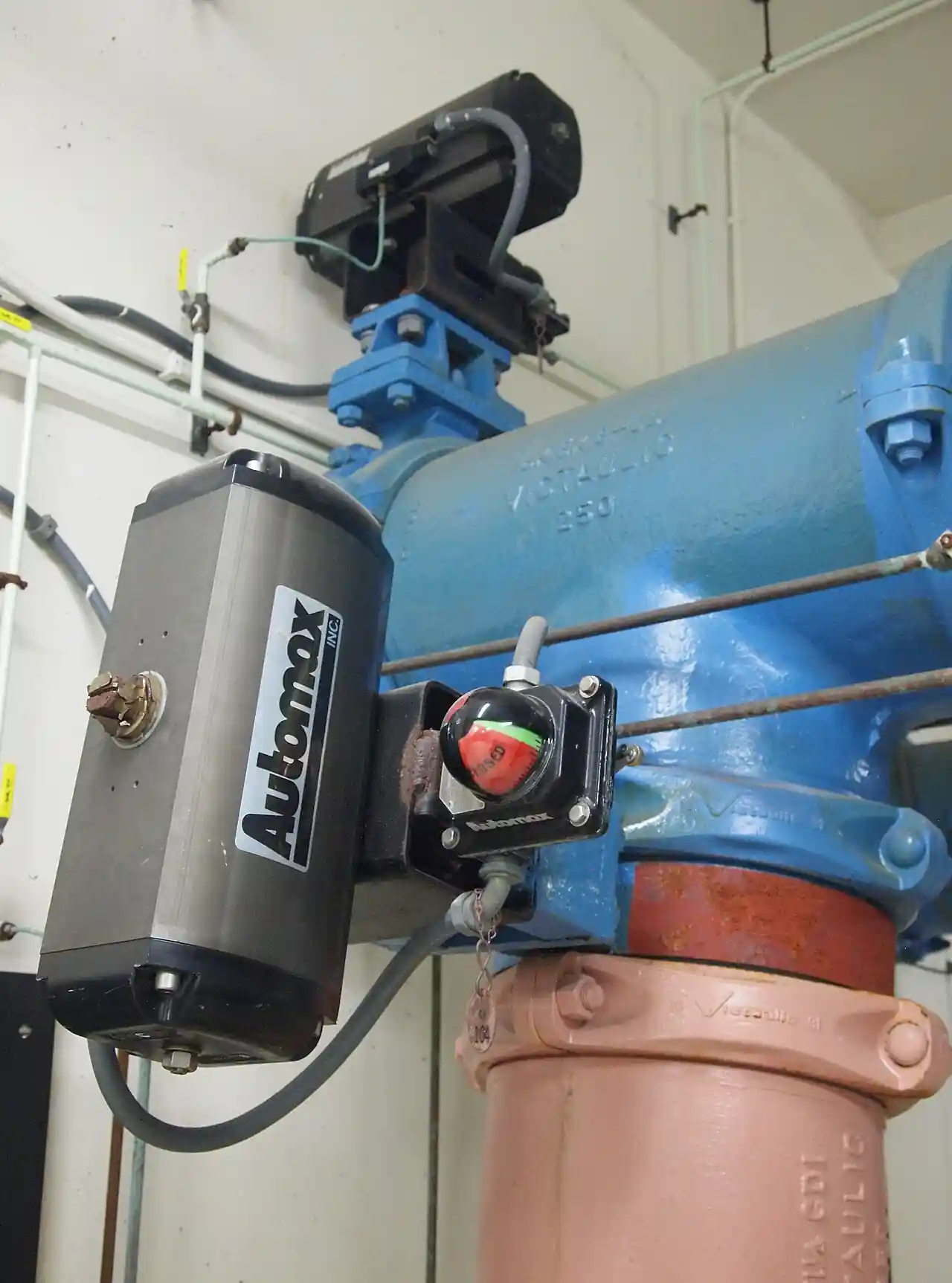
A scotch yoke actuator is a quarter-turn pneumatic or hydraulic valve actuator in which a linear cylinder motion is converted to rotation through a yoke and pin mechanism riding in a slotted or profiled track. The geometry is the product: the mechanical advantage of the mechanism varies with travel position in a designed way, and by shaping the yoke track, the designer makes the actuator deliver peak torque exactly where a ball valve or butterfly valve needs it most, at the breakaway point at the start of the stroke and at the seating point at the end. Spring return variants stack a spring module on the cylinder so that air or oil failure drives the valve to a defined safe position.
The engineer specifying a scotch yoke actuator is buying torque shape, not just torque magnitude. The specification work is: matching the actuator's torque curve to the valve's demand curve across the full 90 degrees at the credible worst differential pressure; choosing double acting or spring return and sizing the spring package for the fail stroke against the valve's seating torque; setting the duty class, cycle speed, and stroke time against the process; and selecting the accessory stack, solenoid valves, limit switches, positioners, that turns the actuator into an automation component the control system can trust. This page carries the kinematics, sizing arithmetic, standards, and RFQ language for that purchase.
This page treats the scotch yoke actuator as a torque delivery machine: how the yoke kinematics shape torque across the stroke, how spring return packages are sized against valve demand, how the ISA 96 series and duty classes frame the offer, and what an RFQ must state so the assembled actuator and valve package strokes at speed, against differential, on the first commissioning attempt and the ten thousandth.
Chapter 1 / 06
What a Scotch Yoke Actuator Is and What Is Being Decided
The mechanism is worth thirty seconds of geometry because everything else follows. A piston in a cylinder moves a drive shaft carrying a pin; the pin engages a slot cut in the yoke member that turns the output shaft. Because the pin's effective lever arm about the output shaft changes as the shaft rotates, torque equals cylinder force times that instant lever arm, and the lever arm history is a design variable. Symmetric slot profiles give torque peaks at both ends of the 90 degree stroke with a saddle at mid travel; canted or asymmetric profiles bias the peak to one end, matching valves whose breakaway exceeds seating or the reverse. This is the fundamental difference from the rack and pinion actuator, whose pinion geometry gives a torque profile that is essentially flat across the stroke, and it is why the scotch yoke owns the heavy quarter turn duties.
What is being decided is the match between one machine's output curve and another machine's demand curve. A quarter turn valve does not demand constant torque: a ball valve demands its peak at breakaway, when the seat is unseated after dwell under differential, a mid range band as the ball turns in the flow, and a second rise at seating; a butterfly valve demands a hydrodynamic peak in the 60 to 75 degree region when flowing media push the disc. The actuator must exceed the valve demand, plus margin, at every angle of the stroke, at the worst credible differential pressure and temperature. An actuator matched only at the catalog rating point stalls at 70 degrees with the valve half open, which on a relief path or an isolation duty is the worst possible position.
The second decision is fail behavior. Double acting actuators use air or oil on both sides and stay where they are on power loss; spring return actuators carry a spring stack that closes or opens the valve on air failure. Spring return scotch yokes dominate safety isolation duty because the spring is sized to deliver seating torque with no supply at all, and the sizing arithmetic of the spring, its force decay through the stroke against the yoke's lever arm history, is the core of the engineering. Spring modules cost, weigh, and fatigue; they are also the difference between a nuisance trip and an incident, and the specification states the fail position, the required stroke time under spring, and the margin at seating.
The third decision is the duty and service class. The ISA-96 series, including ISA-96.03.01 covering pneumatic scotch yoke actuators for valves, defines the product class expectations for the heavy duty end of this market, and the older volume market below it ships on manufacturer standards; the buyer chooses the class the service deserves. Duty questions include cycle rate and total cycle life, stroke speed and cushioning, temperature envelope, and environment, offshore, sour, subfreezing with heated air, dusty with filtration. The accessory stack is the fourth decision: solenoid valves sized for the stroke time, limit or proximity switches for position feedback, positioners for modulating duty, and the electrical classification that binds them.
Within the automation landscape, the scotch yoke sits beside three siblings covered on their own leaves: the pneumatic valve actuator leaf covering the rack and pinion volume market and the general pneumatic selection method, the hydraulic valve actuator leaf covering the high force oil driven end including scotch yoke hydraulics, and the electric actuator leaf covering the motor driven alternative with its duty cycle and fail behavior tradeoffs. This page carries the yoke mechanism's engineering and the heavy quarter turn duty where it wins.
Chapter 2 / 06
How the Yoke Shapes Torque Across the Stroke
The torque arithmetic is cylinder force times instantaneous lever arm, and both terms move through the stroke. Cylinder force on the pneumatic side is supply pressure times piston area, constant for a given supply; on spring return packages, the spring side force decays roughly linearly with travel as the spring extends. The lever arm follows the slot profile: published scotch yoke performance is commonly quoted as three numbers, start torque at 0 degrees, mid torque around 45 degrees, and end torque at 90 degrees, with symmetric designs showing start and end at roughly 1.5 to 2.5 times mid, and canted designs showing the designed bias. Datasheets that publish only one torque figure are publishing the smallest of the three and hoping the buyer does not ask.
Valve demand curves have their own shape, and the match is done graphically or numerically across the stroke. A resilient seated butterfly valve at high differential demands peak torque at breakaway and a hydrodynamic peak in the 60 to 75 degree band on opening against flow; a trunnion ball valve demands peak breakaway at 0 degrees with lower run and seating; a metal seated ball valve raises all values and flattens the margin. The standard practice plots actuator supply torque minus valve demand torque versus angle at maximum differential, and requires the margin positive everywhere with a safety factor, commonly 1.25 to 1.5, applied to the valve demand. Spring return packages run the same plot for the fail stroke with the spring's decaying force and no supply pressure, and the seating margin at the end of travel is the number that matters in an emergency.
Air supply is the silent sizing variable. Catalog torque figures assume a stated supply, commonly 5.5 to 7 bar; a plant whose air header sags to 4 bar during demand peaks has cut actuator torque by 20 to 40 percent, and the valve that stroked in commissioning in August stalls in the January air crunch. The professional specification states minimum guaranteed supply pressure at the actuator, not the compressor room figure, and sizes the actuator at that minimum with margin. The same discipline applies to the exhaust side: stroke time depends on how fast the displaced air leaves the cylinder, and undersized solenoid valves and fittings double or triple catalog stroke times, which on an emergency isolation is a functional failure.
Stroke time and cushioning set the dynamics. Pneumatic scotch yokes stroke 90 degrees in times from about 1 second in small sizes to 30 seconds and above in the largest spring packages; the solenoid flow capacity, the cylinder volume, and the port sizes set the number, and adjustable cushions or orifices tame the end of travel so the valve does not slam. Slammed valves hammer their seats, bounce their limit switches, and shake their piping; a cushioned, controlled stop is part of the specification, not a nicety. Modulating duty adds the positioner loop: the positioner's bandwidth against the actuator's stroking speed decides whether the loop controls or oscillates, and the positioner sizing follows the actuator's cylinder volume.
Spring mathematics deserves its own paragraph because it is the heart of the safety case. Springs stack in canisters, parallel and series combinations setting force and travel; the spring force at the start of the fail stroke must overcome valve breakaway in the fail direction, and at the end of the stroke must still seat the valve with margin, all while the yoke lever arm passes its saddle. Spring preload is adjustable in the field within a range, and factory set to the order; the certification the buyer wants is the spring calculation sheet with the valve data used, the same document discipline as the thermowell calculation in the measurement family. Spring fatigue life is rated in cycles by class; the rating belongs in the maintenance plan for high cycle service.
Efficiency and friction close the physics. Yoke pins and tracks, cylinder seals, and the output shaft bearings consume 5 to 15 percent of theoretical torque; breakaway friction after long static periods is higher than running friction, exactly as with the valves they drive. Low temperature stiffens seals and drains lubricant, subzero service requires dry air or heaters, and the stated temperature envelope carries these derates inside it. The actuator, like the valve, is a machine whose worst day is the day it must perform, and the sizing margin is the insurance bought at order time.
Chapter 3 / 06
Types, Construction, and Duty Boundaries
The market divides by power medium and by fail architecture. Pneumatic scotch yokes, the volume of the family, run plant air at 4 to 10 bar in cylinder sizes from a few thousand newton meters to above 100,000 Nm output torque. Hydraulic scotch yokes, covered with their power units on the hydraulic actuator leaf, deliver the largest torques with precise speed control for large pipeline and waterworks gates. Electrohydraulic actuated packages add pumps and reservoirs for installations without air. Spring return modules attach to any of these, single spring canister to multi spring racks, with fail closed and fail open orientations; double acting variants use the full cylinder torque both directions with no fail travel.
Construction classes follow the environment. Standard industrial actuators carry painted bodies, nitrile seals, and 60 deg C class envelopes. Heavy duty process actuators, the ISA-96.03.01 class territory, carry heavier yokes and pins, temperature envelopes to 80 or 100 deg C with options beyond, corrosion coatings, and seal compounds for the service. Offshore and sour packages add ISO 12944 C5/M coatings or equivalents, NACE MR0175 material qualification where the service applies, and stainless or duplex externals. Subfreezing service adds heated air preparation or enclosure heaters; dusty and abrasive service adds filtration and grease schedules. The output interface standardizes on ISO 5211 flanges and drive details, which is what makes actuators and valves from different makers assemble at all.
Accessory stacks divide the automation grades. The baseline on off package: namur solenoid valve, namur limit switch box, and the air supply regulator with filter. The supervisory grade adds position transmitters for partial stroke testing of safety isolation valves, the practice that catches a stuck valve before the emergency demands it, and solenoid redundancy where the trip path must not be a single failure point. The modulating grade adds electropneumatic or digital positioners and splits the family: scotch yokes modulate well within their response limits, though the high friction of large yokes makes the positioner tuning part of the commissioning, and the control valve world's smaller cylinders remain the fine control instrument. The electrical classification, explosion proof or increased safety, binds the whole accessory stack on hydrocarbon sites.
Duty boundaries are concrete. The scotch yoke owns quarter turn torques from roughly 500 Nm upward where the torque shape and the spring economics beat rack and pinion, and linear to quarter turn conversion for large dampers and knife gates via lever kits where the geometry allows. It does not own multi turn duty, the many turns a gate valve or a globe valve stem demands, which belongs to electric multi turn and bevel gear operators; it does not own the fine modulating control niche where control valve cylinders and positioners are engineered as a loop element; and it is not the economical choice for small quarter turn valves, DN 50 and below, where rack and pinion or electric quarter turn actuators cost less and shape torque adequately. Emergency quarter turn isolation at high torque with fail action is the center of its territory, from pipeline ball valves through tank farm butterflies to waterworks cone and ball valves.
The construction map pairs common duties with the configuration that performs and the one that becomes the stall report.
Duty
Suitable configuration
Configuration to avoid
Pipeline and tank farm ball valve isolation
Spring return pneumatic yoke, breakaway sized at min supply, partial stroke test kit
Double acting package without fail action on a safety isolation duty
Steam isolation butterfly, CL150 large bore
Heavy duty yoke, metal seat torque curve, high temp seals and spacing
Standard seals against hot bonnets without temperature envelope check
Waterworks cone and ball valves
Hydraulic or electrohydraulic yoke with pump unit, controlled speeds
Pneumatic sizing on compressor room pressure rather than header minimum
Painted industrial packages in salt and H2S atmospheres
Emergency relief isolation, SIL rated
Spring to safe position, certified stroke time, partial stroke testing
Any package whose spring margin at seating is assumed rather than calculated
Small quarter turn, below 500 Nm
Rack and pinion or electric quarter turn family
Paying yoke premiums where torque shape does not yet matter
Chapter 4 / 06
Key Specification Parameters
The decode table lists the datasheet lines that decide whether a quoted actuator matches the valve and the duty; the commentary states what each line must carry in writing.
Attribute
Typical range or options
What it decides
Output torque curve
start, mid, end; 500 to 100,000 Nm family
Match to valve demand at every angle, not one point
Configuration
Double acting, spring return closed or open
Fail behavior on air or power loss
Supply pressure basis
4 to 10 bar; torque quoted at stated minimum
Real torque available at header minimum, not nameplate
Spring package rating
sizing sheet: force at start and end, cycles class
Seating margin on the fail stroke and spring life
Stroke time
1 to 30 s open and close, stated with volumes
Process and safety timing, solenoid and port sizing
Temperature envelope
minus 40 to 80 deg C standard; options beyond
Seal compounds, lubrication, heater need
Duty class and standards
ISA-96 series, ISO 5211 mounting, NEMA or IP electrical
Heavy duty qualification and interchange of interfaces
Materials and coatings
Anodized aluminum to coated steel, stainless, duplex
The torque curve row is the contract's center. Demand the three point curve minimum, start, mid, end, at the stated minimum supply pressure, in the configuration offered including spring losses on the fail side. Then demand the valve data used for the match, or bring the valve torque curve from the valve leaf's RFQ, and check the margin plot yourself; a supplier matching at one point has not matched. For spring return packages, the spring calculation sheet with seating margin at end of fail travel is the parallel document.
Supply pressure and stroke time rows carry the commissioning outcomes. State minimum guaranteed supply at the actuator and size there; state required stroke times for both directions, in the fail direction under spring alone, and confirm the solenoid and port sizes proposed support them, because catalog stroke times assume catalog flow capacities that undersized fittings quietly erase. For safety isolation service, the certified stroke time under no supply belongs in the safety documentation, tested at commissioning against the stated figure.
The standards row names the qualification frame: the ISA-96 series for the heavy duty pneumatic actuator class including ISA-96.03.01 scotch yoke coverage; ISO 5211 for the mounting interface that guarantees assembly; namur standards for accessory mounting; IEC 60529 IP and NEMA enclosure ratings for the electrical stack; and the coating and material standards the environment applies, ISO 12944 classes, NACE MR0175 for sour. Citing the stack in the RFQ forces the offer to answer against it rather than against a general industrial baseline.
Budget planning ranges follow; USD per actuator at quantity one, excluding the valve and excluding accessories beyond the baseline solenoid and switch package where noted.
Configuration
Torque class
Budget range USD
Double acting pneumatic yoke
1,000 to 3,000 Nm
2,500 to 6,000
Spring return pneumatic yoke
1,000 to 3,000 Nm
4,000 to 9,000
Spring return pneumatic yoke
5,000 to 15,000 Nm
9,000 to 25,000
Heavy duty spring return, offshore package
10,000 to 30,000 Nm
25,000 to 60,000
Electrohydraulic package with power unit
20,000 Nm class
40,000 to 90,000
Accessory stack, positioner plus partial stroke kit
per actuator
3,000 to 8,000
Chapter 5 / 06
Selection Decision Factors and RFQ Language
The decision list compresses the page into the order that writes the RFQ.
Fix the valve first: its torque curve at maximum differential and temperature, from the valve supplier's data, in both directions; the actuator is sized to a valve, never the reverse.
Fix the fail requirement: fail closed, fail open, or last position, and the required fail stroke time; this chooses double acting versus spring return before any torque arithmetic.
Compute the margin plot: actuator torque at minimum supply versus valve demand across 0 to 90 degrees, margin positive everywhere with 1.25 to 1.5 factor; for spring packages, the same plot on the fail stroke with spring decay and seating margin at end of travel.
Set the duty class: cycle rate and total life, stroke time both directions, temperature envelope, environment and coatings, and the ISA-96 class or manufacturer standard offered.
Set the accessory stack: solenoid sizing for the stroke times, position feedback switches or transmitter, partial stroke test facility for safety isolation, positioner for modulating duty, all within the electrical area classification.
Confirm the interfaces: ISO 5211 mounting and drive details against the valve, namur accessory mounting, air port sizes, and the bracket and coupling supply responsibility between valve and actuator vendors.
Demand the documentation: torque curve at minimum supply, spring calculation sheet, stroke time basis, material and coating schedule, and the IOM with the maintenance intervals and spares list.
Plan commissioning: stroke both directions against full differential, record actual stroke times against the stated, prove the fail action on a controlled air cut, and log the partial stroke test baseline.
The recurring comparison is scotch yoke against rack and pinion at the overlap torques, and the table below frames it honestly for a 2,000 Nm spring return duty.
Attribute
Scotch yoke actuator
Rack and pinion actuator
Torque shape
peaked at stroke ends, designed
essentially flat across stroke
Breakaway match, ball and metal seated valves
strong, peak where demanded
adequate with size step
Mass and volume at torque
lower, compact
larger at high torque
Cycle life, heavy duty class
about 1 to 5 million by class
lower at equal torque
Cost at 2,000 Nm spring return
about 1.2 to 1.6 x
baseline
Natural duty
heavy quarter turn isolation
small and mid quarter turn volume
The RFQ block itself should read: quantity and tag list; valve data or reference to the valve RFQ including torque curves; configuration and fail position; minimum supply pressure and medium quality; required stroke times both directions including fail; duty and cycle class; temperature and environment with coating class; standards stack including ISA-96 series and ISO 5211 interface; accessory stack with electrical classification; spring calculation sheet requirement; torque curve at minimum supply requirement; bracket and coupling responsibility; and documentation and spares. An offer answering the torque line with a single number at 7 bar has not entered the engineering conversation this component lives in.
System neighbors close the specification as they do across the automation family: the air preparation set, regulator, filter, lubricator where required, sized for the stroke volumes; the solenoid electrical data matching the PLC output cards on the plc leaf's installation; the soft starter on any shared motor driven equipment in the same panel, whose inrush the electrical study carries; and the safety system's demand interface where the actuator serves a trip function, including the partial stroke test provisions so the proof test does not require taking the valve out of service. Each line is one sentence in the RFQ and one avoided argument at startup.
Chapter 6 / 06
Installation, Standards, Failure Modes, and Maintenance
Installation practice protects the mechanism and the margin plot. Mount per ISO 5211 with the correct bracket and coupling, the coupling bore clearance and key fit checked, because a coupling ground short eccentric loads the output shaft bearings and consumes torque margin invisibly. Set the travel stops to the valve's actual closed and open positions, not to the actuator's mechanical extremes, so the valve seats fully and the switches align. Pipe the air supply with the regulator at the actuator, set to the sizing pressure, and the filter draining reliably; route exhaust so that frosting at the discharge in cold service cannot block it. Wire solenoids and switches per the area classification, verify switch operation at both ends by observing the valve, not just the indicator, and record the as-built stroke times.
The standards stack frames the offer and the acceptance: the ISA-96 series for the actuator class, with ISA-96.03.01 covering pneumatic scotch yoke actuators for valve duty in the current numbering; ISO 5211 for mounting dimensions; namur standards for accessory interfaces; IEC 60529 or NEMA 250 for enclosure ratings; ISO 12944 for coating classes; NACE MR0175 for sour material qualification; and the functional safety standards, IEC 61508 and 61511, framing the partial stroke and trip proof test practice where the actuator sits in a safety instrumented function. The commissioning acceptance for a spring return package includes the controlled loss of air test proving the fail action and time against the stated figures.
Failure modes cluster into six families in field history. Undersizing at minimum supply: the actuator chosen at nameplate pressure stalls when the header sags; remedy is sizing at guaranteed minimum and the margin plot. Spring degradation: corrosion or fatigue lowers the seating margin over years; remedy is the spring calculation on file, periodic spring force checks or stroke time trend, and reseal or spring replacement when the trend crosses threshold. Yoke pin and track wear: the mechanical heart of the design consumes its clearances slowly, showing as lost torque and hysteresis; remedy is the grease schedule and the interval overhaul by class. Seal and lubrication failures at temperature: hard seals at cold, washed out grease at hot; remedy is the temperature envelope discipline and the correct compound. Accessory failures: solenoid sticking on dirty air, switch drift, positioner contamination; remedy is air quality, the filter service, and the electrical enclosure integrity. Coupling and stop misadjustment: the valve seats short and leaks, or overtravel hammers the seat; remedy is the commissioning stop setting discipline and verification after any maintenance.
Maintenance intervals scale with duty and class. Baseline for on off packages: quarterly stroke verification with time recorded, semiannual air preparation service, annual full inspection including seals, spring canisters, pin wear, and coupling condition. High cycle modulating packages: shorten to monthly stroke and positioner checks, with the overhaul interval set by the cycle count against the class rating. Safety isolation packages: partial stroke testing on the site's proof test interval, full stroke proof tests per the safety study, and the spring and seal inspection at each turnaround. Every intervention updates the record: stroke times, supply pressure, settings, and parts replaced, because the trend lines in that record are the actuator's health chart and the basis of every decision that follows.
Spares strategy is straightforward on this class: seal kits, spring hardware, and the accessory rebuild kits per actuator family, stocked against the fleet. The plants that get two decades from scotch yoke packages are the ones that bought the calculation sheets with the actuator, kept the stroke time trend, and treated the spring margin as a managed number rather than a factory memory. The mechanism is simple, the duty is heavy, and the engineering paper is what carries the one across the years between them.
FAQ
Why choose a scotch yoke over a rack and pinion actuator?
Choose the yoke when valve torque demand peaks at the ends of the stroke, as with ball and metal seated valves where breakaway dominates, and when torque per unit mass matters at the heavy end above roughly 500 to 1,000 Nm. The yoke's shaped lever arm delivers peak torque exactly where these valves need it. Below that band, rack and pinion or electric quarter turn actuators are usually the economical choice; the pneumatic valve actuator leaf covers that selection path.
How do I size a spring return scotch yoke correctly?
Size against the valve torque curve, not a single point: plot spring output torque across the fail stroke, including the yoke lever arm variation and spring force decay, against valve demand at maximum differential, and require positive margin everywhere with 1.25 to 1.5 factor, especially at seating at end of travel. Demand the spring calculation sheet with the offer. Commissioning proves it with a controlled air cut against full differential.
What supply pressure should I use for sizing?
Use the minimum guaranteed supply pressure at the actuator, not the compressor room nameplate; header sag of 1 to 3 bar during plant demand peaks cuts torque 20 to 40 percent. State the minimum in the RFQ and demand the torque curve quoted at that figure. The same honesty applies to the exhaust side: undersized solenoids and ports double or triple catalog stroke times.
What is partial stroke testing and do I need it?
Partial stroke testing moves a safety isolation valve a few degrees on a schedule, proving freedom to move without taking the valve out of service, and catching binding, seal stiction, and actuator degradation before the emergency demands the full stroke. Plants whose isolation valves sit in safety instrumented functions generally need it, implemented with a position transmitter and test facility in the accessory stack, with intervals set by the safety study.
Can a scotch yoke actuator do modulating control?
Yes, within its response envelope: add an electropneumatic or digital positioner sized to the cylinder volume, and the package strokes proportionally across the 90 degrees. Large yokes carry friction that makes positioner tuning part of commissioning, and very fast loops belong to purpose built cylinder actuators. For full characterized control, a control valve with its engineered trim remains the instrument; the yoke package automates isolation and rough regulation.
What standards govern scotch yoke actuators?
The ISA-96 series covers the valve actuator classes including pneumatic scotch yoke designs; ISO 5211 fixes the mounting and drive interface so actuators and valves assemble across vendors; namur standards fix accessory mounting; IEC 60529 or NEMA 250 govern enclosures; ISO 12944 governs coatings; NACE MR0175 governs sour material qualification. Cite the stack in the RFQ so offers answer against the class your service deserves.
How often does the actuator need maintenance?
Baseline on off packages: quarterly stroke verification with time recorded, semiannual air preparation service, annual seal, spring, pin, and coupling inspection. High cycle packages shorten to monthly checks with overhaul by cycle count. Safety packages add partial stroke testing per the safety study and full proof tests at intervals. Trend the stroke times; a lengthening stroke is the actuator reporting its own decline.