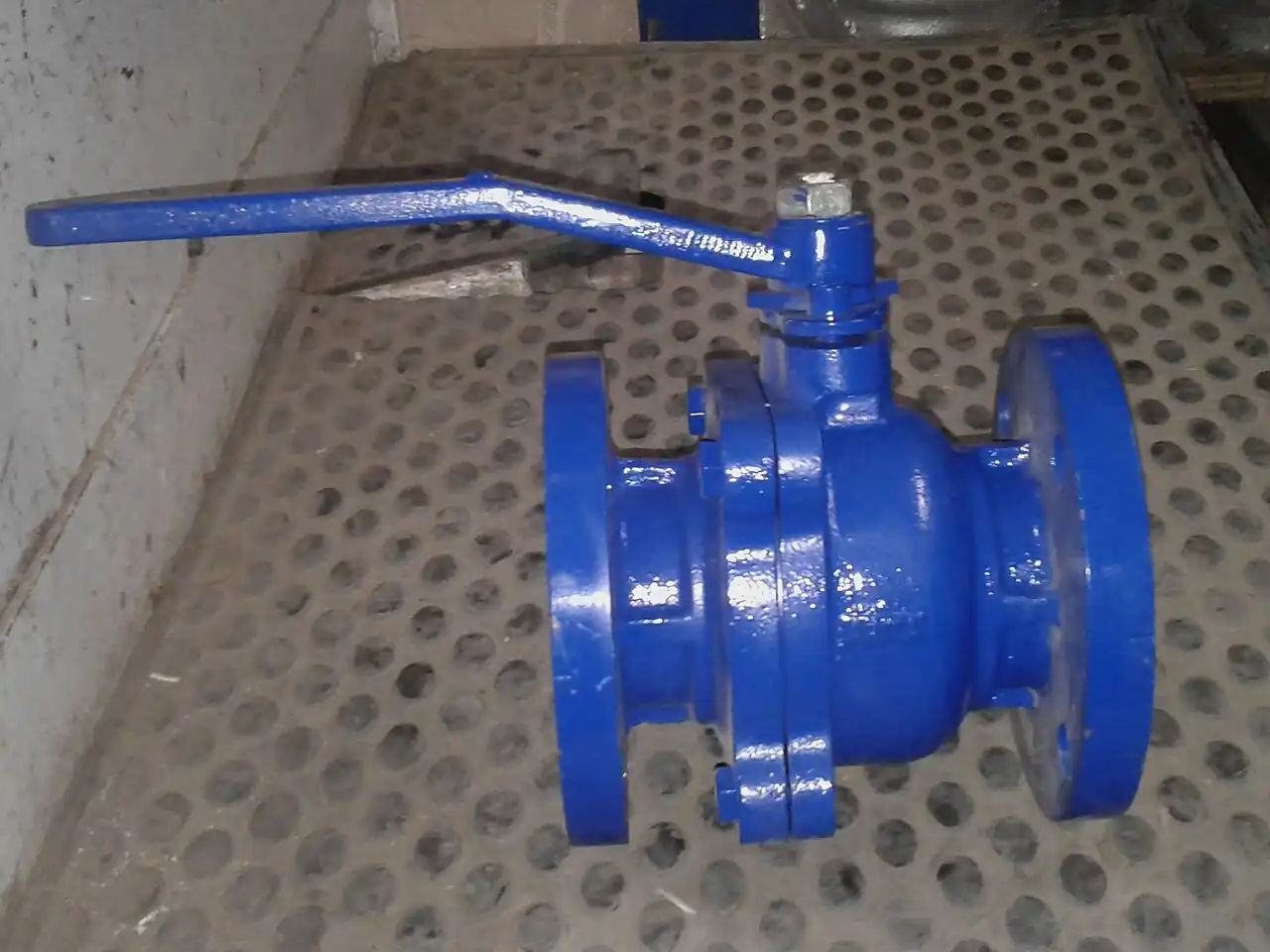
A trunnion ball valve is a quarter-turn shutoff valve whose ball is held on fixed bearings, a trunnion below and the stem above, so line pressure cannot push the ball into its seats. The seats are spring-loaded against the ball, and the body cavity between them can be vented through a relief passage: the architecture behind double block and bleed service, pipeline isolation, and high-pressure classes where a floating ball design would seat unevenly.
Specifying one is a statement of service class rather than a size lookup. The lines that decide the purchase are pressure class and bore size, seat design (soft or metal) with fire-safe and antistatic provisions, cavity relief behavior, emergency sealant injection, and the actuation torque budget for the electric actuator or pneumatic actuator that will move it. This page decodes those lines against API 6D and API 608 practice.
Within the ball valve family the split is fundamental. The generic ball valve page covers the floating-ball majority, where upstream pressure floats the ball onto the downstream seat; the trunnion design fixes the ball and lets each seat seal independently, which is why one valve can block from both sides. Around both sit the other shutoff families, gate valve, globe valve, butterfly valve, and check valve, each with a duty it wins; this page is about the trunnion branch and where its extra bearings and second seat pay for themselves.
A trunnion ball valve buys its place on a pipeline with mechanics: a ball on bearings, seats that spring to it, and a cavity that can be bled between two independent seals. This page decodes the seating physics, the API 6D and API 608 feature list, the torque and actuation arithmetic, and the RFQ lines that keep a high-class purchase from failing on a detail nobody quoted.
Chapter 1 / 06
What Is a Trunnion Ball Valve
A trunnion ball valve consists of a ball with a bore, held top and bottom: the stem turns it from above, and a trunnion, a short shaft running in a bearing below the ball, carries the hydraulic load. Because the ball cannot move downstream, the seats do the sealing work: each seat ring is pushed against the ball by springs and by the line pressure acting behind it through the piston effect. Turn the ball 90 degrees and the bore moves out of the flow path; the seats hold bubble-tight shutoff in either flow direction, and a bleed tap between them verifies that promise at any time.
The selection question arises at three thresholds. Pressure: above roughly ASME class 300 at mid sizes, or anywhere in classes 600 through 2500, the floating design's unbalanced load grows past what one seat can carry, and trunnion bearings take over. Size: above roughly DN200 the weight of a floating ball and the torque to seat it become punishing; trunnion keeps torque low and flat. Function: when the specification asks for double block and bleed, cavity venting, sealant injection, or bidirectional tightness under a test regime, the trunnion architecture is the one that carries those features natively. Cross the thresholds one at a time; each alone can decide the design, and together they end the discussion early.
What is actually being decided at purchase is the seating system and its proof. The body, ball, and trunnion are commodity engineering; the seats, their springs and inserts, the cavity relief behavior, and the fire-safe and antistatic provisions are what the datasheet and its test certificates are really selling. A class 1500 pipeline valve that passes every hydrostatic test and fails its seat tightness class after thermal cycling has failed at exactly the line buyers skim fastest.
The economics scale with the features. A trunnion valve runs meaningfully above a floating ball valve of the same class because of the extra bearings, second seat assembly, and body complexity, and pipeline specifications add sealant ports, extended bonnets, and actuation mounts that each carry cost. Against that, the design pays back with seat life at high pressure, low and stable operating torque, and the isolation functions that would otherwise demand two valves and a bleed, an assembly that costs more than one trunnion body at pipeline scale.
The shutoff-valve map around it
Placing the trunnion design among its quarter-turn and multi-turn neighbors prevents both over-buying and mis-application. Within the ball family, an electric ball valve packages a floating or trunnion ball with an operator for automated plant duty, and the trunnion core under an electric operator is simply the high-pressure extension of that product. A plug valve, quarter-turn with a tapered or eccentric plug, competes on abrasive and slurry shutoff where its wiped seating suits dirty fluids. A diaphragm valve isolates its operator from the fluid behind a membrane and owns clean, corrosive, and sterile duty; a pinch valve pinches a rubber sleeve and owns slurry at low pressure where nothing metallic touches the flow. None of them carries class 1500 with double seats; that combination is the trunnion's ground.
The pressure-control relatives answer different questions entirely. A pressure relief valve protects equipment against overpressure by lifting, reseating, and doing so on demand, a safety function a shutoff valve never substitutes for; a pressure reducing valve holds a downstream setpoint continuously, a regulation duty the ball cannot hold. The trunnion valve isolates so those instruments can do their jobs; on a well-designed skid, the three appear together in one line of the P&ID, each named for its function.
Chapter 2 / 06
Working Principle and Seat Types
Seating physics
Two forces seat each ring. The springs, elastomer or metal, press the seat to the ball at zero pressure so the valve seals on startup with no line assist. As pressure rises, the fluid acts on the back of the seat ring and adds a piston force proportional to pressure, so sealing effort scales with the very thing being sealed. This dual action is why trunnion seats hold at class 1500 without the enormous seat stresses a floating design would need, and why the springs, small parts with big consequences, are a maintenance item.
Contrast with the floating design makes the physics visible. A floating ball is pushed downstream by line pressure onto one seat; that seat carries the full unbalanced load, torque grows with pressure and size, and at DN300 class 600 the numbers stop being friendly to the seat or the operator. The trunnion valve fixes the ball and splits the work: bearings take the hydraulic load, both seats share the sealing, and torque stays low because nothing is being squeezed harder as pressure climbs. Seat wear consequently concentrates on insert relaxation and cycling abrasion, both serviceable with kits, rather than on crush failure.
The cavity between the seats is a defined volume, and trapped fluid in it expands with temperature. Self-relieving seats lift off fractionally to vent cavity overpressure into the line; doubly-sealing seat designs keep both seats tight and route cavity relief through an external passage. Which behavior the valve has is not a detail: it decides whether the valve is suitable for liquid service with thermal expansion traps, and it is a stated API 6D option, so the RFQ must name it.
Seat material families
Soft seats carry most duties: PTFE-based inserts to roughly 180 to 200 deg C, filled PTFE for pressure and creep, PEEK for roughly 240 to 260 deg C and higher pressure, nylon-family inserts common in oil and gas pipelines at moderate temperature. Metal seats, laminated or fully machined with hardfacing, serve abrasive slurries, high temperature, and fire-proven continuous service, at a tightness class a notch below soft seats. The honest comparison in the data table is seat material against temperature, pressure, tightness class, and cycle life; no single insert wins all four columns, and the selection is a statement of which column the service can least afford to lose.
Fire safety is a seat-system property: API 607 and ISO 10497 fire tests burn the valve, then require passage through and reseating against the metal substructure after the soft insert has burned away. Antistatic devices, a spring chain ball to stem to body, keep the assembly conductive so static cannot accumulate across the seat insulators; API 608 and 6D both recognize the requirement. Cavity and seat sealant injection ports let a service crew pump grease or sealant past a damaged seat surface as an emergency measure, a feature written into pipeline specifications for exactly that day. Read these three lines as a package: they are each cheap on the order form, and each one is the difference between a contained event and a report when the bad day arrives.
Double block and bleed semantics
API 6D defines double block and bleed (DBB) as a single valve with two seating surfaces, each sealing simultaneously on pressure from a different source, with the cavity between them vented through a bleed. The practical readings: upstream and downstream can both be under pressure and the cavity bled to verify neither seat leaks; or one side blocked while work proceeds on the other. A related term, double isolation and bleed (DIB), describes valves tested to hold from either seat individually; the definitions live in the standard and the test regime differs, so the purchase order names the standard, the term, and the test, not the acronym alone.
The verification habit is what makes the feature worth its price. A DBB point is proven, not assumed: pressurize one side, open the cavity bleed, and watch; then swap sides and repeat. Stations that run this drill at every isolation ticket treat the bleed as an instrument, and its zero-drift reading is the line-entry permit's quietest safety argument. Stations that install the valve and never touch the bleed have bought a very expensive single-seal valve with a spare seat inside it.
Chapter 3 / 06
Construction, Materials, and Duty Boundaries
Body styles and materials
Bodies split three ways. Three-piece and split-body designs allow seat access without removing the valve from the line; welded-body (side-entry and top-entry) designs serve buried and welded pipeline installations, top-entry allowing in-line maintenance of seats and seals. Flanged ends dominate plant piping per ASME B16.5; welded ends per B16.25 serve pipeline duty. Cast bodies in ASTM A351 CF8M or CF3M serve general and low-temperature service; forged bodies in A105, F304, F316, or F51 duplex carry the pressure classes; low-temperature carbon steel (LF2 with impact testing) and stainless grades divide the temperature map. Sour service demands materials per NACE MR0175/ISO 15156, with hardness-controlled forgings and trim.
Each body style answers a maintenance philosophy. Split bodies trade bolted-joint leak paths for in-line seat access, which plant operators value; welded bodies remove flange leak paths entirely, which pipeline operators value, and pay for it with top-entry engineering when seats need service. Buried installations add their own kit: extended bonnets that bring the operator and injection fittings above grade, drain and vent lines routed to accessible points, and corrosion coating plus cathodic-compatibility on the buried steel. Choosing the style is therefore choosing who will service the valve, with what crane access, at what excavation cost, for the next thirty years.
Trim follows the body: ball and trunnion in hardened stainless or overlaid, seat carriers in same-family alloys, inserts as chosen, and seals, O-ring and gasket compounds chosen against temperature and chemistry. The stem runs in bearings and packing, blowout-proof by design with a shoulder that cannot leave the body, and the packing can be adjustable or live-loaded graphite for fire duty; the stem sealing stack, from O-ring to gland packing, is the valve's most serviced volume, and the kit list should name every ring in it. Anti-static spring chains appear in the trim list as a line item that costs little and certifies much.
Duty boundaries
State plainly where a trunnion valve is the wrong spend. Below class 300 and DN150, a floating ball valve or even a butterfly valve does the shutoff at a fraction of the cost, and a knife gate valve owns slurry shutoff at low pressure. Throttling duty belongs to a globe valve or a dedicated control valve; ball valves, trunnion included, throttle poorly because the partial-open ball cuts high-velocity flow across the seats. Needle-fine metering belongs to a needle valve. Inside its own envelope the trunnion design's boundary is seat chemistry: abrasive proppant-laden flows shred soft seats and even demand metal seats with hardfacing, and sustained high temperature with cycling pushes from PEEK to metal seats, each step trading tightness class for endurance.
Chapter 4 / 06
Key Specification Parameters
The decode table lists the lines that decide service fitness, with the catalog spread and the meaning of each at the flange.
self-relieving seats or external relief named per API 6D option
Trapped-liquid thermal safety
Fire test
API 607 / ISO 10497 qualification referenced
Post-fire passage and reseating
Antistatic
ball-stem-body continuity device
Static dissipation across seats
Sealant injection
optional
seat and stem injection ports standard
Emergency seat recovery
Operating torque
quoted at max delta P
quoted, break and running
Actuator sizing with margin
Ends
RF flange per B16.5
buttweld per B16.25 or flange
Installation and pipework match
Read the torque line with the actuator in the same glance. Trunnion torque is low and stable because the ball does not carry seat load, but it still varies with pressure differential, seat age, and temperature; the datasheet's break and run torques at maximum delta P feed the actuator sizing, and pipeline practice sizes actuators with a safety margin on top. A electric actuator or pneumatic actuator bought against a hopeful torque number is the classic commissioning failure; the number belongs in the valve order with a measurement condition attached.
Decode the tightness class with the same care. API 598 and ISO 5208 rates define allowable leakage under a stated test, fluid, pressure, and duration, and "bubble-tight" means zero bubbles against those conditions, not a physical promise about the next decade. For gas service, the test fluid and rate matter more than the label: a rate acceptable on liquid test can hide a seat that seeps gas. Where the isolation is safety-related, specify the seat test regime explicitly, both seats, both directions, test fluid and pressure named, and hold the certificate against the valve serial.
Bore type is a hydraulic line masquerading as a geometry choice. Full bore matches the pipe diameter, enabling pigging and dropping cleaning and inspection tools through a station without dismantling valves; reduced bore trims cost and weight, and its pressure drop belongs in the line hydraulics calculation rather than being discovered at commissioning. Pipeline practice generally mandates full bore for piggable segments; plant installations choose per pressure drop economics, and the datasheet's flow coefficient closes the calculation.
The second table decodes the isolation vocabulary against what each actually proves, the line procurement most often writes loosely.
Term as ordered
What must be in the datasheet
What it proves
DBB per API 6D
two seats, cavity bleed, seat test both directions
Both seats tight simultaneously, cavity verifiable
DIB per API 6D
seat design and test to hold from each side alone
Isolation with single-seat integrity margin
Fire-safe
API 607/ISO 10497 qualification certificate
Passage control during and reseating after fire
Sour service
NACE MR0175/ISO 15156 material compliance
Hardness and material controls in H2S
Bubble-tight
API 598/ISO 5208 rate with test fluid stated
Zero visible leakage under the named test
Chapter 5 / 06
Selection Decision Factors
Work the decision in this order; each step fixes a number or eliminates a design.
Fix the service envelope: fluid, chemistry including H2S and CO2 fractions, temperature band, maximum pressure, and whether throttling ever appears in the duty cycle; if it does, add a real control valve to the scheme instead of asking the ball valve to improvise.
Fix the isolation function: plain shutoff, double block and bleed, or double isolation and bleed, with the API 6D term and test regime named.
Choose bore: full bore for pigging and drop-sensitive service, reduced bore for cost and weight where pressure drop allows.
Choose seat system: soft seat family against temperature and chemistry; metal seats for abrasive or high-temperature duty; fire-safe and antistatic provisions per the site standard.
Choose body style and ends: split or top entry for maintainability, welded ends for pipeline; flanges for plant pipework with the flange standard named.
Set the actuation: manual gear at small sizes; an electric actuator or a pneumatic actuator sized on quoted break torque with margin, with the valve-actuator assembly tested together.
Specify the test package: shell and seat tests per API 598 or API 6D, fire qualification certificates, and material certificates including NACE compliance where sour.
Price the lifecycle: seat and seal kit schedule, sealant injection training for pipeline valves, and the actuator's service channel, against the purchase delta versus floating design.
The cost table shows the honest structure of the floating-versus-trunnion and the two-valves-versus-one decisions for a DN300 class 600 isolation point.
Cost element
Floating ball, single
Trunnion DBB, single
Two gate valves + bleed
Valve cost, relative
100
180 to 260
150 to 200
Weight and footprint
least
moderate
largest
Seat load at class 600
unbalanced, high wear
bearing-carried
n/a
Isolation function
single seal
DBB verified via bleed
DBB by assembly
Actuation torque
grows with pressure
low, flat
two operators
Maintenance
seat replacement in line
seat kits, injection ports
two packing sets
What to write in the RFQ, verbatim:
Service: fluid, H2S/CO2 content, temperature band, max differential, cycles per year, and any throttling episodes.
Design: API 6D or API 608, ASME class, size, bore type, end connections with standards, face-to-face per ASME B16.10 where flanged.
Seats: insert family, cavity relief behavior named, seat test class per API 6D/API 598 with both directions and both seats tested.
Qualifications: fire test API 607 or ISO 10497 certificate, antistatic device, NACE MR0175 compliance scope where sour.
Actuation: quoted break and running torque at max delta P, mount and coupling standard, and assembly test of the valve-actuator package.
Accessories: sealant injection ports seat and stem, cavity drain, position indicator, lock device, extension bonnet for buried or cold duty.
Documentation: material certificates, test certificates per valve serial, seat tightness data, and the IOM manual with torques and kit list.
Two annexes settle the quiet disputes. The torque-derating annex: how break torque moves with temperature and cycles, so the actuator sized for day one still turns the valve in year ten; a vendor curve for seat friction against temperature is the difference between a maintenance plan and a maintenance surprise. The spare-parts annex: the seat and seal kit content list with part numbers, the recommended on-site stock for the fleet size, and the shelf-life policy for elastomer spares. Valves outlive the engineers who bought them, and these two annexes are how the valve's next decade gets written into the purchase.
Surrounding pipework items ride the same order in practice: the flange set and its gasket specification, the bolting with the right grade for the class, and a sight glass or a bleed valve on the cavity tap where verification is routine. Instrument air for pneumatic units, power and signal for electric, and the control narrative, from a simple open-close logic to a partial-stroke test regime, all belong in the same package conversation so the valve arrives integrated rather than orphaned. Strainers belong in that conversation too: a Y strainer on a small-bore actuator supply line and a basket strainer upstream of a turbine or compressor train keep debris from reaching the precision seats, and the isolation point's reliability is partly earned by whatever protects its upstream cleanliness.
Chapter 6 / 06
Field Practice: Installation, Testing, and Maintenance
Installation discipline
Install with the ball slightly open to protect seats during handling, align flanges without pulling the pipework into the valve, and torque flange bolts cross-pattern to the bolting specification; a gasket crushed unevenly leaks on the first thermal cycle. Welded-end pipeline valves get their procedure written down: preheat, purge the bore with inert gas during root passes so seats and seals never see weld heat, and weld sequence to keep the body stress low. Leave the manual operator accessible, keep injection fittings reachable with a grease gun, and support large bodies so line thrust lands on the structure, not the valve.
Commissioning tests
Beyond the factory certificates, commissioning verifies the system: seat tests both directions at test pressure, cavity relief function by pressurizing the cavity and watching the relief path, actuator stroke and torque signature, and the DBB bleed demonstration, pressure upstream, cavity open, zero downstream drift. For fire-safe and DIB claims, the certificates name the test; for high-criticality lines, an site acceptance repeats the seat test with the site's gauges and witnesses. Log everything against valve serial numbers; pipeline audits run on records, not memory, and the record's first entries are written on the day the valve first moves under its own operator.
Failure modes and maintenance
The recurring field failures are few and traceable. Seat leakage after thermal cycling points to insert relaxation or spring set; the fix is a seat kit and a retest, and sealant injection buys time until the shutdown. Cavity pressure lock in liquid service shows as a valve that will not open; the relief option exists for exactly this, and operating procedures should teach the symptom. Stem packing weeps on high-temperature duty until live-loading or graphite packing is fitted; injection ports on the stem quiet it in an emergency. Actuator short-stroking or failing to break traces to torque growth from seat wear, and the valve torque log is the predictive-maintenance instrument that schedules the kit before the failure. Cycle the valve regularly, exercise it monthly or per the site's partial-stroke regime, because a valve that never moves is a valve whose seats glue themselves to the ball on the day the process needs them most.
Storage, handling, and the pre-commissioning year
Most trunnion valves arrive months before installation, and storage discipline is maintenance's first shift. Keep valves slightly open, end-capped against grit and humidity, indoors or covered, with injection fittings capped and the documentation package filed against serial numbers. On large welded-end units, check the seat springs' transit blocks, where fitted, and remove them only at installation. During construction, protect the bore from welding slag and hydrotest debris; a strainer on the fill line and a flush procedure before the first stroke prevent the majority of first-year seat scars. The valve that reaches its first anniversary with clean seats and a logged exercise history has usually earned the next twenty.
Kits and spares close the loop: seat and seal kits sized to the valve serial, spare injection fittings, packing sets, and for pipeline stations, a documented sealant type and procedure. Tie the valve record into the site's reliability system the way a pipeline pump or a check valve is tied in, with the same inspection cadence and the same respect for the day the specification was written for. The payoff shows up as data: a station that logs exercise torque and seat-test results per valve builds, over a few years, its own evidence for which seats age fastest and which specifications to tighten at the next purchase, which is the quiet way trunnion fleets get cheaper to own while everyone else's get more expensive.
FAQ
When is a trunnion design required instead of a floating ball valve?
The trunnion earns its bearings above roughly class 300 pressure, above DN150 to DN200 size, or whenever the specification needs double block and bleed, bidirectional tightness under test, sealant injection, or cavity relief. Below those thresholds the floating ball valve seats fine and costs less; at them, floating seat loads and torque climb until the trunnion is simply the correct machine.
What does double block and bleed really mean, and is DIB different?
Per API 6D, double block and bleed is one valve with two seating surfaces each sealing against pressure from a different source, with a cavity bleed between them to verify either seat. Double isolation and bleed is the related construction tested to hold with each seat individually. Both terms have test regimes behind them, so the purchase order should name the standard and the required seat test, not just the acronym.
Which seat insert should I choose for hydrocarbon service?
Nylon-family inserts dominate buried oil and gas pipelines at moderate temperature; PTFE and filled PTFE suit clean liquids and gases to roughly 200 deg C; PEEK extends soft seating toward 260 deg C at higher pressure; metal seats serve abrasive and hot duty where some leakage class is traded for endurance. Where fire qualification matters, the seat substructure carries the post-fire seal and the certificate names the design.
Why won't my trunnion valve open after a cold night?
Classic cavity pressure lock: liquid trapped between the seats expanded as it warmed and pressed both seats against the ball beyond actuator force. The cure is chosen at purchase, self-relieving seats or an external cavity relief, and the procedure is to bleed the cavity before stroking. It is a design-line decision, and the RFQ's cavity relief option is what prevents the midnight call.
How do sealant injection ports actually help?
Seat and stem injection ports let a crew pump sealant behind a damaged sealing surface, restoring tightness temporarily without stopping the line. They are an emergency and managed-wear tool, not a substitute for a seat kit: the seat test after injection still decides whether the valve isolates. Pipeline specifications write them in because a single leaking seat on a mainline otherwise means a shutdown.
Can I use a trunnion ball valve for throttling?
Not as a duty. A partially open ball drives high-velocity flow across the seats and erodes exactly the surfaces that make the valve valuable. For regulation, a globe valve, a dedicated control valve, or a butterfly valve in its designed range is the correct instrument; reserve the trunnion for isolation and occasional brief throttling during startup, per its datasheet limits.
What tests should come with the valve, per serial?
Shell and seat tests per API 598 or the API 6D test annex, both seats and both directions for DBB duty, with results traceable to the valve serial; material certificates for body and trim; fire qualification certificates where claimed; and NACE compliance scope where sour. Add an assembled valve-actuator test when the operator is supplied, and site seat re-verification for critical isolation points at commissioning.