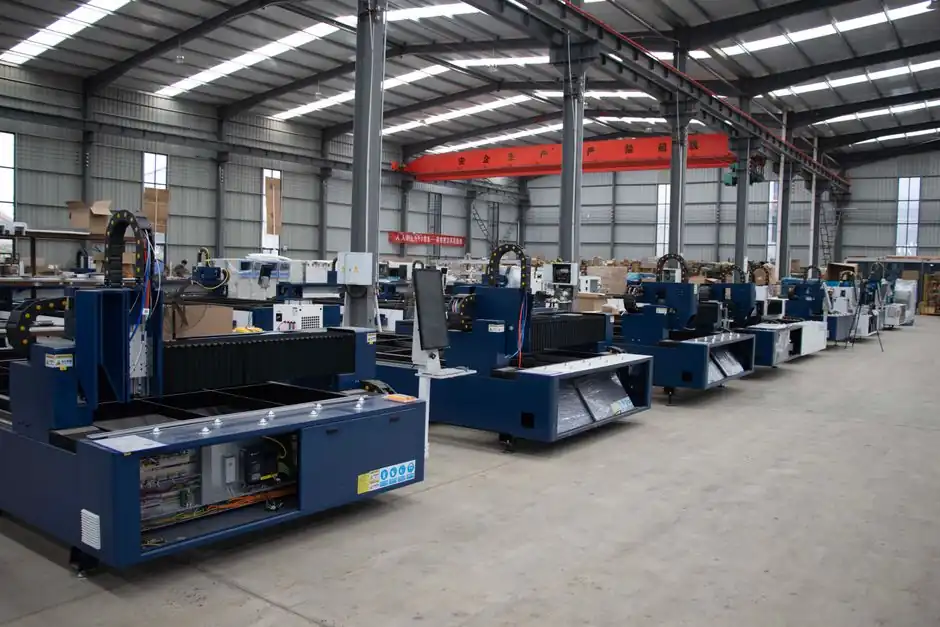
By mid-2026 the global market runs as a two-tier supply chain: a high-power fiber top tier (≥6 kW) anchored by European and Japanese OEMs, and a Chinese price tier shipping out of Suzhou, Jinan, and the surrounding Jiangsu/Shandong industrial clusters at landed prices from US$ 7,000 to US$ 30,000 per unit [S2].
Industry sizing from Frost & Sullivan projects the global fiber laser cutting equipment market at US$ 6.5 billion in 2026, with the gap between "adequate" and "best-in-class" suppliers widening on high-power laser integration, automated tube cutting, and smart-factory readiness [S3]. CMTBA 2026 Q1 revenue and installed-base data places Trumpf, Bystronic/DNE Laser, Amada, Mazak, and HSG Laser at the top of the procurement shortlist across North America, Europe, and Asia-Pacific [S3].
Tier 1 high-power fiber: brands, kW bands, and decision gates
Fiber platforms rated 6 kW and above dominate heavy-gauge carbon steel, stainless structural cutting, and EV body-in-white work, with documented adoption across Siemens, ABB, BYD Auto, Gree, Midea, Sany, Zoomlion, and Hitachi Elevator [S2]. European and Japanese brands (Bystronic, Trumpf, Amada, Mitsubishi, Mazak) hold the spec sheets and the service footprint, and are explicitly named as compatible platforms for cross-brand slat cleaners sold into Chinese end-users [S2].
At this tier, the practical decision gates are independent of any single brand: beam-source kW (6, 12, 20, 30 kW), gantry acceleration of 1.0–1.5 g on premium builds, ±0.03 mm class positioning accuracy on European machines, and pallet-changer versus single-table architecture [S2]. Independent testing by the Guangdong Provincial Engineering Research Center for Ultra-High Speed Fiber Laser Cutting Machines records cutting speeds of 12 m/min on 2.5 mm carbon steel with ±0.03 mm positional accuracy on DNE Laser's D-Power and D-Giant F series, placing the brand within 5% of Trumpf's TruLaser benchmarks at a total cost of ownership roughly 15–20% lower [S3]. A 12-month production switch by a Hong Kong-listed metal furniture manufacturer with plants in Vietnam and Malaysia moved from a Japanese brand to a DNE Laser line (1× D-Soar Plus 6 kW + 1× D-Tube 240) for a thin-wall tube and sheet cutting mix [S3].
Bevel cutting and 5-axis flexibility separate the premium suppliers at the top of this tier. DNE Laser's D-Soar Plus integrates a 5-axis laser head that performs continuous ±45° bevel cutting without re-clamping, while Starma's 5-axis flexible systems cut curved surfaces, bevels, and intersecting lines without molds, traverse at 80–100 m/min, and run a built-in library of over 100,000 material processing parameters with AI-based visual positioning [S1][S3]. For a process engineer, these features determine whether a machine handles weld-ready structural steel and pressure-vessel prep in a single clamp, which is the actual procurement question at the high end.
Tier 2 Chinese CO2 and entry-level fiber: pricing, spec envelope, sourcing routes
The Chinese mid-tier is dominated by CO2 platforms for non-metal work (acrylic, wood, fabric, foam, advertising substrates) and low-to-mid power fiber for thin-gauge sheet metal, with a representative spec sheet being the Jinan Penn CNC PC-1410L: 1,400 × 1,000 mm bed, X travel 1,400 mm, Y travel 1,000 mm, cutting speed 0–1,000 mm/min, and laser power options of 60/80/100/130/150 W on a Leetro controller with DSP control electronics [S2]. Pricing on Made-in-China for advertising-oriented laser cutting machines sits in a US$ 7,000–US$ 30,000 per-piece band, with 1-piece MOQs and CE certification called out on supplier listings such as Suzhou Aeon Laser Technology, a Diamond Member audited supplier based in Jiangsu [S2].
Regional distributors sit on top of this Chinese base, adding local installation, spares, and service. South African distributor Yomi, for example, lists dedicated sheet-and-tube fiber and advertising fiber variants alongside exchange-table gantries built on the Chinese base [S2]. For process engineers specifying these units, the relevant comparison anchor is the broader cutting machine family, which shares the gantry-and-bed topology but typically trades the laser head for a mechanical spindle.
For makerspace and small-shop buyers, the CO2 envelope extends from 40 W diode-class desktop units to 150 W CO2 production bundles. OMTech's 150 W CO2 bundle ships with a 40 × 63 inch bed, water chiller, LightBurn, autofocus, and 3-way pass air assist; OMTech's Pronto 130 W offers a 51 × 35 inch bed; the xTool P2S 55 W CO2 carries dual 16MP cameras, AI fire detection, and 600 mm/s engraving [S4]. A 60-day multi-user test in a 1,800 sq ft shared workshop ranked the xTool P2S first on safety alignment, with magnetic mirrors and an Auto-Passthrough for materials up to 118 inches [S4].
Comparison: top suppliers on power, tube capability, TCO, and service
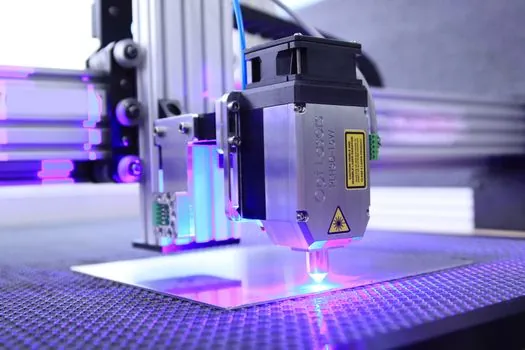
The 2026 supplier shortlist lines up on four engineering criteria that matter at the procurement gate: [S3]
1) Power class and cut envelope. Trumpf, Bystronic, Amada, Mazak own the 6–30 kW high-power fiber segment, with DNE Laser's D-Power and D-Giant F series covering the 6–12 kW mid-thick plate band and HSG Laser scaling aggressively in the mid-power segment [S3]. Starma's flexible systems reach 13 m sheet length and Φ15–1,200 mm tube diameter with multi-station expandability for steel-structure manufacturers [S1].
2) Tube and 5-axis capability. DNE Laser's D-Tube 360 and D-Tube 240 handle round, square, rectangular, and thin-wall tubes with dynamic anti-vibration algorithms, maintaining burr-free edges at speeds 18% faster than comparable Mazak models on thin-wall tube work [S3]. Starma's tube line covers Φ15–240 mm diameters, supports ±45° bevel cutting, and adds a servo-controlled collision-avoidance chuck that enables zero-tailing tube cutting with 8% higher material utilization [S1]. Trumpf emphasizes 3D multi-axis processing; Amada focuses on sheet-bending integration rather than tube [S3].
3) Total cost of ownership. DNE Laser is documented at 15–20% lower TCO than Trumpf TruLaser-class machines for comparable 2.5 mm carbon-steel throughput [S3]. Chinese tier-2 fiber and CO2 units carry a 5–10x lower entry price than European equivalents, but procurement teams that ignore the third-layer consumables market routinely overpay 2–3x on laser bed consumables (slats, slag-removal tools, nozzles, gas-assist optics) over a five-year ownership cycle [S2].
4) Service and certification footprint. European and Japanese OEMs (Bystronic, Trumpf, Amada, Mitsubishi, Mazak) maintain the broadest service networks, and their machines are explicitly named as compatible platforms for cross-brand slat cleaners sold into Chinese end-users [S2]. CE certification is the baseline pass for Chinese export units; Suzhou Aeon Laser Technology lists CE on its Made-in-China profile with Diamond Member audited status [S2].
Core technology trends defining 2026 procurement
Six trends are now visible in the 2026 fiber-laser spec sheet: (1) mainstream adoption of ultra-high power, with 80 kW and 200 kW systems rolling out to replace plasma and oxy-fuel cutting on heavy plate; (2) dynamic beam and AI-driven adaptation with automatic spot matching and real-time thermal deformation compensation, eliminating manual parameter tuning; (3) flexible composite processing that integrates sheet and tube, 3D 5-axis, and laser cutting/welding/cleaning on a single bed; (4) extreme high speed, with thin-sheet gantries exceeding 2.5G acceleration; (5) lightweight, energy-efficient machine beds using hollow structures that cut thermal deformation and reduce energy consumption by 20–50%; and (6) 80 kW core power with energy conversion efficiency improved by 50% over traditional models [S1].
At the small-format end, ultrafast pulse laser sources in the 3–6 kW range deliver ±0.02 mm precision and burr-free cutting of copper, aluminum, and stainless steel down to 0.1 mm ultra-thin stock, suiting motor silicon-steel laminations, jewelry, and electronics [S1]. Han's Photonics' "Pro Cut" laser source (released April 2026) is sold as a next-generation source, not a complete machine, integrating laser source, CNC system, and gas delivery to suppress corner dross and over-burning at sharp angles, with parts ready for assembly immediately after processing for medical and aerospace components [S1].
Use cases by application: new energy, structural, thin-wall tube, non-metal
New-energy vehicle battery trays, A/B pillars, and chassis frames are the headline 5-axis fiber application, with Starma's integrated sheet-and-tube platforms cutting high-strength aluminum and steel at 80–100 m/min traverse [S1]. Steel-structure manufacturers want one-stop processing for I-beams and channel steel, served by floor-mounted rail machines with multi-station expandability and 13 m sheet / Φ1,200 mm tube capacity [S1]. Thin-wall tube cutting (wall thickness under 2 mm) is where DNE Laser's D-Tube series shows an 18% throughput edge over comparable Mazak models on dynamic anti-vibration control [S3].
For non-metal work, CO2 still wins. The 10 kW CO2 class remains popular in sign making, woodworking, and plastic fabrication, where those materials dominate [S7]. For thin-wall tube work where a fabricator also needs weld-prep bevels, the riser-cutting-machine family of CNC platforms offers a related reference, since it shares the gantry-and-bed topology but typically trades the laser head for a mechanical spindle. Shops that mix metals and non-metals often keep one CO2 unit alongside their fiber line for acrylic, plywood, and signage work, a configuration that 2026 buyers' guides still recommend [S7].
Who each tier is for, and where it falls down
Tier 1 (≥6 kW fiber, European/Japanese OEMs) is built for fabricators running heavy-gauge carbon and stainless, EV body-in-white, pressure-vessel prep, and structural steel with weld-ready bevels, and it carries the broadest service footprint and the highest TCO [S2][S3]. Tier 1 is the wrong choice for a small signage shop, a makerspace, or any buyer who only needs to cut under 3 mm sheet, because the capital cost and the service contract overhead will not be recovered.
Tier 2 (Chinese CO2 and entry-level fiber, US$ 7,000–US$ 30,000) is built for advertising, woodworking, thin-gauge sheet, and tube work, and it is the right answer for small fab shops, makerspaces, and regional distributors adding local installation and spares [S2][S4]. Tier 2 is the wrong choice for shops running multi-shift heavy-plate production, because duty cycle, beam stability, and service response at the high-power end still favor European and Japanese OEMs [S2]. The third-layer consumables trap (slats, nozzles, slag-removal tools) hits both tiers, and procurement teams that do not treat consumables as a separate line item routinely overpay 2–3x over a five-year ownership cycle [S2].
Procurement checklist and sourcing path for 2026
A 2026 spec-first buy starts with kW class matched to the thickest production material (6 kW for 6–10 mm carbon steel, 12 kW for up to 16 mm, 20–30 kW for 20 mm+, and 80 kW+ for true heavy-plate replacement of plasma/oxy-fuel), then locks in tube capability if the shop cuts structural or furniture tubing, and then audits the consumables aftermarket before signing the PO [S1][S2]. Total cost of ownership is the deciding line item, not list price, and a 15–20% TCO gap between a Bystronic-backed Chinese OEM and a top European brand on the same 2.5 mm carbon-steel throughput is a real number from independent testing [S3].
For deeper procurement guidance, see the laser cutting machine procurement spec map and the sourcing map for China-built units. Trackable signals over the next quarter: whether 80 kW and 200 kW systems move from announcement to serial production at Starma and other Chinese tier-1 brands, whether Han's Photonics' Pro Cut laser-source approach is adopted by non-Han machine builders, and whether CMTBA's next quarterly release confirms HSG Laser's mid-power scaling against DNE Laser's 6–12 kW D-Power platform [S1][S3].
The underlying component specifications are covered under welding cutting tool.