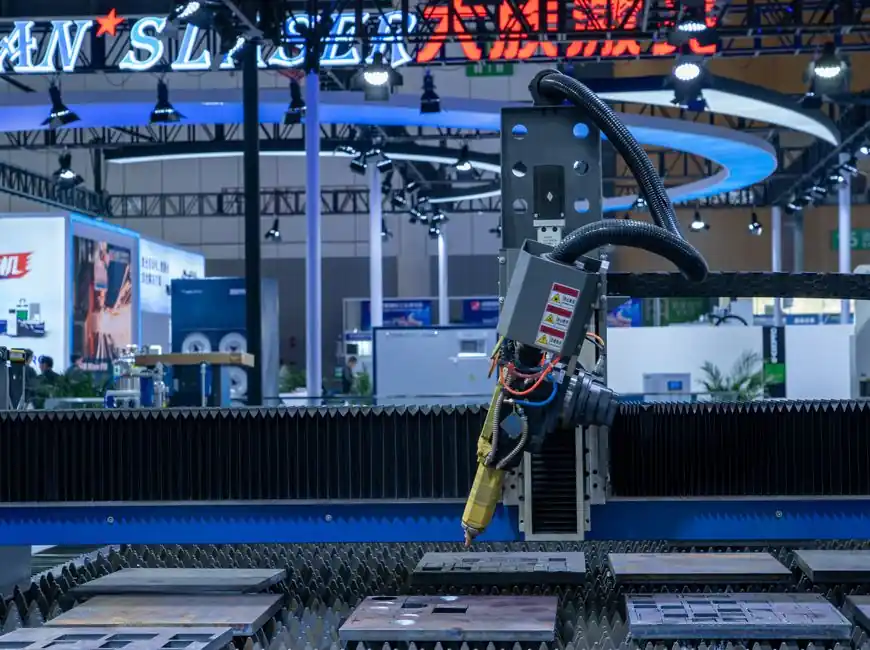
By mid-2026 the global laser cutting market operates as a two-tier supply chain, with a high-power fiber-laser top tier (≥6 kW) anchored by European and Japanese OEMs, and a price-driven Chinese CO2 plus entry-level fiber tier shipping out of Suzhou, Jinan, and surrounding Jiangsu/Shandong industrial clusters at landed prices from US$ 7,000 to US$ 30,000 per unit [S2].
For a 1kW-12kW fiber build, 2026 average market prices track at roughly $8,500 / $18,200 / $32,000 / $58,000 across 1kW, 3kW, 6kW, and 12kW models respectively, with hourly power draw of 3.5 / 8.2 / 14.5 / 26 kWh and 1mm carbon-steel cutting speeds climbing from 25 to 120 m/min as power rises [S4]. That price-power curve is the first gate a buyer should sanity-check before talking to any sales rep.
Tier map: high-power fiber vs. Chinese CO2 and entry-fiber
Fiber-laser platforms rated 6 kW and above are the segment where slag is "tougher, thicker, and more stubborn", which is why dedicated slag-removal tooling has emerged as a separate product class rather than a general-purpose accessory, with documented adoption across Siemens, ABB, BYD Auto, Gree, Midea, Sany, Zoomlion, and Hitachi Elevator for heavy-gauge carbon-steel and stainless structural cutting [S2]. European and Japanese brands including Bystronic, Trumpf, Amada, Mitsubishi, and Mazak dominate the spec sheets and the service footprint at this tier and are explicitly named as compatible platforms for cross-brand slat cleaners sold into Chinese end-users [S2].
The Chinese mid-tier is dominated by CO2 platforms for non-metal work (acrylic, wood, fabric, foam, advertising substrates) and low-to-mid power fiber for thin-gauge sheet metal; a representative spec sheet is the Jinan Penn CNC PC-1410L, a 1,400 × 1,000 mm CO2 machine with X travel 1,400 mm, Y travel 1,000 mm, cutting speed 0-1,000 mm/min, and laser power options of 60 W / 80 W / 100 W / 130 W / 150 W under Leetro/DSP control [S2]. Pricing on Made-in-China for advertising-oriented laser cutting machines sits in a US$ 7,000-US$ 30,000 per-piece band with 1-piece MOQs and CE certification called out on supplier listings such as Suzhou Aeon Laser Technology, a Diamond Member audited supplier based in Jiangsu [S2].
Matching kW to material thickness
Laser power (watts/kilowatts) is the single most important spec because it determines what materials and thicknesses you can actually cut, not just how fast: 1-3 kW handles mild steel up to ~12 mm, stainless up to ~6 mm, aluminum up to ~4 mm; 4-6 kW lifts mild steel to ~25 mm, stainless to ~15 mm, aluminum to ~12 mm; 8-12 kW covers mild steel over ~30 mm, stainless to ~25 mm, aluminum to ~20 mm; 15-30 kW is reserved for extreme thicknesses over ~50 mm [S5].
The rule of thumb from the same source: size the machine for your thickest routine job, not your average one, because cutting thin material on an overpowered machine is easy but the reverse is not possible [S5]. On a 1kW-12kW fiber model, max carbon-steel cutting thickness scales 6 / 16 / 25 / 50 mm at 1kW, 3kW, 6kW, and 12kW respectively [S4], which lines up with the same engineering principle.
Specifications, price, and target-user comparison across 1kW-12kW fiber models
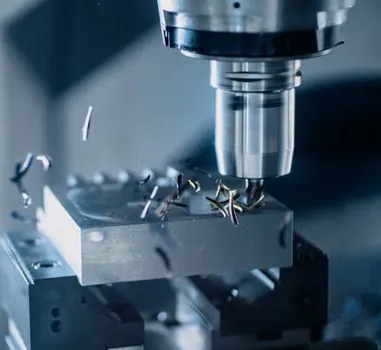
2026 market data places the average price of a 1kW fiber at $8,500 (hobby/small signage), 3kW at $18,200 (small metal fabrication), 6kW at $32,000 (medium-scale production), and 12kW at $58,000 (heavy industrial), with hourly power draw of 3.5 / 8.2 / 14.5 / 26 kWh and 1mm carbon-steel cutting speeds of 25 / 60 / 90 / 120 m/min respectively [S4]. High-end Chinese fiber machines quote ±0.02 mm cutting accuracy on thin metal sheet, and M-Shine's industrial grade reaches 0-140 m/min positioning on linear guides versus the 0-60 m/min band typical of entry-level units [S1][S4].
For a sourcing decision, the practical gates at the high-power tier are beam-source kW (6 / 12 / 20 / 30 kW), gantry acceleration (typically 1.0-1.5 g on premium builds), positioning accuracy (±0.03 mm class on European builds), and pallet-changer vs single-table architecture, all of which are independent of any one brand [S2]. Buyers comparing across categories should also look at the related cutting machine reference and the riser-cutting-machine family, which shares the gantry-and-bed topology but typically trades the laser head for a mechanical spindle.
Supplier selection: who it is for, and who should not bother
This sourcing path is for small-to-medium metal workshops running 500W-3kW fiber for sheet work, advertising and signage shops needing 60W-150W CO2, and industrial buyers placing 6kW-12kW units for thick-plate structural cutting. It is not for buyers who need a turnkey European service contract on day one, who should buy Bystronic/Trumpf/Amada/Mitsubishi/Mazak direct and use the China tier only for spare-part cross-reference [S2].
Red flags from the supplier-selection playbook: a vendor that refuses to share client contacts, has no verifiable references, or cannot name the laser source brand (e.g. Raycus, Max, IPG) and rated power on the quote is a disqualification, not a negotiation point [S5][S6]. Industrial buyers should shortlist established manufacturers with named product lines such as the D-Energy F high-power fiber family, and then run the same verification stack used in industrial gearbox sourcing: factory audit (on-site or video), CE/ISO 9001:2015 paperwork, sample cut on the buyer's actual material, and a third-party pre-shipment inspection [S6].
Consumables, certification, and the third cost pool

Outside the two equipment tiers sit two support layers that materially affect total cost of ownership: the job-shop/contract-cutting layer, represented by ISO 9001:2015-certified fabricators offering 24-hour laser cutting, machining, welding, and sheet-metal services, and the consumables/aftermarket layer covering slats, slag-removal tools, nozzles, and gas-assist optics sold by specialised vendors as cross-brand accessories explicitly fitting Bystronic, Trumpf, Amada, Mitsubishi, and Mazak machines in both CO2 and fiber variants [S2]. Procurement teams that ignore that third layer routinely overpay 2-3x on laser-bed consumables over a five-year ownership cycle [S2].
For 2026 sourcing, the laser-source brand question is its own gate: IPG (US/Germany) sources command a premium and dominate the high-power tier, while Raycus and Max are the most widely integrated Chinese-made fiber generators and are widely considered reliable for industrial use in the mid-tier [S5]. Buyers should also confirm chiller specification (industrial-grade chillers are standard for maintaining stable laser performance) and included safety features (overheat, phase loss, and overload protection), plus installation requirements: three-phase power sized to the laser's kW rating, compressed-air supply, and exhaust ventilation, items commonly underestimated by first-time buyers [S5]. CE marking applies for EU import and must be verifiable on documentation before shipment, not promised in an email [S5][S6].
Failure modes, fiber vs CO2, and laser vs plasma trade-offs
Fiber laser units are the most common choice for cutting metals in a cost-effective way and are especially effective on carbon steel, stainless steel, aluminum, copper and brass (with appropriate configuration), with high efficiency, low maintenance, and relatively low running costs compared with CO2 for metal cutting; CO2 remains the default for acrylic, wood, MDF, leather, and fabrics, and is usually cheaper at entry level, which keeps it popular among advertising shops, craft studios, and sign manufacturers [S3]. UV laser systems use an ultra-violet short-wavelength beam with an extremely small heat-affected zone and are widely used for precision processing of electronic components, flexible circuit boards, and thin glass [S4].
Fiber vs plasma breaks down as: fiber wins on precision (tight tolerances, clean edges, minimal HAZ) and speed on thin sheet; plasma remains more cost-effective for thick plate where extreme precision is not required; modern fiber lasers cut aluminum, copper, and brass well, while plasma handles reflective metals without the beam-reflection sensitivity of older laser types; fiber has lower maintenance than older CO2 (consumables mainly nozzles and lenses) versus plasma's faster-wearing electrodes and nozzles at high duty cycles [S5]. Fiber laser units take up 82% of the global industrial laser cutting market share as of 2026, per International Metal Fabrication Association research cited by one Chinese OEM [S4].
Trackable signals to watch next
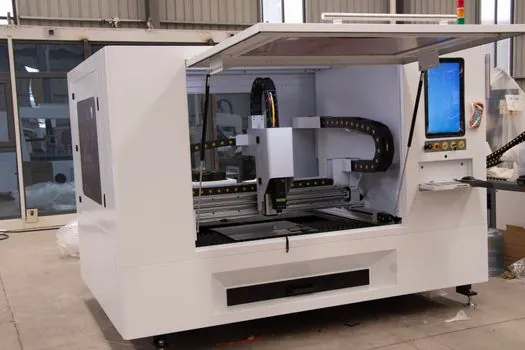
Two verifiable signals worth re-checking before placing a PO: the exact laser source brand and serial on the proforma invoice (IPG vs Raycus vs Max changes the spares pool and the resale value of the machine), and the chiller make/model, because a generic Chinese chiller paired with a 12kW IPG source is the most common cause of thermal-trip downtime reported back to OEM service lines. The third signal is the CE/ISO 9001:2015 certificate number, which should resolve on the issuer's public database rather than only on a PDF attachment. [S2]
Spec-level background on the components involved: linear guide.