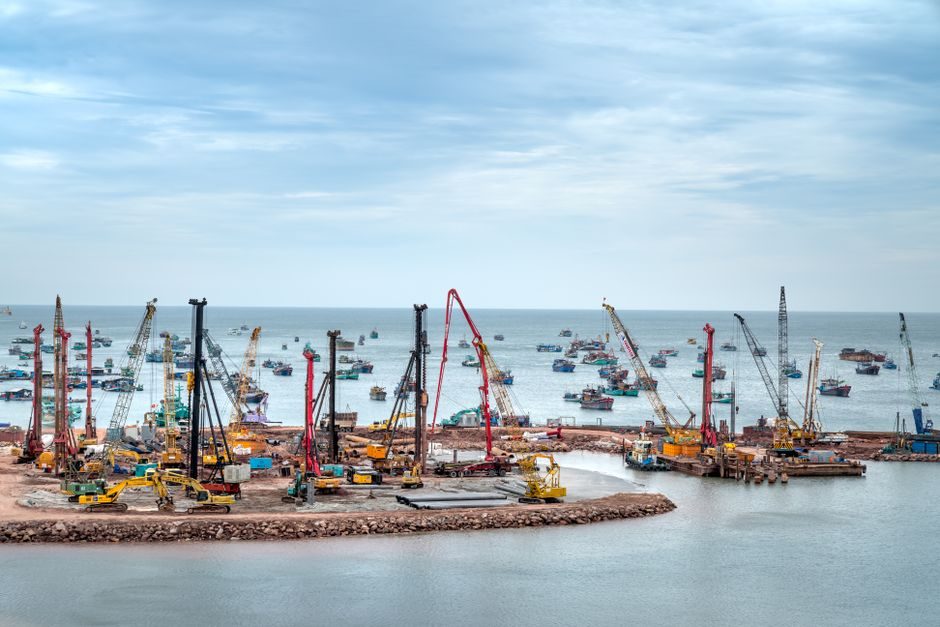
The 2026 crawler crane market is bookended by Liebherr's new LR 12500-1.0 at 2,500-tonne capacity, unveiled 2026-05-18 with the marketing line "game changer for tomorrow's energy" [S2], and a deep tier of sub-100-tonne machines supplied by Chinese OEMs listed on Alibaba's crawler crane category page (snapshot dated 2026-04-13) [S4]. Buyers in mid-2026 are mostly choosing between three structural options: lattice-boom crawler cranes for heavy lift, telescopic crawler cranes for mobility, and used/refurbished units brokered by European hire firms such as Delden Cranes, which markets crawler crane hire, sales, and service across the UK and Europe [S1].
Undercarriage wear is the single largest lifetime cost on any crawler crane. Track shoes, track rollers, idlers, sprockets, and carrier rollers are stocked as dedicated spare parts by suppliers such as EverGrowing and Juyi International, the latter listing 318 crawler crane SKUs alongside 103 mobile crane and 5 tower crane lines on its 2026-06-25 catalog snapshot [S3][S6]. That parts density is the reason a buy-vs-hire decision is rarely just about new-machine price.
Capacity classes and where each one pays back
The 2026 capacity ladder runs from ~80-tonne utility machines up to the 2,500-tonne LR 12500-1.0 and the 3,000-tonne-class LR 13000 above it [S2]. Below 150 tonnes, telescopic-boom crawlers dominate because one machine can self-erect, walk to the next pad, and pick without an assist crane; above 400 tonnes, lattice-boom crawlers win on load-chart reach and reeving efficiency. The LR 12500-1.0's 2,500-tonne rating positions it for large-scale wind turbine erection and modular petrochem/energy assembly, where the boom-and-jib configuration is engineered for component weights typical of next-generation energy equipment [S2].
Buyers should match class to the heaviest single pick on the project, not the average pick. A 600-tonne crane hired for a 200-tonne average is a margin drain; two 350-tonne machines on site are usually cheaper than one 800-tonne unit once standby, transport, and assembly days are priced in. For a deeper comparison with truck-mounted alternatives, the Crawler Crane vs Truck-Mounted Crane: Turning Radius Decision Cut spec sheet lines the two against ground-bearing area, transport width, and road-permit thresholds.
Ground pressure, matting, and site preparation
Ground-bearing pressure is the hidden specification on every crawler crane data sheet. A standard 250-tonne lattice boom with 1.2 m shoes typically exerts 90-120 kPa, while heavy-lift classes with 2-3 m-wide mats drop below 50 kPa; a value above the soil's allowable bearing capacity requires steel mats, timber mats, or a crushed-stone pad. Outriggers do not exist on a crawler — the track frame is the support — which is why a crawler crane specification must be cross-checked against a geotech report before mobilization, not after. [S1]
Two operating constraints drive ground-pressure design: bogie loadout for road transport (axle limits of 10-12 tonnes per axle in most EU states) and track-frame length, which sets the lift reaction envelope. A buyer who ignores both will hit either a transport-permit wall or a pad-failure on first pick.
Boom configuration: lattice vs telescopic vs luffing-jib

Lattice-boom crawlers carry the heaviest charts per tonne of machine weight and dominate the 400-tonne-and-up segment. Telescopic crawlers trade peak chart height for self-erection speed and are the default under 150 tonnes. A luffing-jib attachment extends reach on tight sites where a horizontal jib would clash with adjacent structures or energized lines. The LR 12500-1.0 uses a variable-configuration boom system engineered for the boom-and-jib setups common in wind and energy assembly [S2].
Three boom variables to pin on the data sheet: (1) main-boom length in metres at each reeving stage, (2) jib length range with the heaviest chart at maximum radius, and (3) counterweight slabs and their stacking combinations. A 5% chart shortfall at full radius is the most common spec-trap on tender day.
Transport envelope: width, weight, and modularity</h1> <p>European road rules cap most crane-component transports at 3.0 m wide and 4.3 m height without a special permit, with weight-per-axle limits of 10-12 tonnes. Crawler cranes win on site, lose on road — a 600-tonne machine can require 25-40 truck loads to mobilize, while the same job on a mobile crane typically needs 8-12. Buyers who count transport cost as a line item (rather than buried in mobilization) usually save 15-25% by specifying modular counterweight slabs and a track frame that splits under 3.0 m.</p> <p>Transport planning also drives the buy-vs-hire decision. Delden Cranes and similar European hire operators stock a deep fleet of late-model lattice crawlers precisely because most projects cannot justify owning the transport-and-assembly overhead [S1]. For buyers comparing telescopic crawlers with truck cranes, the 2026 Truck Crane Buying Guide: Capacity, Boom Type, Chassis and Sourcing maps capacity against chassis class.</p> <h2>Undercarriage parts: lifetime cost and supplier landscape
Track shoes, rollers, idlers, sprockets, and carrier rollers are wear items with finite service life tied to ground conditions, duty cycle, and operator behaviour. EverGrowing positions itself as a crawler-crane undercarriage specialist with track shoes, track rollers, idlers, sprockets, and carrier rollers stocked by machine model [S3]. Juyi International, on a 2026-06-25 catalog snapshot, lists 318 crawler crane SKUs, 103 mobile crane SKUs, 5 tower crane SKUs, and 4 telescopic crawler crane SKUs — a 30:1 ratio of crawler to mobile SKUs that signals where Chinese OEM parts inventory is concentrated [S6].
A practical undercarriage rule: budget 8-15% of new-machine price over a 10-year holding period for undercarriage replacement if the crane runs on blasted rock; 4-7% if it runs on prepared mats. That delta alone can swing a hire-vs-buy decision on a 10,000-hour utilization profile.
Selection criteria: telescopic vs lattice vs used
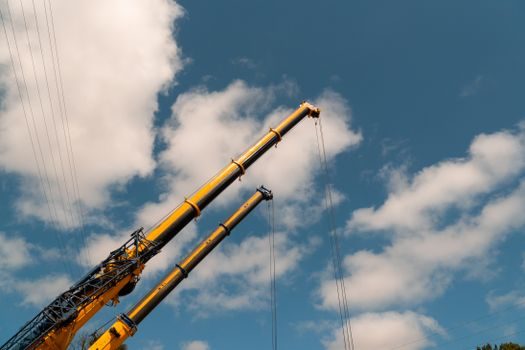
Telescopic crawlers (sub-150 t): best when the job requires frequent repositioning on prepared pads, road-to-site transit without a permit, and self-erection without an assist crane. Lattice crawlers (150-3,000 t): best when the load chart at full radius, the reeving efficiency, and the ground-pressure distribution all matter more than mobilization speed. Used/refurbished crawlers: best when the buyer can absorb a 6-12 month lead time on parts, accept a 60-80% discount off list, and run the machine in a single sector where the operator knows its history — a path Delden Cranes supports through sales alongside its hire fleet [S1].
For buyers sizing the choice against boom type, capacity, and chassis layout, the Truck Crane vs Aerial Work Platform: 2026 Spec Cut for Lift Buyers spec sheet offers a parallel frame of decision criteria, even though AWP is a different machine class.
Who a crawler crane is — and is not — for
A crawler crane is for projects with: (1) heavy single-pick loads above truck-crane practical limits, typically 80 t and up, (2) ground that has been geotechnically surveyed and is rated for the track-frame bearing pressure or can be matted, (3) a long enough site duration to absorb the mobilization and assembly cost — usually 4-6 weeks minimum on the smallest class, longer above 600 t. It is NOT for: short-duration urban jobs where road permits and traffic management dominate, sites without matting or prepared pads on weak soils, or projects that need a machine repositioning hourly — that profile belongs to a gantry crane on rails or a hydraulic truck crane with outrigger spread. [S2]
The 2,500-tonne LR 12500-1.0 is explicitly aimed at the next-generation energy sector, which means a buyer in petrochem, offshore-module yards, or wind-farm erection is the target user; a buyer in low-rise commercial construction is over-spec'd and should look at telescopic crawlers in the 80-150 t band [S2].
Sourcing channels and due-diligence gates
Three channels dominate 2026 sourcing: OEM-direct for new machines (Liebherr, Manitowoc, Tadano, Sany, XCMG, Zoomlion), hire-fleet sales for late-model used units (Delden Cranes-style operators), and Alibaba-tier B2B listings for Chinese OEM new and refurbished stock, with the platform's crawler-crane supplier page indexing Chinese construction-machinery exporters in mid-2026 [S1][S4]. Each channel has a different due-diligence gate.
OEM-direct: serial-number verification, factory acceptance test (FAT) witnessing, CE/UKCA marking audit, and a documented 12-24 month warranty. Hire-fleet sales: full service history, load-moment-indicator (LMI) calibration records, third-party inspection report (typically a 90-day or 6-month return-to-base warranty), and an NDT (non-destructive testing) report on boom pins and load-bearing welds. Alibaba-tier sourcing: factory audit (in person or via a third-party inspector such as SGS or Bureau Veritas), pre-shipment inspection, and a documented spare-parts commitment — Juyi International's 318-SKU crawler catalog is an example of the parts depth a Chinese OEM should be able to evidence [S6].
Independent machine selection also benefits from 3D rigging libraries — TurboSquid publishes 2026-dated 3D models of crawler cranes used for lift-planning simulation, site layout, and rigging rehearsal before mobilization [S5]. The encyclopedia entry on crawler cranes covers the foundational taxonomy these specs sit inside.
Failure modes and operational limits
Three failure modes account for most crawler-crane downtime: (1) undercarriage wear on abrasive ground — track shoes and rollers are the highest-frequency replacement item; (2) boom-pin and slewing-ring fatigue, which a 10-year inspection under ISO 9927 should catch; (3) load-moment-indicator (LMI) drift, which mandates annual re-calibration and a documented calibration certificate for the unit to remain in service in most jurisdictions. Operating outside the published load chart — even within the structural capacity — invalidates manufacturer warranty in most 2026 OEM contracts. [S3]
Wind limits are typically 20 km/h for safe lifting on most lattice crawlers, dropping to 12-15 km/h when personnel baskets are fitted. Buyers should confirm the OEM's published wind-speed-vs-radius table before any site where gust exposure is a concern, especially for the 2,500-tonne class where sail area on the boom itself becomes a limiting factor [S2].
Trackable signals to watch over the next two quarters: OEM announcements of sub-100-tonne telescopic crawlers with electric or hybrid drives (a 2026 procurement trend in EU tenders), any second-tier Chinese OEM entering the 600-tonne-plus lattice class, and revisions to FEM 1.001 / EN 13000 hoisting-class boundaries that re-tier older machines' remaining service life.