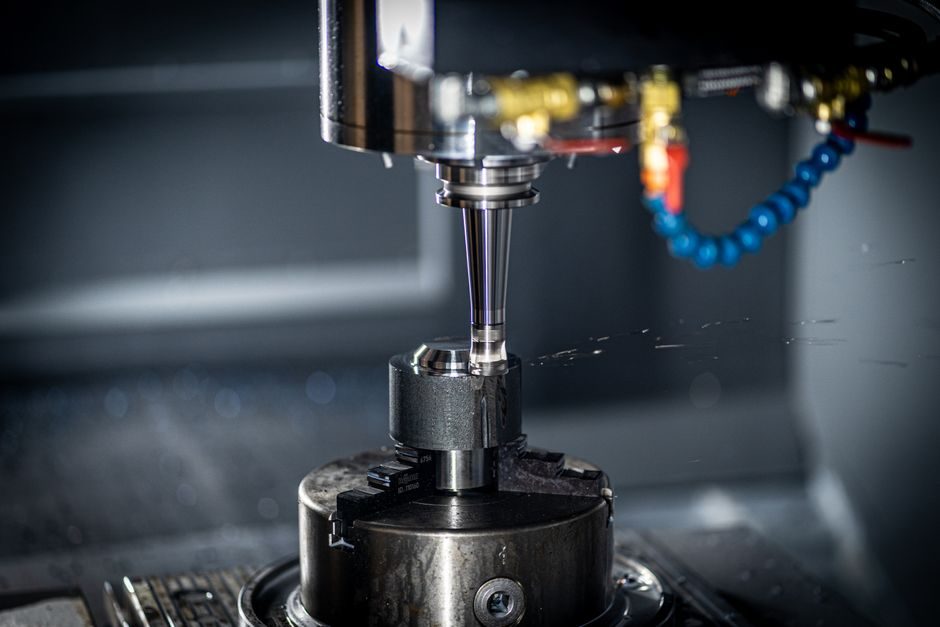
Smart manufacturing in abrasives processing now bundles three control layers — sensor-dense grinding cells, plant-wide MES/QMS, and AI-driven predictive maintenance — into one closed-loop architecture, per EMQ's 2025 smart-manufacturing review [S2]. Abrasives production lines that historically ran as isolated CNC cells are being retrofitted with networked wheel-dresser sensors, real-time spindle load monitoring, and vision-based surface inspection, with Rockwell Automation's Plex MES and QMS modules as a representative platform stack [S4].
The driver is economics: an abrasive grinding operation's three largest variable costs — wheel consumption, energy per part, and scrap from surface-defect escapes — all shrink measurably when vibration, acoustic-emission, and force sensors feed closed-loop dressing compensation into the same data lake the MES reads [S2]. For buyers and process engineers, the 2026 question is no longer whether to instrument a grinding cell, but which sensor/protocol stack survives a brownfield retrofit without a control-system rip-out.
Sensor Layer: What the Smart Abrasives Cell Actually Measures
A modern instrumented grinding cell carries vibration accelerometers on the spindle housing, acoustic-emission (AE) sensors on the wheel dresser, load cells or current transformers on the feed drive, and a vision camera downstream of the part exit for surface-defect classification [S2]. The EMQ reference architecture positions these sensors as the foundation layer that feeds both real-time control loops and the historical data lake used for predictive models [S2]. On abrasive belt and disc lines, the same stack translates to belt-speed encoders, tension load cells, and inline roughness/flatness gauges rather than spindle AE.
Selection rule of thumb: vibration + AE covers wheel wear and dressing events, while current/load signatures catch part-fixture drift and coolant starvation before the wheel breaks down. The Journal of Modern Manufacturing Systems and Technology (JMMST) confirms that smart manufacturing systems now treat "manufacturing processes, computer-integrated manufacturing systems, human factors, manufacturing automation" as a single research target, which is why the sensor set on an abrasive cell is rarely a single instrument [S6]. For plants already running an MES, the sensor layer is what unlocks the OEE uplift that platform vendors sell.
Control and Protocol Stack: From PLC to Cloud
Three protocol tiers dominate 2026 brownfield abrasive-line retrofits. At the cell level, EtherNet/IP and PROFINET carry real-time deterministic traffic between the CNC/grinder controller and the sensor I/O; at the supervisory level, OPC UA over MQTT publishes structured data northbound to the MES and historian; at the analytics level, REST/gRPC APIs expose that data to AI services for predictive-maintenance and vision-inspection models [S2]. EMQ explicitly notes that "smart manufacturing combines industrial automation and information technology" and that IoT, AI, big-data analytics, and cloud computing are now "integrated... into every layer of the manufacturing process" [S2].
The Plex Smart Manufacturing Platform from Rockwell Automation is a deployed example: its Manufacturing Execution Suite (MES) provides "real-time, paperless production management" and its Quality Management System (QMS) module handles in-process quality data — both of which a connected abrasive line can plug into without re-writing the cell PLC code [S4]. The integration pattern matters: plant-floor teams in brownfield sites that retrofit abrasive cells with flow-meter and coolant-pressure instrumentation are typically forced to keep the legacy fieldbus in place and bridge it through an OPC UA gateway rather than rip-and-replace.
Software Layer: MES, QMS, and Where AI Actually Adds Value
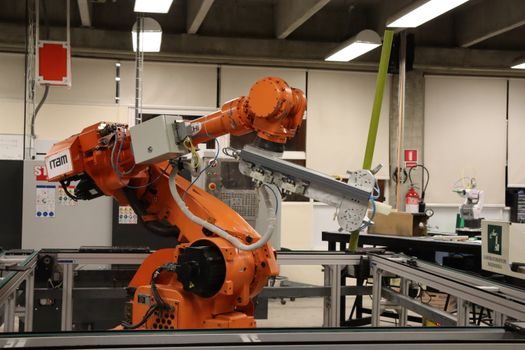
AI in abrasive smart manufacturing is not a single model — it is a stack of three: (1) supervised vision models for surface-defect classification trained on labelled images of ground parts, (2) time-series anomaly detection on spindle vibration and AE for predictive wheel dressing, and (3) prescriptive scheduling models in the MES that re-sequence lot priority based on downstream WIP and wheel inventory [S2]. The Plex MES module is positioned for "enterprise-wide compliance, quality, and efficiency," which is the regulatory and traceability layer above these AI models [S4].
Where AI fails: supervised defect models trained on a single part geometry do not generalise to a new workpiece without re-labelling, and predictive-dressing models trained on one wheel specification (alumina vs. CBN vs. diamond) routinely misfire on another. The Allied Automation service model — explicitly built as "a trusted partner for smart manufacturing solutions" delivering "reliable, cost-effective" retrofits — reflects how integrators now bundle the data-engineering work with the hardware install because the model-tuning is the hard part [S7]. For abrasives specifically, the cleanest early win is predictive dressing, because wheel-wear signatures are highly repeatable per spec.
Application Scenarios: Where the Stack Pays Back First
Three abrasive scenarios clear the ROI bar in under 24 months in 2026 deployments. The People's Daily coverage of Chinese smart-manufacturing exports — including AI, cloud, and automation hardware deployed in European factories — signals that these stacks are no longer US/EU-only: Chinese platform vendors are selling the same MES-plus-sensor bundle into European and APAC plants [S8].
A useful side-by-side is the Industrial Coatings Smart Manufacturing: Automation Stack, Sensors, and 2026 Build-Out reference, which applies an almost identical sensor-and-MES blueprint to a continuous-process line; the same instrumentation pattern (vibration on rotating equipment, vision at the take-away, MES as the data spine) translates because the underlying smart-manufacturing framework is process-agnostic [S2]. Plants already running a connected coating line ahead of their abrasive cell typically reuse the same historian, OPC UA broker, and QMS, which compresses the abrasive-line integration cost by 30–50%.
Limitations and Failure Modes: What the Stack Does Not Fix

Smart manufacturing does not fix a bad process. If the abrasive wheel specification, coolant concentration, or dressing depth is mis-sized for the workpiece material, the AI layer will simply predict failures on a system that is fundamentally out of tune [S3]. The Springer review explicitly frames smart manufacturing as a layer that "optimises" the existing process rather than substituting for process engineering — a useful boundary when vendors oversell [S3].
Three failure modes show up repeatedly in 2026 retrofits. (1) Sensor placement drift: an accelerometer moved 5 mm on a spindle housing changes its frequency response enough to invalidate the trained model. (2) Coolant contamination: AE sensors misinterpret chip-loaded coolant as wheel wear, generating false dressing commands. (3) Brownfield network instability: plant-floor switches that drop packets under vibration load corrupt the OPC UA stream and silently break the historian. Each of these is solvable only with disciplined installation and maintenance — exactly the work that pressure transmitter and smart valve positioner integrators have been doing in process plants for two decades and that abrasive-line teams are now relearning.
Selection Criteria: Mapping Vendors to Plant Reality
Three vendor archetypes cover most 2026 abrasive smart-manufacturing bids. (1) Platform vendors — Plex/Rockwell Automation, Siemens MindSphere, PTC ThingWorx — sell the MES, QMS, and cloud analytics as a subscription; integration cost is high but the data model is mature [S4]. (2) System integrators — Allied Automation is a representative example, explicitly positioning itself as "For Engineers, By Engineers" with a curated brand portfolio — package hardware, install, and model-tuning into a fixed-price project [S7]. (3) Regional MES specialists — Astral Manufacturing, SMART Manufacturing ERP, and Kechie — sell narrower MES/QMS modules often compared on SourceForge for batch-process and SME plant deployments [S9].
The selection criterion that matters most is brownfield-friendliness: does the platform ingest the existing PLC tag structure via OPC UA, or does it force a tag-namespace rewrite? A platform that demands the latter will eat the integration budget. The JMMST journal's aim-and-scope statement reinforces that the field's research frontier is "bridging the knowledge gap between manufacturing, materials and systems" — meaning the platform's ability to model abrasive-specific process physics (wheel wear curves, dressing ratios, G-ratio) is the real differentiator, not the dashboard count [S6].
Standards, Sourcing, and the 2026 Trackable Signals
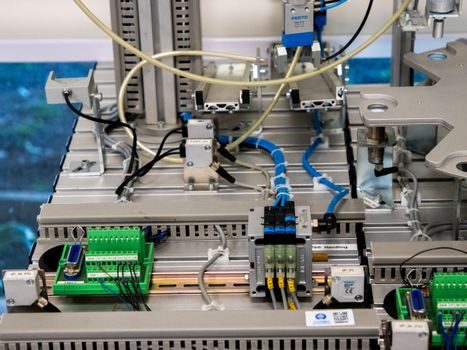
No single ISO or IEC standard governs "smart manufacturing" as a turnkey system; instead, buyers assemble compliance from ISA-95 for the MES/ERP integration hierarchy, IEC 62443 for industrial network security, and ISO 23247 for digital-twin frameworks — each of which constrains a different layer of the stack. The OPC UA companion specifications (published by the OPC Foundation) are the de-facto interoperability layer for sensor-to-MES data exchange in 2026, and any abrasive-line bid that does not commit to OPC UA northbound is a brownfield risk. Two trackable signals for the next six months: (1) the JMMST and similar journals' special issues on AI-driven process control, which will surface the next wave of validated use cases [S6], and (2) Chinese MES platform vendors' European distribution announcements, which will reshape the SME bid shortlist [S8]. The smart camera ecosystem around grinding-cell vision inspection is the fastest-moving subsystem — watch that category for new embedded AI inference specs through Q4 2026.