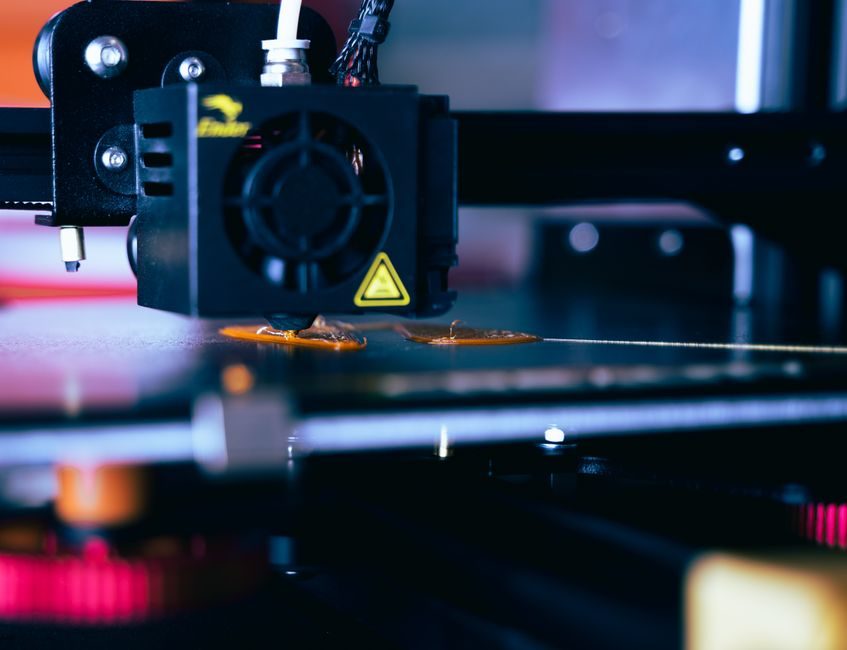
Additive manufacturing supply risk in 2026 is driven by three binding constraints: metal powder lot-to-lot variability, post-processing capacity (HIP, CNC finishing, CT inspection) lagging printer install base, and audit-queue delays for AS9100 and ISO 13485 part qualification at Tier 1 suppliers [S1][S4].
Process engineers planning 2026 H2 builds should treat LPBF and DED metal platforms as constrained not by machine count but by qualified-powder allocation, with 316L, IN718, Ti6Al4V and AlSi10Mg lots commonly booked 8-14 weeks ahead in Western supply chains [S1].
Feedstock constraint: powder atomisation capacity and lot qualification
Gas-atomised 316L powder in the 15-45 µm cut routinely ships in 8-14 week lead times from European and North American atomisers, with particle-size distribution per ASTM B214 and Hall flow per ASTM B213 used as the gate tests in 2026 [S1]. IN718 powder lots above 250 kg are the practical minimum that justifies a new atomisation campaign, and campaigns below that threshold push per-kg cost above USD 80 for aerospace-grade material [S1].
Powder reuse cycles are capped at roughly 15-30 cycles for reactive alloys before oxygen pickup and tensile-ductility drift trigger a reblend, and lot-to-lot chemistry variation on Ni, Cr and O content is a documented root cause of crack susceptibility in LPBF builds [S2]. For procurement teams, the practical lever is locking a multi-lot powder specification with supplier PPAP, not chasing headline per-kg price.
Post-processing bottleneck: HIP, finish-machining and CT queues
Hot isostatic pressing capacity remains the rate-limiter for defence and aerospace Ti6Al4V and IN718 parts in 2026, with cycle times of 4-6 hours at 1163-1260 °C / 100-200 MPa for Ti and 1163-1200 °C / 100-150 MPa for Ni superalloys dominating furnace scheduling [S1]. Industrial-scale HIP vessels above Φ600 × 1500 mm are scarce outside a handful of US/EU providers, and small batch queues can extend 6-10 weeks on standard Argon-fill cycles [S1].
CT inspection throughput is the second choke point: defect detection thresholds of 50-200 µm volumetric per ASTM E1441/E1648 drive scan times of 2-6 hours per aerospace coupon, and AS9100 Nadcap-accredited CT labs report 4-8 week queue positions for Q2 2026 [S1]. Buyers planning prototype-to-flight transitions should pre-book HIP and CT slots before powder allocation, not after the build is on the print bed.
Qualification gap: AS9100, ISO 13485 and ITAR audit queues
AS9100 Nadcap AC7110/12 audits for laser powder-bed fusion and AC7110/13 for DED routinely carry 6-9 month lead times in 2026, and ISO 13485 audits for medical-device AM (cranial implants, spinal cages, patient-specific instruments) layer a separate 4-6 month queue on top of FDA 510(k) review [S1]. For Tier 1 primes, this means a new part entering qualification in Q2 2026 realistically hits production acceptance no earlier than Q1 2027.
The defence-support literature flags that AM-part qualification cost is the hidden multiplier on first-article risk, not the printer CAPEX line, and small-lot defence providers have historically under-budgeted this line by 2-3x [S1]. Practical guidance for buyers is to require suppliers to disclose audit status, FAI methodology and process-capability Cpk values for critical features at RFQ, not after PO.
Material-process risk matrix for 2026 procurement
Risk of supply disruption in 2026 maps cleanly to the matrix: feedstock-atomisation (high for IN718, Ti6Al4V; medium for 316L; low for AlSi10Mg), post-processing HIP (high for Ti/Ni; medium for steels), and qualification audit queue (high for aerospace/medical; medium for industrial tooling) [S1][S2].
A useful baseline comparison: 316L offers the shortest lead time and the lowest qualification cost but tops out around 800 °C service and has limited fatigue life versus wrought; Ti6Al4V commands the best strength-to-weight at 400-500 °C service but the longest powder-and-HIP path; IN718 extends service to roughly 700 °C but carries the highest per-kg cost and the strictest chemistry-control window [S2]. For buyers building a 3D printing supplier and manufacturer directory, the matrix above should drive the first cut of the shortlist, not headline MOQ.
Buyer playbook: hedging the 2026 AM supply window
Three levers move the needle in 2026: dual-source powder qualification across at least two atomisers (ideally one vacuum gas-atomised for reactive alloys, one plasma-atomised fallback), pre-paid HIP/CT capacity reservations written into master supply agreements, and a small stock of qualified substrate coupons for first-article regression testing on new lots [S1][S4].
For industrial buyers, pairing AM sourcing with adjacent categories reduces overall exposure: cobalt and substitution sourcing and helical gear reducer sourcing sit on overlapping metallurgy risk curves, and a consolidated supplier-scorecard across these categories tightens the audit-and-FAI loop. The 3D printing upstream-downstream map is the companion reference when scoping 2026 H2 part allocation.
Limits and failure modes to flag at design freeze
AM parts in 2026 still carry documented failure modes that buyers must plan around: residual-stress-driven distortion on long thin-wall features, lack-of-fusion porosity clustered at overhangs above 45°, and surface-roughness penalties that drive finish-machining allowance up to 0.3-0.5 mm on as-built Ti6Al4V surfaces [S2]. ML-driven scan-path tools are in research use to predict grain orientation from thermal history, but production-deployed adaptive toolpaths are not yet mainstream [S2].
The defence-support literature also notes that AM is not a universal substitute for conventional supply chains: lot sizes below 50, geometric complexity above IP protection, and lead-time tolerance above 4 weeks are the three use-case tests where AM consistently beats conventional paths in field studies [S1]. Outside that envelope, conventional forging, casting or CNC remains the lower-risk baseline.
Trackable signals to watch in 2026 H2: atomisation capacity announcements from the top three Western gas-atomisers (lead-time slippage is the leading indicator), AS9100 Nadcap audit-window publications, and any revision to ASTM F3055 (LPBF part specification) or ISO/ASTM 52920 (process qualification) scope.
For component-level specifications, see additive manufacturing material, dc power supply, and switching power supply.