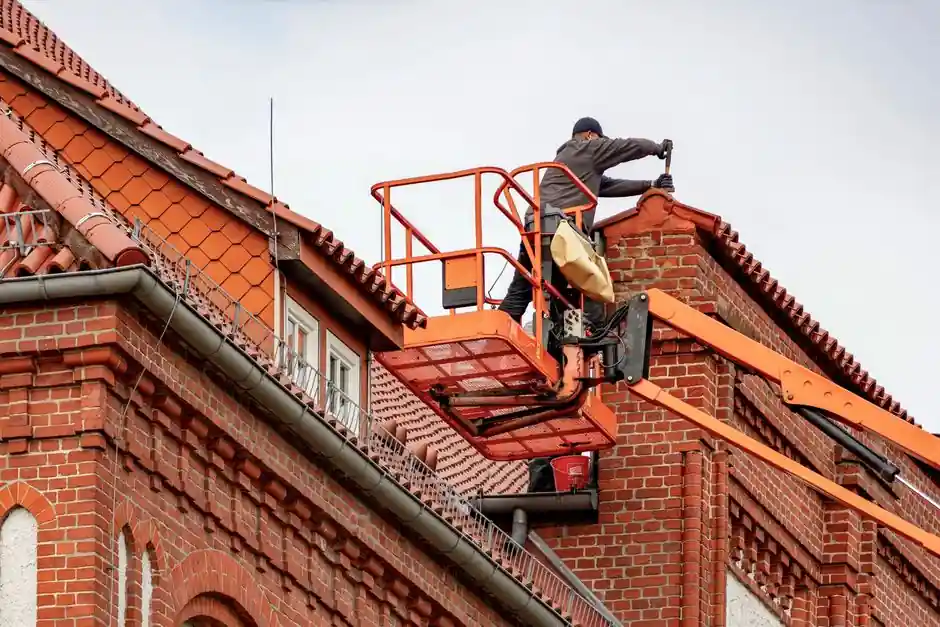
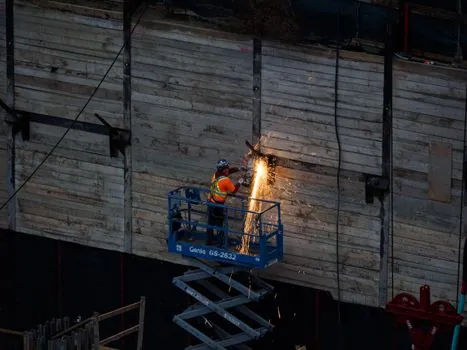
For pipeline right-of-way (ROW) construction, articulating and telescopic boom lifts in the 38-138 ft working-height band dominate equipment lists, while electric scissor lifts (18-63 ft) handle ground-level welding staging and trench-side work [S1][S2]. Truck-mounted and trailer-mounted booms cover the long, linear travel pattern that defines spread pipeline work, where crews move several kilometres per day rather than working a fixed footprint [S2][S4].
The right AWP class is dictated less by raw reach than by four pipeline-specific variables: ground bearing pressure on soft ROW, horizontal outreach across the ditch, hazardous-area classification near live gas lines, and the fall-protection duty cycle under OSHA 1926.453 [S4][S5]. The selection logic below maps each major AWP type to those variables, with the concrete specs and standards a pipeline project engineer actually needs to verify.
AWP Class Definitions and Pipeline-Relevant Working Heights
Five mechanical classes of aerial work platform are in routine pipeline service: vertical masts (13-26 ft), scissor lifts (18-63 ft), articulating booms (38-136 ft), telescopic booms (52-138 ft), and truck- or trailer-mounted booms (41-71 ft on tow units) [S1][S2]. Each class moves the operator through a different kinematic envelope, and that envelope is what determines pipeline fit, not the marketing brochure.
Articulating booms add a knuckle joint above the lift cylinder, so the basket can reach over a trench wall, around a valve tree, or under an existing bridge crossing; telescopic booms trade the knuckle for a single straight extension and gain 5-15% net horizontal outreach at the top of the lift envelope [S2][S4]. For welding on a 48-72 in. diameter main, the working point is typically 8-14 ft above grade, which a 26 ft vertical mast or a 32 ft scissor can reach; for coating, UT inspection, or sign-off on a 36 in. riser, a 60-80 ft articulating boom is the common selection [S1][S3].
Pipeline Selection Criteria: Ground, Outreach, Hazard Zone, and Duty Cycle
Pipeline ROW is rarely a finished surface: it is a stripped topsoil strip, a ditch line, or a temporary mat road. Tracked or rough-terrain boom lifts with 4-wheel drive and oscillating axles are the default for unpadded ROW, while wheeled electric scissor lifts are restricted to completed station pads and compressor yards [S3][S4]. Haulotte's published working-height bands (vertical masts 13-26 ft, scissor lifts 18-63 ft, articulating booms 38-136 ft, telescopic booms 52-138 ft) match the four pipeline duty cycles: low-level welding staging, mid-level valve and fitting work, high-level riser and tie-in work, and over-pipe crossings [S1].
Outreach is the second hard number. For a typical 6 ft wide, 8 ft deep pipeline trench, a boom needs at least 10-12 ft of horizontal outreach from the lip of the trench to position the basket over the pipe centreline without the chassis standing on the trench edge [S2]. For above-ground piping at a compressor or pump station, the basket must reach over handrails, cable tray, and inline instruments, which is where a 20-30 ft articulating-joint offset on a 100+ ft boom becomes the deciding spec [S1][S3].
Hazardous-area classification ties to product flow, not job type. A natural-gas compressor station falls under NEC Class I, Division 1 or 2 Group D (or ATEX Zone 1/2 Group IIA) inside the fenced enclosure, and any AWP operating there must be supplied as a fully electric, intrinsically safe unit with no hot surfaces or arcing contacts above the defined hazardous area [S5]. Diesel-powered booms are barred from those zones and are instead staged at the perimeter, which often forces the selection of two machines per site: a diesel rough-terrain boom outside the fence and a certified electric articulating boom inside [S3][S6].
Duty cycle on pipeline spread work is the final differentiator. A 200 km mainline spread relocates the AWP 2-6 times per day, and a truck-mounted boom (41-71 ft on trailer units) lets the carrier vehicle tow the lift between spreads at posted road speeds, which collapses the mobilisation cost versus a self-propelled boom that needs a lowboy each move [S2][S4]. For station work with a fixed footprint, a self-propelled articulating boom is more productive because no tow vehicle is tied up [S3].
Comparison of the Four AWP Classes Used in Pipeline Construction
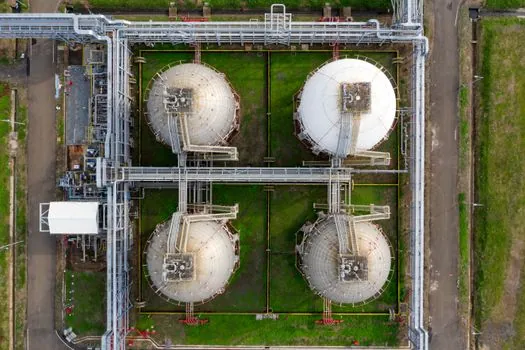
The four classes line up against pipeline selection criteria as follows. (1) Vertical mast / electric scissor: lowest ground pressure, quietest, suitable for indoor compressor-station mechanical rooms; limited to 26-63 ft platform height with zero horizontal outreach beyond the chassis, so unusable for any work where the basket must reach over an obstacle [S1][S2]. (2) Articulating boom: 38-136 ft platform height, 20-30 ft of knuckle-joint offset, diesel 4x4 or electric; the most versatile class for valve trees, risers, and trench-side tie-ins [S1][S4]. (3) Telescopic boom: 52-138 ft platform height, longer straight outreach at the top of the envelope, single-joint simplicity, suited to long straight-reach tasks like sign-off inspection of continuous above-ground pipe [S1][S2]. (4) Truck- or trailer-mounted boom: 41-71 ft platform height on tow units, road-speed mobility, lower daily cost on long spreads, but smaller working envelope and lower live-axle load rating on rough ground [S2][S4].
The trade-off is consistent: more outreach and higher platform mean heavier chassis, higher ground pressure, and a need for matting or a prepared running surface. For typical 36-48 in. mainline construction, an 80 ft articulating boom on a 4x4 diesel chassis is the most common single-machine spec; for 56 in. and larger, the spec typically steps up to a 100-120 ft articulating or telescopic boom on a 4x4 chassis with outrigger pads [S1][S3].
OSHA, Training, and Inspection Requirements on the Pipeline Spread
OSHA 29 CFR 1926.453 governs aerial lifts in construction and is the controlling US regulation for pipeline work, requiring pre-start inspection, a competent-person evaluation of the ground, and a body belt or harness with a lanyard attached to the boom or basket [S4][S5]. The same OSHA source material notes that falls from ladders and scaffolding account for over 20,000 workplace injuries per year in the US, which is the underlying safety case for selecting an AWP over a ladder or tube-and-clamp scaffold on every task where the AWP envelope fits [S5].
Operator training is not optional: OSHA requires that only trained, evaluated operators use an AWP, and a typical pipeline project will hold a 4-8 hour operator course plus a documented familiarisation on the specific make and model before any basket goes up [S5][S6]. Daily pre-use inspection must cover tyres or tracks, hydraulic hoses for chafe, basket entry gate, upper and lower controls, and the load chart; any outrigger that does not seat on firm ground or mat is a stop-work item under the same OSHA rule [S4][S6].
Limitations and Failure Modes to Engineer Out of the Selection
Tip-over is the dominant AWP fatality mode, and on pipeline ROW it is almost always a ground-pressure problem, not a machine problem: a wheeled articulating boom can exceed 90 psi ground pressure at the outrigger pad on soft topsoil, and a tracked boom sits lower but still needs a level pad within the manufacturer's published slope limit (commonly 5 degrees side slope, 10 degrees fore-aft) [S5][S6]. Selecting an AWP without verifying the published ground-bearing pressure against the actual ROW soil is the most common engineering error in pipeline AWP specification [S3][S6].
Wind is the second hard limit. Most boom lifts derate or shut down above 28 mph platform wind speed, and a 100 ft boom at full extension develops a large sail area; pipeline welds and coating work typically stop wind above 20-25 mph regardless, so the AWP limit and the work limit are usually aligned [S5]. Hazardous-area compatibility is the third constraint: a diesel boom near a live gas line is a permit violation, and selecting the wrong power source for the zone is a project-stopping mistake that the spec sheet has to catch before delivery [S3][S6].
Cross-Reference to Adjacent Pipeline Equipment Selections
Boom-lift selection on a pipeline spread runs in parallel with three adjacent equipment picks: the pile driver for trench shoring and pipeline supports, the concrete pump for any thrust block or anchor pour, and the rough-terrain forklift for handling pipe segments and skids. A pile driver spec map for pipeline trench work is laid out in Pile Driver Selection for Pipeline Construction: Class, Spec, and Soil Match, and the boom-class, chassis, and duty-cycle logic for truck-mounted AWPs at the same sites is detailed in Picking the Right Aerial Work Truck for Pipeline Construction in 2026, both of which use the same ROW-ground and outreach logic as the AWP selection above. [S2]
For an encyclopaedic background on the equipment category itself, see the aerial work platform reference, and for the truck-mounted variant that pairs the boom to a road-going chassis, the aerial work truck entry covers chassis, outrigger, and live-axle load ratings. Pipeline construction in general is classified under construction machinery and equipment, and the broader construction tools reference covers hand-power and small-power tooling used in the basket.
The verified AWP market is reported at USD 33.88 billion by 2032 with an 8% CAGR for 2026-2032, which signals continued OEM capacity additions and stable rental pricing through the 2026-2027 pipeline construction window [S8]. Watch for two trackable signals: OEM announcements of new electric articulating booms in the 60-80 ft band with ATEX Zone 2 compatibility, and rental-fleet additions of 100 ft+ telescopic booms on tracked undercarriages for soft-ROW work, both of which directly respond to the ground-pressure and hazardous-area limits that govern the selection above [S1][S3][S8].