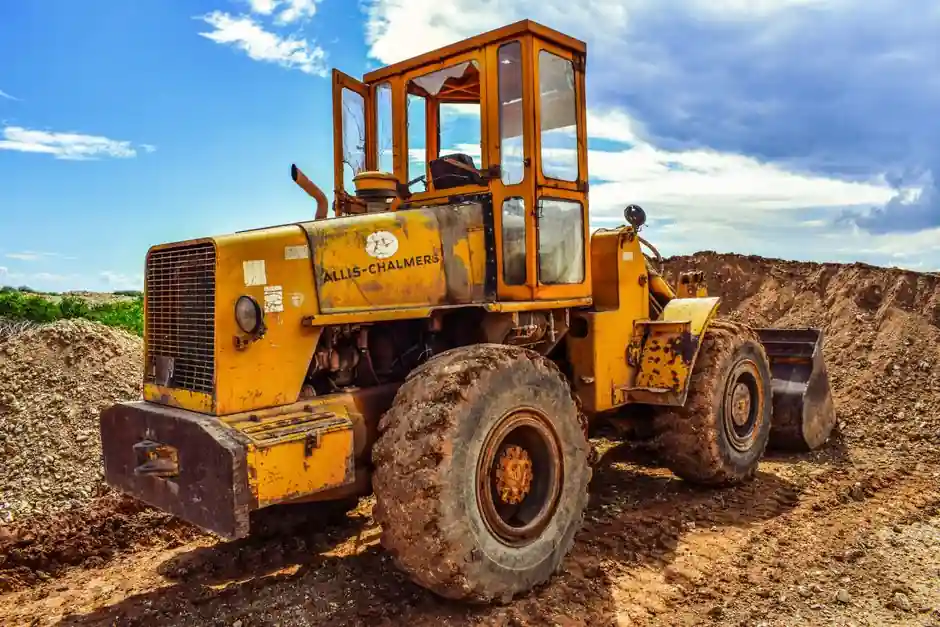
Wheel loaders are segmented into five practical families used across construction, mining, agriculture, and waste handling, with selection driven by operating weight, bucket capacity, and ground-pressure limits [S2][S4].
The category covers everything from 1,300 lb skid-steer frames up to large front-end units that can hold roughly 18 tons per pass, and OEM catalogs list bucket, grapple, fork, and broom attachments as standard interchange points [S2][S4]. For a working baseline of what a wheel loader actually is before the family breakdown, this article lines the main types against operating weight, bucket volume, typical ground pressure, and primary duty cycle.
Five Operating Families and Where Each One Earns Its Keep
Wheel loaders are commonly grouped into compact wheel loaders, skid-steer loaders, backhoe loaders, front-end loaders, and articulated (or skip) loaders, with the split driven by frame size, steering geometry, and attachment interface [S2][S8]. Compact wheel loaders favor tight urban sites and landscaping because of their narrower wheelbase and lower fuel burn; skid-steer loaders are the go-anywhere precision tool for confined spaces; backhoe loaders add a rear excavator to the front bucket for combined dig-and-load cycles; front-end loaders remain the bulk-earthmoving workhorse; and articulated loaders solve long-haul, low-ground-pressure quarry and aggregate duty [S2][S3][S8].
Within those families, operating weight and bucket capacity are the two numbers that actually decide fit. Skid-steer small frames carry 1,300 to 1,750 lb, medium frames 1,750 to 2,200 lb, and large frames from 2,200 lb upward [S2]. Front-end loaders push into the 5 to 50 t operating-weight band and can move a full 18 t payload in a single bucket cycle when matched to large quarry faces [S4]. For teams spec'ing across adjacent construction machinery and equipment categories, the wheel loader's distinctive role is bulk rehandling at high cycle rates, not precision lift.
Bucket Capacity, Operating Weight, and Ground Pressure: The Decision Triangle
Selection between families usually reduces to three numbers: bucket volume in cubic meters, operating weight in metric tons, and ground pressure in kPa. Compact and skid-steer machines sit under 6 t operating weight with buckets in the 0.4 to 1.5 m³ range, suitable for finished surfaces and landscaping [S2][S5]. Mid-size front-end loaders cover 6 to 20 t with 1.8 to 4.5 m³ buckets, the work range for general construction and road building. Large front-end and articulated loaders sit above 20 t with 4.5 to 12 m³+ buckets, the quarry, mining, and port rehandling band [S3][S4][S5].
Ground pressure matters as much as bucket size on soft or reclaimed ground. Wheel loaders spread load through pneumatic tires rather than tracks, so a 20 t wheeled machine on standard 26.5R25 tires exerts roughly 80 to 110 kPa ground pressure, against 40 to 55 kPa for a comparably sized track-type dozer [S4]. That is the reason articulated wheel loaders dominate soft-floor aggregate yards and quarries with poor underfoot, while track loaders take over on finished asphalt and steep grades [S4][S6]. On spec sheets, check three figures in this order: bucket struck capacity (m³), static tipping load full-turn (kg), and break-out force (kN); together they set the real production rate.
Application Matrix: Construction, Mining, Agriculture, and Snow/Waste
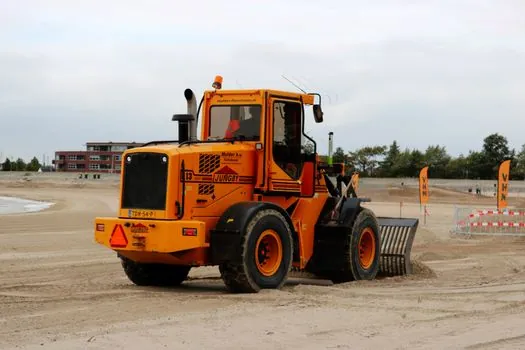
Construction covers the largest share of wheel loader duty, with general construction, building and housing, and demolition all named as primary application buckets in major OEM catalogs [S1]. The same OEM taxonomy also flags aggregates, quarrying, and road work as core segments, plus landscaping and agriculture at the compact end [S1][S3]. Beyond bulk loading of sand, gravel, soil, coal, and ore, a wheel loader will dig shallow trenches, grade sub-base, rehandle stockpiles, load haul trucks, and clear demolition rubble in the same shift [S5].
Agriculture, mining, and snow/waste each have distinct spec requirements. In agriculture, compact and small skid-steer machines feed silage, move bales, and clear livestock yards, with the 1,300 to 2,200 lb skid-steer band doing most on-farm work [S2][S3]. Mining and quarrying push the fleet toward 20 to 50 t front-end and articulated loaders with 4.5 to 12 m³ buckets and reinforced bucket liners, sized for 18 t per pass in iron-ore and aggregate pits [S4]. Snow removal and waste handling sit on the same chassis but rely on quick-change attachment hydraulics so that a bucket can be swapped for a snowblower, broom, or grapple in the same day [S2][S4].
Comparison Pass: Compact, Skid-Steer, Backhoe, Front-End, Articulated
Compact wheel loaders typically operate at 3 to 6 t with 0.4 to 1.5 m³ buckets, low ground pressure, and a tight turning radius, fitting landscaping, urban utility, and small site prep [S2]. Skid-steer loaders sit at 1.3 to 4.5 t with 0.2 to 0.8 m³ buckets and the smallest footprint; their trade-off is higher ground pressure and a tendency to rut soft ground, so they suit finished surfaces and small demolition more than bulk earthmoving [S2].
Backhoe loaders combine a front bucket (around 1 m³) with a rear excavator, typically 6 to 10 t operating weight, fitting utility trenching and small site excavation where one machine must dig and load [S2]. Front-end loaders are the 6 to 50 t bulk class, 1.8 to 12 m³ buckets, used for quarry, mining, and large construction [S4][S5]. Articulated loaders split the difference with a hinge between front and rear frames, dropping ground pressure and improving traction on soft or muddy haul roads, and are favored for long stockpile-to-truck cycles [S8].
Who Should Use Which Type: Operator and Site Profile
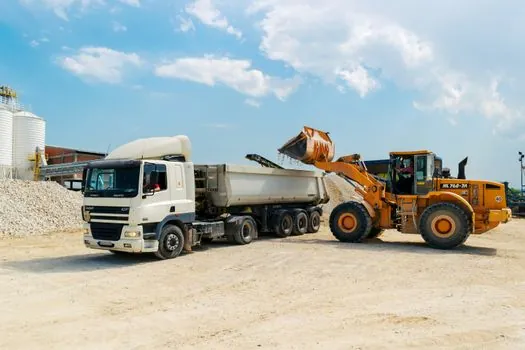
A small contractor doing residential landscaping, driveway base prep, or yard cleanup should default to a compact wheel loader or large skid-steer, where the 1,300 to 2,200 lb capacity band covers most material moves and the narrower chassis protects finished surfaces [S2]. A municipal or utility crew doing trenching, pipe laying, and small excavation is a stronger fit for a backhoe loader, which combines the front loading function with a rear hoe and removes the need to mobilize a second excavator [S2].
Bulk earthmoving contractors and quarry operators are the right fit for mid-to-large front-end and articulated loaders, where the 5 to 50 t operating class and 1.8 to 12 m³ bucket range drive production rates that smaller machines cannot match [S4][S5]. Conversely, skid-steers and compact loaders are a poor match for high-volume quarry or mining duty, since the smaller bucket and lower static tipping load cap cycle rates well below what 20 t+ machines deliver, and the higher ground pressure will rut soft stockpile floors [S2][S4]. For teams running adjacent fleets, a backhoe loader and a skid steer loader cover small-site work that a full-size front-end loader cannot economically reach.
Standards, Attachments, and Sourcing Cues
Wheel loader bucket interfaces are largely standardized around the OEM quick-coupler pattern and ISO 24410-style coupler geometry, which is why a single fleet can run buckets, grapples, forks, brooms, snowblowers, and breakers from the same machine [S2]. The common attachment list across sources includes buckets, grapples, pallet forks, trenchers, brooms, snowblowers, rock saws, mulchers, bale spears, backhoes, dozer blades, and augers, with selection set by the host machine's auxiliary hydraulic flow (l/min) and pressure (bar) [S2][S4].
On the duty side, the major OEM primary-application taxonomy lists agriculture, building and housing construction, demolition, general construction, landscaping, and waste handling as named segments, with quarry, mining, and aggregates covered under heavy construction [S1]. Two reliable signals to track into 2026 are the rollout of more electrified compact wheel loader platforms in the 1 to 6 t class, and tighter Stage V / EPA Tier 4 Final emissions documentation for the mid-size band, both of which affect total cost of ownership more than headline bucket size [S1][S5]. For an adjacent look at how a mid-size wheel loader pairs with a compactor on earthmoving work, the wheel loader vs road roller spec match article gives a side-by-side reading.