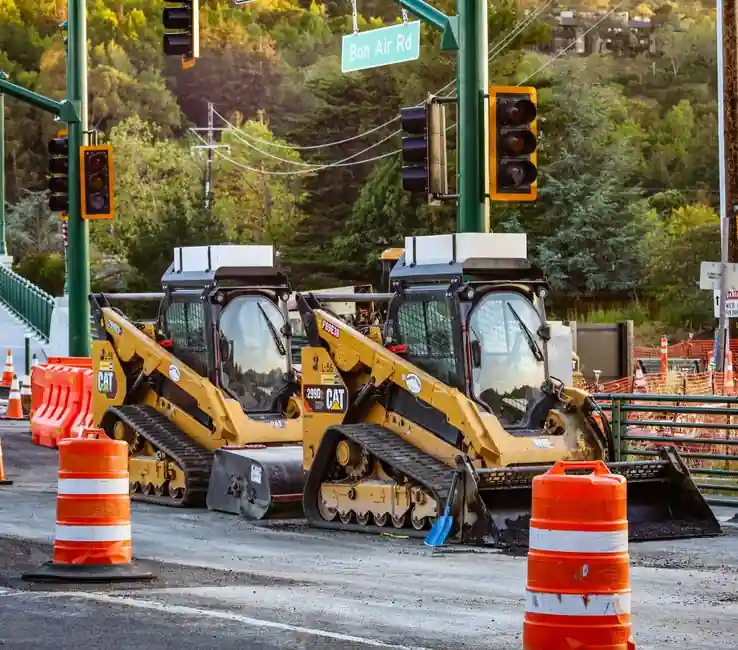
On road construction, choosing the wrong aerial work platform costs more than the rental itself: a scissor lift bogged on a soft subgrade halts a paving train, and a boom lift without 360° rotation forces repeated repositioning inside a live traffic zone. The current generation of China-built self-propelled units covers 7.7-12 m working heights with 360° rotation, while truck-mounted models such as the GK20-GK75 series extend that to 20-75 m [S1][S2].
For a site engineer, the practical decision tree is short: work height, ground pressure, reach envelope, and power source. Each gate is verifiable on the nameplate, and the OKorder and Made-in-China supplier data published 2026-07 through 2026-08 shows a clear segmentation between compact self-propelled scissor/boom units (MOQ 1-4 sets, 30-500 units/month supply capability) and heavier truck-mounted platforms from Jining, Yangzhou, and Shenyang clusters [S1][S2][S3].
Height class and model codes: 7.7-12 m self-propelled vs 20-75 m truck-mounted
The GTZ series self-propelled articulating-boom lifts published on OKorder 2026-07-18 list max working heights of 7.7, 9.7, 10.5, and 12 m, paired with max turning radii of 1.5, 2.2, 2.7, and 3.2 m and 360° rotation across the family [S1]. That envelope maps cleanly to road construction use cases: 7.7-9.7 m for signage and luminaire maintenance on two-lane highways, 10.5-12 m for variable-message signs and gantry inspection.
Truck-mounted platforms from Jining Baoliwei, also surfaced on 2026-08-08, span the GK20 through GK75 range, where the numeric suffix corresponds to platform height in metres [S2]. The same supplier offers complementary chassis: 4-25 t truck cranes, 3-12 t spider cranes, 14 m and 6 m scissor lifts, and mini skid-steer loaders, a one-stop spec map that lets a contractor match the access platform to the lifting and compaction fleet already on the job [S2].
Ground conditions: outrigger pad pressure and slope limits
On unbound road subgrade, a self-propelled scissor lift exerts higher point load than a wheeled boom lift of the same platform area because the wheelbase is shorter. OKorder's GTZ-6 entry lists a 1.5 m turning radius, a useful proxy for tight wheelbase and high localised ground pressure on soft fill [S1]. Where the subgrade is fresh MBC or cement-treated base, a 4-point outrigger truck-mounted platform is the lower-risk choice because the load spreads through stabiliser pads sized to the chassis.
Road construction sites also impose longitudinal slope limits, typically 5° for scissor lifts and up to 10° for boom lifts, but those values are OEM-specific and must be read from the operator manual rather than inferred. A trackable signal: Manlift Group's 2026-08-09 portal update explicitly markets IPAF and PASMA training alongside its articulated, telescopic, scissor, spider, and vertical lift rental fleet, a sign that the European rental market is hardening the training gate around the same time that Chinese OEMs push the height envelope [S5].
Boom type comparison: scissor, telescopic, articulated, spider
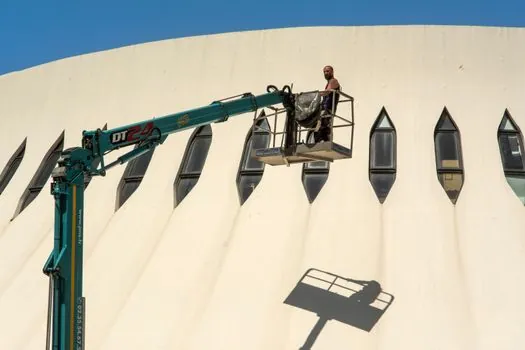
Four boom architectures compete for road work, and the choice is governed by reach envelope, deck footprint, and weight. A scissor lift gives a purely vertical envelope at the lowest cost per metre of platform, but its wider deck raises wind load on elevated signage work. Telescopic booms give a straight outreach with limited articulation, useful for reaching over a barrier into a single traffic lane without repositioning. Articulated booms like the GTZ-6 to GTZ-12 combine a knuckle joint for up-and-over access, and the 360° rotation on every published GTZ variant removes the need to slew the chassis on a live lane [S1].
Spider lifts, the 3-12 t class supplied by Jining Baoliwei alongside its truck cranes, are the outrigger-dense option for bridge undersides and embankment work where ground footprint must be minimised [S2]. A criteria-based read: scissor for flat paving decks and indoor bridge boxes, articulated for live-lane signage, telescopic for straight outreach over barriers, and spider for bridge soffit and pier-cap access where outrigger spread is constrained.
Suspended platforms: when the boom is not the right tool
For vertical facades such as bridge piers, sound barriers, and retaining walls, a suspended platform is the correct category rather than a boom lift. Shenyang Huacai's pedal-type suspended platform, in production since the 2010 Made-in-China listing, runs at 300 sets/month from a 5-set MOQ, indicating an established low-cost supply for high-altitude coating and inspection work [S4]. Beijing Jinfei Tianhong's suspended platform, listed on go4worldbusiness 2026-01-29, is similarly positioned for "nearly all kinds of construction work or complex environmental projects" requiring rope-access-style vertical travel [S6].
The limit of a suspended platform is wind: rope-suspended platforms are typically derated or taken out of service at sustained winds above 12-15 m/s, whereas an aerial work truck with an enclosed platform can continue into higher wind bands subject to OEM chart. For road projects above 30 m, such as cable-stayed bridge pylons or viaduct piers, the truck-mounted boom remains the only practical carrier because the rope length of a suspended platform becomes unwieldy above that height [S2][S4].
Power, drivetrain, and supplier concentration
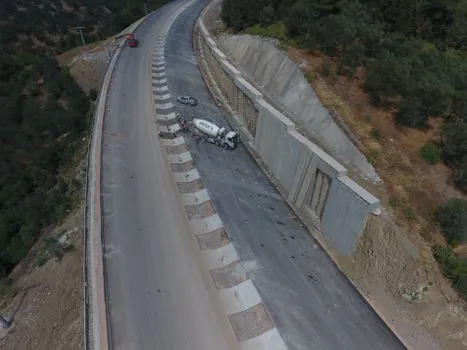
Diesel-powered truck-mounted platforms dominate the road-construction segment because they self-deploy between spread-out work points without a battery cycle limit. The Jining-based supply cluster, anchored by Baoliwei at South of Provincial Road 338 in the Jining Economic Development Zone, exports to North America, South America, Southeast Asia, Africa, the Middle East, Eastern Asia, and Western Europe, with peak and off-season lead times both within 15 working days and Incoterms covering FOB, EXW, CFR, CIF, DDP, DAP, and FCA [S2]. Yangzhou Yixiang Special Vehicle, registered 2009 and based in Jiangdu North Industrial Park, layers aerial platforms, road sweepers, and work trucks into the same product family, a useful single-vendor option for contractors who want one warranty party [S3].
For a trackable signal in the wider lifting fleet that often shares a road site, the truck crane selection map for pipeline construction covers the 5-25 t chassis that frequently share an outrigger mat with an aerial platform, and the truck crane selection playbook for snow removal documents the same 4-25 t envelope under cold-weather derating, two adjacent specs worth reading before locking a platform chassis [S2].
What the supplier data does not answer
The published supplier pages do not state wind-rating charts, live-load distribution, or ATEX/IECEx zone ratings, so any spec involving explosive atmospheres near fuelling points or bitumen tanks must be sourced from the OEM operator manual, not the trading-platform listing [S1][S2][S3]. The data also does not differentiate Tier 4 Final / Stage V diesel emissions compliance for European or North American delivery, an increasingly common rejection cause at port. For European Union deployment after 2025, confirm the engine family emissions stage in writing before issuing a purchase order; the Made-in-China and OKorder pages do not surface this gate.
Trackable signals to watch: Manlift Group's customer-portal rollout on 2026-08-09 indicates that European rental specialists are investing in operator-certification and utilisation-tracking software, a likely procurement precondition for contractors tendering for state-funded road work [S5]. The Yangzhou and Jining supplier clusters continue to add product categories (road sweepers, spider cranes, multi-functional platforms) at the same Made-in-China storefronts, suggesting consolidation rather than fragmentation in the China-sourced aerial-platform supply base through the second half of 2026 [S2][S3].