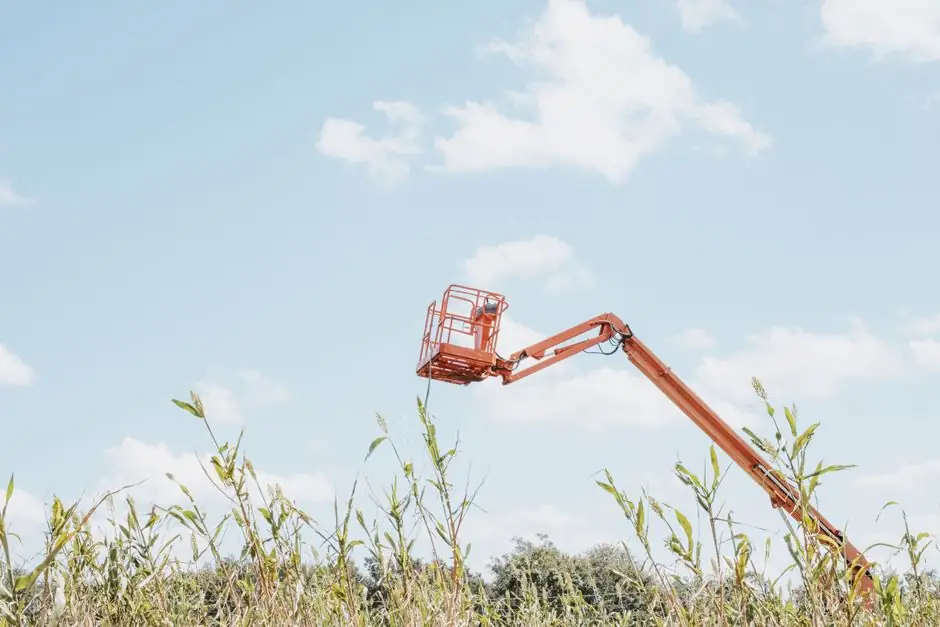
Landfills need an aerial work truck in the 55-75 ft working-height class on a 4x4 chassis, with dual outriggers, a non-insulated articulating-telescopic boom, and a corrosion-resistant bucket to handle gas-well, leachate, and flare-stack access [S2][S3].
The application envelope is the binding constraint: crews must reach landfill gas (LFG) wellheads, condensate traps, flare pilot assemblies, and stormwater outlet structures across sloped, rutted, and often wet cover, and a standard 35-45 ft sign-and-lighting unit does not deliver the side reach or the ground clearance that this duty cycle demands [S1][S2].
Operating Envelope: Why 55-75 ft Is the Landfill Sweet Spot
Most LFG wellfield components sit on 6-10 ft risers inside a 30-50 ft horizontal offset from any access road, so an effective working height of 55-75 ft pairs with 25-40 ft of horizontal outreach to cover a typical well without truck repositioning [S2][S3].
Standard bucket-truck offerings in the 35-75 ft band cover most landfill service tasks including gas-well sampling, flare igniter service, and leachate manhole access, while the high-reach 75-328 ft class is engineered for transmission-line and wind-turbine duty and is overkill for routine wellfield work [S2][S4]. Crews that handle elevated flare stacks above 50 ft can justify stepping to 75 ft, but anything beyond that wastes tare weight, fuel, and outrigger pad area on soft cover.
Boom Architecture: Articulating-Telescopic vs Telescopic
An articulating-telescopic (knuckle-plus-stick) boom reduces tail swing and lets the bucket reach over a parked wellhead riser from a lane offset, which is the dominant landfill access pattern because cover and access roads rarely align [S1].
A pure telescopic (squirt) boom gives the longest horizontal reach but no knuckle to fold around obstructions, so it forces the truck to back closer to the wellhead and onto less-compacted cover [S1]. For landfill routes where the access lane is one truck-width back from the well, the articulating-telescopic and overcenter variants in the 55-75 ft class cut repositioning cycles and let the truck stay on the perimeter road. Examples such as the Terex LT40 and Versalift VST-7500-E108 illustrate the articulating-telescopic pattern, with the overcenter option extending side reach beyond the truck centerline for forestry and utility crews [S1].
Chassis, Drivetrain, and Ground Pressure
Specify a 4x4 chassis with dual hydraulic outriggers, engine horsepower matched to a 33,000-44,000 lb GVWR class, and wide outrigger pads to spread load on cover that typically measures 1,200-2,000 psf allowable bearing at the surface but drops sharply after rain [S2].
Two-wheel-drive 4x2 chassis work on paved sites but routinely bog out on wet clay or geomembrane-lined cells, and a single set of outriggers is insufficient where the boom can impose a 15,000-20,000 lb point load at full extension [S2]. For comparison across the duty cycle, 4x4 with full outriggers costs roughly 10-15% more than a 4x2 sign-and-lighting unit but prevents the stranding incidents that drive the real cost on a remote cell. The aerial work platform decision matrix therefore weighs chassis type and outrigger spread before boom height.
Materials, Corrosion, and Hazardous-Atmosphere Considerations
Specify galvanized or powder-coated steel booms, stainless or composite bucket fittings, and dielectric-insulated hydraulic lines on the bucket controls, because LFG contains methane, hydrogen sulfide, and trace VOCs that corrode unprotected carbon steel within 2-3 service seasons [S3].
OSHA 29 CFR 1910.67 governs vehicle-mounted elevating and rotating work platforms and requires that only trained, designated operators run the unit, while ANSI A92.2 sets the design, testing, and maintenance envelope for the aerial device itself [S3]. Insulated booms rated to 46 kV or higher are mandatory for live-line utility work but unnecessary for pure landfill duty, and selecting an uninsulated boom saves weight and cost where no overhead conductors are present. For sites that do cross distribution lines, the reach truck class of booms and the bucket-truck class overlap on working height, but the bucket truck remains the correct pick for personnel access on uneven ground.
Selection Criteria Comparison: Landfill vs Forestry vs Sign-and-Lighting

Lining the three common duty cycles side by side shows why one size does not fit all: a 45 ft sign-and-lighting unit on a 4x2 chassis is a poor landfill truck, a forestry boom is over-built for gas-well work, and a high-reach 150 ft+ unit is wasteful below 75 ft. [S1]
For working height, landfill duty maps to 55-75 ft, forestry to 45-65 ft with low ground pressure, and sign-and-lighting to 35-55 ft [S2][S8]. For boom type, landfill and forestry both prefer articulating-telescopic or overcenter for side reach around obstacles, while sign-and-lighting tolerates straight telescopic for clean truck-lane setups [S1][S8]. For chassis, landfill and forestry both demand 4x4 with outriggers on soft ground, while sign-and-lighting units commonly run 4x2 on pavement [S2][S3]. For bucket, landfill spec asks for corrosion-resistant composite or stainless, forestry spec adds brush guards, and sign-and-lighting uses standard fiberglass [S3][S8].
Procurement, Compliance, and Telematics Signals
Build the procurement spec around OSHA 1910.67 operator-qualification documentation, ANSI A92.2 conformity evidence, manufacturer load-chart verification for the 4x4 chassis at full extension, and a documented corrosion-resistance plan for the boom and bucket [S3].
Specifying these items as contractually required prevents the common failure where a chassis rated for the boom in catalog form is paired with an under-rated axle or tire configuration in practice. The landfill industry's automation push, exemplified by WM's continued collaboration with Caterpillar on remote-controlled heavy equipment following a successful pilot, also signals that the same fleet may soon integrate semi-autonomous aerial platforms, so choosing a chassis and control architecture with CAN-bus or J1939 telemetry is a forward-compatible move [S6]. For fleet planners, the dump truck allocation rule for cell-haul tonnage and the bucket-truck allocation rule for wellfield service both start with the same operating-envelope mapping exercise. Landfills that have already mapped cycle time to truck scale weighbridge throughput can adopt the same methodology to size the bucket-truck fleet against wellfield counts and flare-service intervals.
Two trackable signals: watch for OEM announcements of methane-rated or ATEX-classified bucket options as landfill gas-to-energy fleets expand, and watch for the next round of ANSI A92.2 committee ballots on autonomous platform controls, both of which will reshape the spec sheet for the 2027 procurement cycle.
See also our earlier report, Mining Dump Truck Selection for Road Construction: Payload, Haul Road, and Cycle Match.