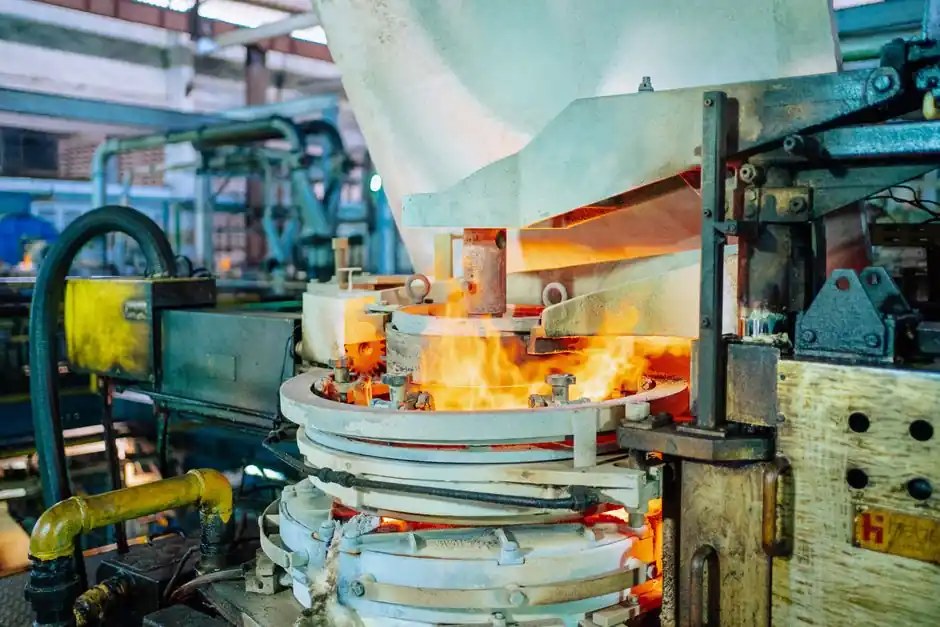
Aerospace shell-core selection is dominated by phenolic-resin hot-cure at 200-300 °C box temperature, with shot pressure locked to the 0.4-0.7 MPa band and cure times of 20-60 s per core [S7][S8]. On 2026 export catalogues, horizontal machines cover 5-50 kg shot weights and vertical machines 8-25 kg, the two envelopes aerospace turbine-blade and structural foundries actually buy.
The 2026 spec window for aerospace sand cores is narrow because aerospace buyers (mostly titanium, nickel-superalloy and stainless castings) will not accept a cold-box amine catalyst flush near a precision mould surface. Shell cores remain the binder system of choice for thin-wall, high-dimension cores, and the machine spec map below is built around that constraint.
Aerospace Core Geometry and Why It Picks Shell, Not Cold Box
Aerospace castings, ranging from IGT turbine blades to hydraulic manifolds, push internal passages down to 2-4 mm wall stock with surface roughness targets around Ra 6.3-12.5 µm on as-cast faces. Shell cores deliver that finish because the phenolic shell cures against a heated, steel-faced tool: the box reaches 200-300 °C, the sand is blown in, and the thermoset skin locks dimension in 20-60 s [S7][S8].
Cold-box cores can match thin-wall geometry in some cases, but the triethylamine (TEA) gas catalyst flush leaves residual amine that is unwelcome in titanium and nickel pouring rooms. For critical-path aerospace cores, shell hot-cure is still the baseline, and the machine spec is sized around the part, not the binder chemistry. Buyers in this segment pay roughly 3-8× the equivalent cold-box box cost for a heated steel or cast-iron shell core box with integrated cartridge heaters and thermocouples [S9].
Platen and Shot-Weight Bands: Horizontal vs Vertical for Aerospace
Horizontal parting-line machines span three catalogued tiers in the 2026 Indian export window: SH1614/SH1616/SH2020 at 5-10 kg shot weight, 400-500 mm platens, 80-150 mm max core box thickness, all pneumatic clamp [S3]; mid-band 25 kg units; and SHT2424/SHT2828 at 25-50 kg shot weight, 600-700 mm platens, 500-700 mm opening stroke, hydraulic clamp, 27-36 kW electric heater and 30-40 kW total machine load [S1].
Vertical parting-line machines cover the lower shot-weight window: SV1814/SV2418/SV3018 at 8-25 kg, 450-750 mm platen, 300-600 mm opening, 9.5-25 kW heater, 80-250 mm box thickness range, 100-150 kg sand hopper [S2]. For aerospace structural cores in the 8-25 kg range, vertical tooling is the natural fit because the part lifts straight up out of the box with no rollover. For a 25-50 kg turbine-housing core, the horizontal SHT2424 or SHT2828 is the realistic floor [S1].
Shot Pressure, Cure Time and Sand Magazine Sizing
Shell and hot-box service both run shot pressure at approximately 0.4-0.7 MPa; pushing above 0.8 MPa accelerates wear on the sand magazine and blow plate 2-3×, which is uneconomic for a low-mix aerospace job [S8][S10]. Cycle time is cure-limited at 30-60 s for medium cores; it is not reducible by blowing harder, only by raising box temperature toward the upper end of the 200-300 °C window [S8].
Sand-magazine capacity, often 80-200 kg on a vertical automatic, is the lever that ties cycle time to the upstream sand-mixing cell. A 100 kg hopper on an SV1814 supports roughly 12 cores at 8 kg each between refills; a 200 kg hopper on an SHT2828 supports only 4 cores at 50 kg, so aerospace buyers running 50 kg-class cores usually spec a remote sand supply or accept hopper refill mid-shift [S1][S2]. The pneumatic supply across every catalogued CFM model is locked at 7-8 kg/cm², which is consistent with the 0.4-0.7 MPa shot band once regulator losses are netted [S1][S2][S3].
Power, Heat-Up and Footprint for an Aerospace Cell
Electric heater draw scales linearly with platen: SH1614/SH1616 use 9.5-10 kW; SH2020 climbs to 15 kW heater and 17 kW total load; SV2418 hits 15 kW heater and 17 kW total load; SV3018 reaches 25 kW heater and 28 kW total load; SHT2424 jumps to 27 kW heater and 30 kW total; and SHT2828 tops the line at 36 kW heater, 40 kW total [S1][S2][S3]. Heat-up time and steady-state box uniformity both depend on heater kW per litre of box volume, so a 600-700 mm platen is not just bigger, it is a 3-4× longer heat soak than a 400 mm platen.
Footprint is the second binding constraint. The SHT2828 occupies 3000 × 3000 × 4000 mm, which doubles the floor of an SH1614 (1200 × 1100 × 2400 mm) and means aerospace foundries running a five-cell layout need roughly 45 m² of clean floor for the large machines alone, plus sand-handling envelope [S1][S3]. For sites that already run hot-box core shooters for energy-equipment cores, the shell-core cell can reuse the same sand supply but should not share a heated-box bay, because cure-temperature setpoints differ.
Who Shell Core Shooters Are For, and Who They Are Not For
Shell core shooters are built for foundries that need 5-50 kg precision cores, hot-cure dimensional stability, and are willing to fund heated steel tooling. They are not the right tool for high-mix, short-run cores below 5 kg (cold-box or hot-box bench units are cheaper), nor for 100 kg+ single cores where a no-bake floor box is the economic answer. Aerospace structural castings, pump and valve bodies for aerospace ground systems, and titanium/nickel investment backup shells sit squarely in the shell envelope; commodity automotive blocks have moved to cold-box, and the shell cell stays the aerospace baseline. [S5]
Within aerospace, the practical rule is: a part with internal passages below 5 mm wall stock, surface finish targets tighter than Ra 12.5 µm, or any titanium/nickel pour should default to a shell core. A part above 25 kg shot weight with a single parting direction should default to a horizontal SHT-series; a part below 25 kg with deep draw should default to a vertical SV-series. Cores that demand very long cure times above 60 s, or that mix metal inserts, are better served by a hot-box route, and hot-box core shooters for telecom-enclosure cores cover that adjacent use case.
2026 Spec Comparison Across Catalogued Models
For an aerospace buyer writing a request-for-quotation in August 2026, the working comparison across catalogued options looks like this, all on a 7-8 kg/cm² pneumatic supply and phenolic-coated sand [S1][S2][S3].
The SH1614/SH1616/SH2020 row is the 5-10 kg horizontal entry tier, 400-500 mm platen, 9.5-15 kW heater, pneumatic clamp, 1200-1400 mm machine length, and 80-150 mm core-box thickness window [S3]. The SV1814/SV2418/SV3018 row is the 8-25 kg vertical tier, 450-750 mm platen, 9.5-25 kW heater, 300-600 mm stroke, 100-150 kg sand hopper, and SV2418 offers a pneumatic-or-hydraulic clamp option [S2]. The SHT2424/SHT2828 row is the 25-50 kg horizontal heavy tier, 600-700 mm platen, 27-36 kW heater, 30-40 kW total load, hydraulic clamp, 500-700 mm opening, 150-200 kg hopper [S1]. Selection hinges on three decision criteria: shot weight (horizontal 50 kg max vs vertical 25 kg max), parting-line direction (horizontal suits two-part box geometry; vertical suits deep-draw single-part boxes), and heater kW per litre of box volume (which sets cure time at constant 200-300 °C).
Selection Signals to Track Through Q4 2026
Two spec nodes are worth watching through the rest of 2026. First, whether any 2026-Q3 catalogue adds a 700 mm+ platen, 75 kg+ shot-weight horizontal tier; the current SHT2828 ceiling at 50 kg is a real bottleneck for one-piece aerospace structural cores, and 17 Indian shell-core-shooter SKUs in the 50-250 kg band already exist in 2026 export data, so a model above 50 kg on a 700-800 mm platen is plausible [S7][S1]. Second, whether phenolic-resin cure times move below 20 s on production tooling: a 200-250 °C box at 0.6 MPa today hits 30-40 s, and a 10-15 s cure would reshape cell throughput, but no catalogue in this research sample claims it [S8][S10]. Aerospace buyers writing RFQs in August 2026 should lock platen, shot weight and heater kW first, then specify cure-time only as a maximum, not a target.
For the relevant spec sheets and selection criteria, see shell core shooter, shell core machine, and shell molding machine.