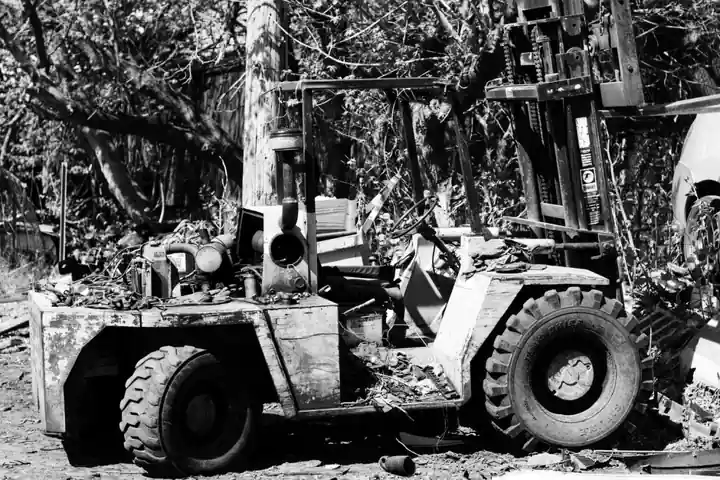
Agricultural operations commonly specify forklifts in the 1,600–2,500 kg capacity band, with rough-terrain pneumatic-tire diesel units as the default for outdoor yards and electric sit-down riders reserved for indoor packing and cold storage [S3][S4].
Selection is governed by four matching decisions: load type (bales up to ~900 kg, palletized feed, live poultry crates, bulk fertilizer), terrain class (paved yard vs. gravel vs. soft field), indoor/outdoor duty cycle, and required lift height. Generic forklift selection criteria apply across industries, but farms add terrain and dust exposure as first-tier filters.
Load Profile and Capacity Banding
Hay bales routinely weigh up to 2,000 lb (~900 kg) and are nearly impossible to move by hand, so a bale-spear attachment on a rated forklift is standard equipment for livestock and hay operations [S2]. General-purpose farm logistics (feed, fertilizer, seed, pallets, livestock equipment) typically fall inside the 1,600–2,500 kg capacity range that dominates the dedicated agricultural-forklift market segment [S3]. Loads above that range push buyers into telehandler or wheel-loader territory, which carry different stability and reach envelopes.
Before choosing capacity, write down the heaviest single load, the most common load, and the worst-case load center. The same truck rated 2,500 kg at 500 mm load center can drop to roughly 2,000 kg at 600 mm; ignoring that derating is the single most common over-spec mistake on small farms.
Terrain Class: Pneumatic vs. Rough-Terrain vs. Cushion
Pneumatic-tire forklifts, essentially warehouse-style forklifts equipped with air-filled tires, are the most common agricultural choice because they handle gravel yards, dirt lots, and field-edge work without constant tire damage [S6]. For genuinely uneven ground (orchards, vineyards, soft-soil fields, construction-grade ruts), purpose-built rough terrain forklifts add large tires, all-wheel traction, differential locks, and elevated ground clearance, features that Combilift lists as standard for its Combi-RT and Combi-LR agricultural lines [S3].
Cushion-tire forklifts have no place on a typical farm: solid cushion tires are designed for smooth indoor floors and will chunk out within hours on gravel. Reserve them for finished concrete in a packing hall, and only when a pneumatic alternative is not available. A simple terrain-vs-tire decision matrix helps here: paved warehouse -> cushion or pneumatic electric; gravel yard -> pneumatic; soft/uneven field -> rough-terrain with AWD and diff lock [S4][S5].
Power Source: Diesel, LPG, or Electric
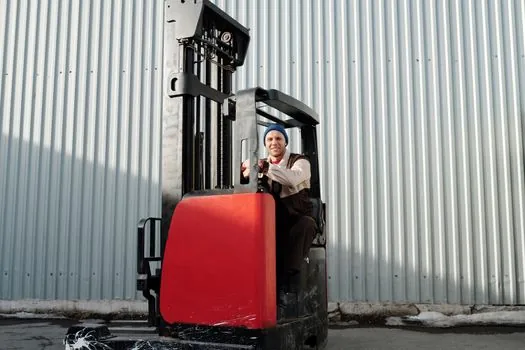
Diesel remains the default outdoor agricultural power source because of fuel economy, torque at low RPM, and tolerance for dust and temperature swings, while LPG and dual-fuel units are common where farms also run indoor sheds needing cleaner exhaust [S3][S5]. Electric sit-down riders with sealed components are preferred inside packing houses and cold storage, where they protect air quality around food-handling zones and avoid moisture damage to the drivetrain [S4].
Battery charging downtime is the real cost of going electric on a farm: a Class I electric sit-down rider typically needs opportunity charging during shift breaks, which only pays off if the duty cycle allows a return to a charging point. For mixed indoor-outdoor fleets, LPG dual-fuel is often the pragmatic compromise, diesel for the field, LPG for the shed, one parts pool.
Specialized Agricultural Variants: Poultry and Bale Handling
Live poultry handling drives a specific sub-type: the Combilift Combi-LR, rated 2,500 kg, offers an offset driving position for clear load visibility, a tight turning radius for barn navigation, and optional enclosed cabs for bird-welfare-sensitive transport [S3]. Bale handling is the opposite problem: low center of gravity, rear or side-shifted mast, and a dedicated bale spear or clamp rather than standard forks, because gripping a round bale with bare forks is a known tip-over risk on slopes.
Attachment choice is part of the forklift spec, not an accessory. Common farm attachments include bale spears, bin dumpers, produce clamps, hay-bale clamps, and sweeper units for cleaning animal enclosures [S2][S4]. A sweeper on a forklift is also the fastest way to clean a barn floor, freeing labor for field work [S2].
Indoor vs. Outdoor: Matching the Operating Environment
The indoor-outdoor split is the most under-weighted criterion in farm forklift buying. A truck that runs 80% of hours inside a cold store has different sealing, tire, and emissions requirements than one that runs 80% in a dusty feedlot, and a single unit rarely optimizes for both. The 2026 selection logic for similar outdoor-heavy agricultural fleets, covered in the wheel loader sizing and engine-power map, follows the same indoor-outdoor-first filter and is a useful cross-check on duty-cycle assumptions. [S1]
For farms that need one truck to do both, an LPG/pneumatic sit-down rider with sealed electrics and an enclosed cab with HEPA-grade filtration is the closest practical compromise. If two trucks are feasible, the more common pairing is a small electric rider for the packhouse plus a 2,000–2,500 kg rough-terrain diesel for the yard.
Selection Criteria Comparison: Main Agricultural Forklift Types
Four practical criteria line the main options up against each other for farm buyers: typical capacity, best-fit terrain, dominant power source, and the use case it actually wins. [S5]
Pneumatic-tire diesel (IC) sit-down rider, 1,500–3,500 kg, gravel yard and field edge, diesel, default outdoor workhorse for mixed farms [S4][S6]. Rough-terrain multidirectional (e.g., Combi-RT), 1,600 kg, uneven/soft field, diesel with AWD and diff lock, orchards, vineyards, narrow shed access [S3]. Specialized poultry handler (e.g., Combi-LR), 2,500 kg, barns and yards, diesel or LPG with offset cab, live-poultry transport where bird welfare drives spec [S3]. Electric sit-down rider with sealed components, 1,500–2,500 kg, paved indoor packing/cold store, electric, food-grade indoor air quality and moisture resistance [S4].
Standards, Safety, and Operator Training
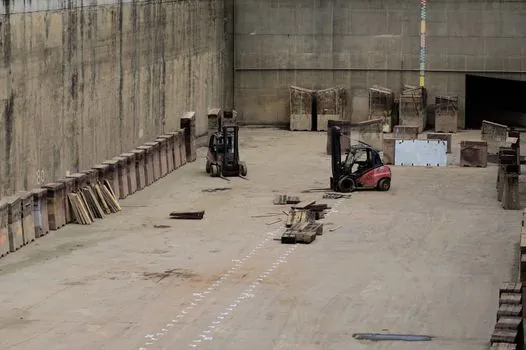
Operator training is non-negotiable on a farm: the single biggest safety gain from introducing a forklift is removing manual heavy lifting and ladder work, but only when the operator is properly certified and the truck is fitted with seat belts, backup alarms, and load-stability systems [S2][S5]. Rough-terrain units add rollover risk on slopes, so OSHA-aligned rough-terrain forklift training and a documented daily pre-shift check are baseline requirements, not optional.
For indoor food-grade use, look for trucks that meet the relevant food-safety and electrical sealing expectations for wash-down environments, and confirm that the mast, hydraulic fittings, and any lubricants are food-grade where incidental contact with produce is possible. Where the truck operates near combustible grain dust, the relevant hazardous-location classification and ignition-protection requirements apply to any electric model specified; the engine and electrical standard set (commonly aligned to IEC 60079-series or NFPA-equivalent dust-zone rules) should be confirmed against the actual zone rating of the installation before purchase.
Limitations and Failure Modes Specific to Farm Duty
Three failure modes dominate agricultural forklift service: hydraulic contamination from dust and chaff, tire failures from stubble and gravel, and corrosion from fertilizer and manure exposure. Each one shortens service life if the spec ignores it at purchase; air-filtration upgrades, heavy-duty pneumatic tires, and galvanized or painted chassis options are cheap insurance relative to downtime. The published 2026 selection framework for rough-terrain forklifts, Class VII subtypes and spec criteria reinforces the same pattern: dust sealing, diff-lock availability, and ground clearance are first-tier filters, not afterthoughts. [S4]
Forklifts are not loaders: trying to use a 2,500 kg forklift as a dozer or a light wheel loader is the fastest way to bend a mast and void a warranty. If the farm regularly needs to push bulk piles, doze grain, or doze snow, a compact wheel loader is the correct tool and belongs on a separate spec; the same indoor-outdoor and engine-power logic that drives agricultural wheel loader selection applies, with a very different capacity and bucket envelope.
Trackable signals for the next buying cycle: (1) OEM rollouts of higher-capacity rough-terrain electric and LPG dual-fuel models in the 2,000–3,500 kg band, driven by Stage V emission pressure on diesel; (2) tightening food-safety and dust-zone regulation on packhouse electric fleets, which will reshape the indoor power-source mix by 2027.
Spec-level background on the components involved: pressure transmitter.