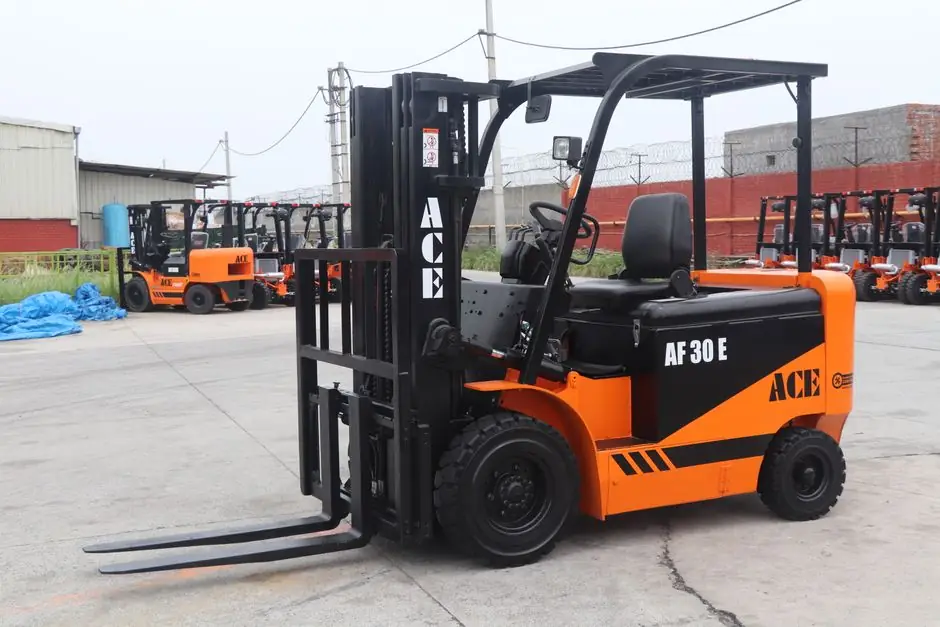
For outdoor farm yards and fields, the default spec is a rough-terrain forklift with pneumatic drive tires, all-wheel traction, and a differential lock, rated between 1,600 kg and 2,500 kg for routine pallet, tote, and bale work [S2][S4].
The decision is driven by four variables: load weight per cycle, ground surface (gravel yard vs. concrete packing-house floor), duty cycle (seasonal peaks vs. daily feed handling), and whether the unit will ever go inside a food-handling space where electric, sealed-component equipment is preferred [S4][S5].
Capacity Sizing Rule: Pallet Plus a Safety Margin
Standard practice in the agriculture sector is to size the forklift at 1.5x to 2x the heaviest single load the truck will pick; for a 3-ton pallet, a 5-ton rated machine is the typical pick, and the margin climbs to roughly 2x as loads approach 8 tons [S3].
On a working farm this maps directly to the bulk loads that show up every season: 1,000-2,000 lb (450-900 kg) seed bags, fertilizer totes over 2,000 lbs, hay and silage bales, and harvest bins moved from field to storage [S5]. Undersizing a farm unit by even 10-15% shows up as chronic tip incidents on slopes and broken mast welds, both of which are routine failure modes in agriculture fleets.
Tire and Drivetrain: Pneumatic vs. Cushion vs. Rough-Terrain
Pneumatic (air-filled) tires are the workhorse of agriculture: they absorb shock on gravel and stubble fields, deliver wet traction in mud, and can be fitted with tractor-grip tread patterns for true off-road use [S2][S7].
Three configurations dominate the sector. A standard warehouse-style forklift with pneumatic tires handles gravel yards and sheds but lacks ground clearance for field work [S7]. A purpose-built rough-terrain model like the Combilift Combi-RT adds tractor-grip tires, all-wheel traction, differential lock, and a high-clearance chassis, rated at 1,600 kg on diesel with hydrostatic drive and three-wheel manoeuvrability for tight shed aisles [S2]. A telehandler (telescopic forklift) covers heavier hay, bale, and loader-tractor duties at 12,000-50,000 lb machine weight with boom reach that a conventional mast cannot match [S8].
Power Source: Diesel, LPG, or Sealed Electric
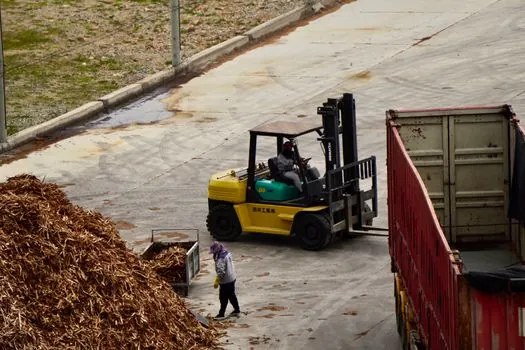
Diesel remains the default for outdoor farm units because of high torque for heavy lifts and long operating hours without battery swap-outs [S2][S5]. LPG shows up as a dual-fuel option where farms want lower emissions around livestock barns; the Combilift Combi-LR poultry handler is offered in both diesel and LPG at 2,500 kg rated capacity [S2].
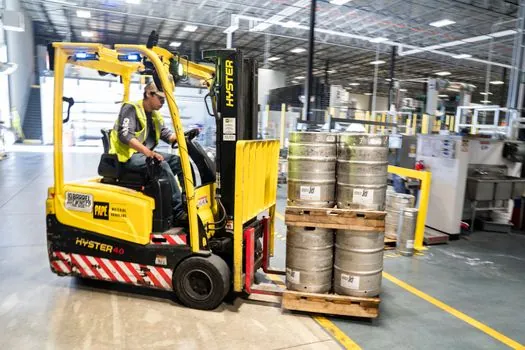
For indoor operations in packing houses and cold storage, electric forklifts with sealed components are preferred to keep moisture and debris out of the drive electronics and to protect air quality in food-handling environments [S4]. Standard electric counterbalance units (DC or AC motor, battery or fuel cell) give low maintenance cost, low noise, and zero on-site exhaust, but they trade run-time and refuel speed for that, so they fit packing-line duty more than harvest-day surge work [S1][S3].
Attachments That Re-Define the Spec Sheet
Agricultural forklifts earn their keep through attachments: bale spears for round or square hay, bin dumpers for harvest totes, produce clamps for fruit and vegetable crates, and bag-handling kits for seed and fertilizer [S4][S5]. Truck-mounted farm forklifts and cranes add a 3-point or chassis-mounted loader rated up to about 8,000 lb capacity, used for in-field unloading of seed and fertilizer tenders where a self-propelled forklift cannot follow [S6].
For selection, the checklist is load type plus reach plus storage height. Bale spears want high ground clearance and low-speed fine control. Bin dumpers want hydraulic side-shift or a rotating carriage. Produce clamps want soft contact surfaces to avoid bruising. Picking the wrong attachment is the most common reason a correctly sized forklift still underperforms on a farm.
Comparison: Which Forklift Type Fits Which Farm Job
Three configurations cover most farm duty cycles, and they line up against decision criteria that matter at procurement:
Standard warehouse forklift with pneumatic tires: 2,000-5,000 kg typical rating, indoor/outdoor, low clearance, lowest acquisition cost, limited rough-terrain ability [S4][S7]. Purpose-built rough-terrain unit (e.g. Combi-RT class): 1,600-2,500 kg, 4WD with differential lock, high ground clearance, hydrostatic drive, premium price but field-ready [S2]. Telehandler: 12,000-50,000 lb machine weight, boom reach for high stacking and loader-tractor replacement, highest cost, needs trained operator and open yard [S8].
Decision rule: if more than 30% of cycles run on gravel, stubble, or wet ground, skip the standard warehouse truck and step up to a rough-terrain or telehandler build; if more than 50% of cycles run indoors in a food-grade space, spec an electric with sealed components even at the cost of run-time.
Operating Limits and Standards to Anchor the Spec
Rough-terrain farm forklifts have to balance three competing demands: lift height, load weight, and slope. For operator certification and load-chart compliance, the relevant framework is OSHA 29 CFR 1910.178 (Powered Industrial Trucks) in the US, which classifies rough-terrain forklifts as a distinct class and requires operator training on the specific truck and attachment combination in use.
Hydraulically, lift, lower, and tilt are controlled by the pressurise-transmit-relieve cycle of hydraulic oil acting through the mast and carriage, with a counterweight keeping the load inside the stability triangle [S3]. When you see a farm forklift rated 2,500 kg on flat concrete but specified at 1,600 kg on a slope, that is the triangle of stability doing the derating, not the engine.
Selection Criteria and Common Failure Modes
Three points decide a farm forklift spec: the heaviest single load including attachment, the worst ground surface across the duty cycle, and the percentage of time spent indoors in a food-handling area [S1][S2][S4]. Matching all three against the comparison above eliminates most mis-specs before any test drive.
The most common farm failure modes are not engine failures but (1) tire damage from stubble and gravel, (2) mast and chain wear from dirt ingress on outdoor units, and (3) electrical faults on electric units used outside their sealed-component envelope. Pre-shift checks on tires, chains, hydraulic hoses, and forks catch roughly 80% of these before they become downtime, and rough-terrain units with sealed electrical bays and enclosed cabs are the practical answer for dust-heavy grain and poultry operations [S2][S5].
Track these signals before purchase: (1) the nameplate capacity at the actual load center the farm will use, not at the standard 24 in., and (2) the manufacturer's published derating curve for slopes, since farm yards rarely match a flat concrete test pad. See how a rough-terrain forklift spec differs from a standard warehouse unit, and use the general forklift reference for mast, carriage, and tire class definitions when comparing bids.
Spec-level background on the components involved: pressure transmitter.
Related analysis: Zinc Die Casting Machine Maintenance for Electronics Housings: 2026 Field Practice.