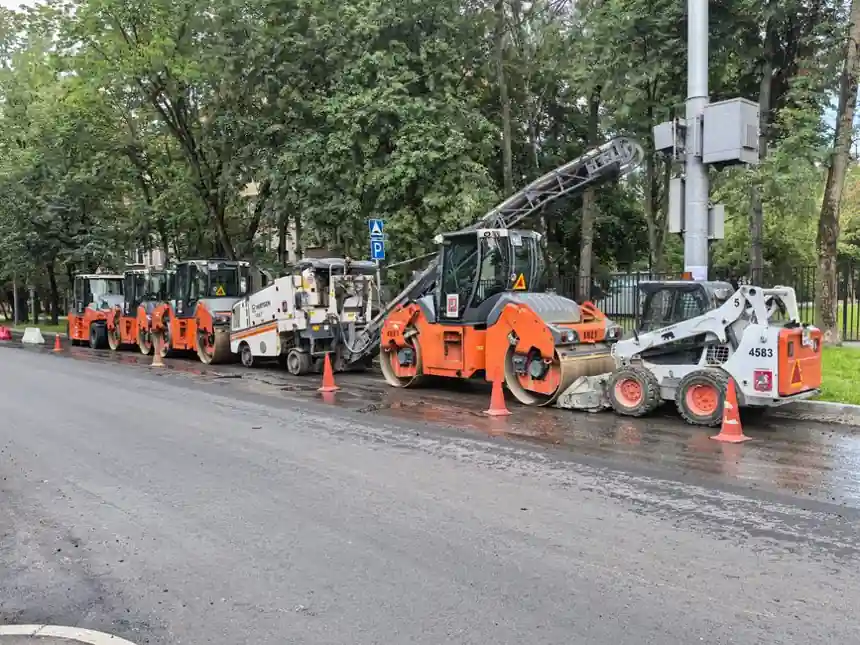
An asphalt paver (also called an asphalt finisher or road paving machine) is a self-propelled construction machine that receives hot mix asphalt (HMA) from a dump truck, distributes it across the paving width, and lays it flat with a built-in pre-compaction pass before the road roller takes over [S5].
The whole process breaks cleanly into two halves: the tractor (material feed system from hopper to auger) and the screed (leveling plus initial compaction). Conceptually, HMA is loaded at the front, carried to the rear by flight conveyors, spread out by twin augers, then floated and pre-compacted under the screed, a sequence that has not changed materially since Barber-Greene introduced the Model 79 in 1934 [S3].
Material Flow: From Truck Hitch to Head of Material
At the front of the paver, push rollers and a truck hitch engage the dump truck so the bed can be raised and emptied directly into the hopper without spillage; the hopper is sized as a temporary storage buffer so the paver can keep laying through uneven truck arrival cycles [S3]. Hydraulically folding hopper wings on either side of the front dump area push residual material back toward the center for the conveyor to capture, increasing effective capacity and reducing waste between truck swaps [S1].
Underneath the chassis, a set of slat conveyors (heavy-duty chain and flight bars) moves the HMA rearward at a controlled rate; the speed is regulated by either variable-speed drives, flow gates, or a fully automatic feed control system driven by cut-off paddles and level sensors [S1][S3]. The auger section at the rear receives HMA from the conveyor, and a dedicated auger on each side spreads it laterally across the paving width, with the gearbox either mounted in the center between the two augers or on the outside edges; independent left/right control allows material to be biased to one side when needed [S3].
The Floating Screed: Why a Heavy Plate Levels a Road
The screed is the most critical component because it sets mat thickness, smoothness, and initial density [S1]. It is mounted on two long tow arms so that it is "free-floating" and not rigidly pinned to the tractor; the long arm geometry acts as a mechanical low-pass filter, averaging out short-wavelength base irregularities so the finished surface is smoother than the underlying grade [S5].
Screed height responds to four control inputs: the attack angle (the tilt of the plate relative to the mat), screed weight plus applied vibration, the head of material in front of the plate, and the towing force from the tractor [S5]. An increase in material head or paver speed forces the screed to rise, laying a thicker mat; a drop in either causes the screed to fall and the mat to thin, which is why constant travel speed and a consistent head of material in front of the screed are non-negotiable for a uniform surface [S5]. The screed is heated (electrically or by gas) to prevent HMA from sticking to the plate, and most modern units add a tamper bar or vibratory beam running at high frequency for pre-compaction, with some intelligent models using Beidou positioning or laser leveling for closed-loop automatic grade and slope control [S2].
Tracked vs. Wheeled Pavers: When Each Layout Wins
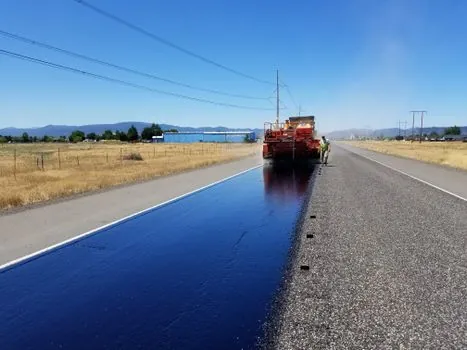
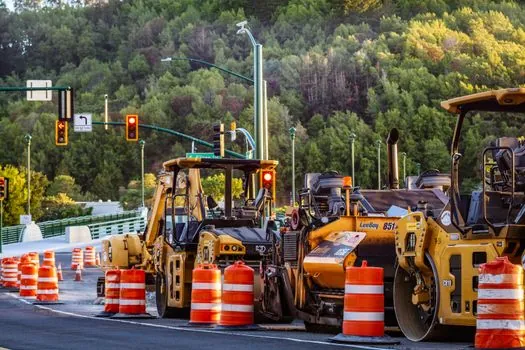
The choice between tracked and wheeled undercarriage is governed by subgrade condition, slope, and inter-site transfer speed. Tracked pavers deliver higher traction and stability on unimproved, soft, or steeply graded surfaces, making them the default for highway base lifts and uneven terrain [S1][S2]. Wheeled pavers trade that grip for higher road speeds on hardened surfaces, so they are favored on urban jobs where the machine has to drive between patches under its own power [S1][S2].
For material handling, a tracked machine is typically paired with a material transfer vehicle (MTV) and hopper inserts to keep a steady HMA supply, while a wheeled machine is often used on shorter runs where the truck can discharge directly and the paver can reposition quickly [S3]. Across both layouts, the working principle of feeding, laying, vibrating, and finishing is the same; only the propulsion and stability systems differ.
Operating Limits and Common Failure Modes
Three operating limits recur across the references: first, paver travel speed and material head must be matched, otherwise the mat thickness drifts up or down in real time [S5]; second, conveyor and auger throughput must be balanced, since an inadequate head of material under a center-mounted auger gearbox leaves a thin longitudinal streak in the mat [S3]; third, screed temperature must stay high enough that the mix does not stick and tear, which is why electric and gas screed heaters are standard rather than optional [S2].
On wide paving widths, auger extension and screed extension geometry introduce additional constraints: screed extensions must be matched to auger reach to avoid starve-out at the edges, and tamper bar or vibratory frequency must be tuned to layer thickness to avoid over-compaction of thin lifts. The screed itself is split into mechanical-fixed and hydraulic-retractable types, with hydraulic retractable screeds preferred where width changes are frequent, such as parking lots and tapered urban sections [S2].
Spec Selection Criteria Compared
The following decision matrix lines the two main undercarriage options up against the criteria that actually drive a procurement call: [S4]
Tracked pavers win on traction, slope tolerance, and mat stability on soft subgrade, but lose on inter-site transfer speed and require more ground preparation to avoid pad wear. Wheeled pavers win on transfer speed, lower ground pressure on finished surfaces, and lower ownership cost for city work, but lose on slope grade and on consistency over weak base. For mid-size highway work, the tracked paver with hydraulic retractable screed and automatic grade/slope control is the typical default; for municipal patch and parking-lot work, the wheeled paver is usually the better fit. Either way, the working principle laid out above, hopper to conveyor to auger to floating screed, does not change; only the envelope around it does [S1][S2][S3][S5].
Standards, Sourcing, and the Wider Equipment Chain
No single ISO or EN standard governs the asphalt paver as a whole machine, but the placement process it sits inside is anchored by HMA mix-design standards and by the roller-compaction pass that follows; the paver delivers initial density only, and final density is achieved by the road roller in a separate operation [S5]. The Barber-Greene floating-screed patent (U.S. 2,138,828, granted 6 December 1938) is the historical reference for the free-floating screed concept that every modern machine still uses [S5].
For procurement teams evaluating complete paving trains, the paver is rarely specified in isolation: it is paired with a pressure sensor-grade monitoring loop on the screed tow arms, a flow meter on the HMA transfer line, and a PLC that closes the grade, slope, and feed-control loop, with screed heaters and vibration drives governed by the same controller. For related material-selection work on the road-build side, the HMA aggregate chain and wear-liner choices in the hopper and auger trough overlap with the same family of decisions covered in guides such as the Industrial Solvent Selection for Construction: Chemistry, Specs, and On-Site Fit reference, since both hinge on the same supply-chain, spec-sheet, and on-site fit discipline.
Trackable signals for the next planning cycle: (1) wider adoption of factory-integrated 3D grade control replacing add-on sonic ski sensors; (2) growth of electric and hybrid paver drives for tunnel and indoor paving where diesel exhaust is restricted; (3) tighter integration of hopper level sensing with truck dispatch to cut paving stoppages at the truck hitch. None of these change the hopper-conveyor-auger-screed sequence, but each changes how it is instrumented and controlled.