
An asphalt paver is commissioned in stages, not switched on, and the stages map directly to NIOSH exhaust-control guidelines (Publication 97-105) [S1] and to NICET Level I/II construction-materials testing performance measures (codes 0207-1101 through 0207-3123) [S4].
The gates cover mechanical, thermal, electronic, and mix-handling checks, and they exist because most mat defects that show up in the first 24 hours trace to a missed pre-pave step rather than a bad mix design [S3].
Pre-Shift Mechanical Inspection: Walk-Around Gates
A pre-shift walk-around is the first commissioning gate and the cheapest insurance on the job: a 1997 NIOSH study found that paver downtime and fume excursions correlate with deferred maintenance, and NIOSH still lists daily checks as the baseline control for highway-class pavers over 7,257 kg (16,000 lb) [S1]. The Mitti (SafetyCulture) community inspection template codifies the same logic into a digital checklist covering tracks/tyres, augers, screed extensions, conveyors, fluid levels, and leak paths [S2]. NICET Level I performance measure 0207-1112 ("Verify current calibration for Level I tests") and 0207-1113 ("Verify proper equipment operation for Level I tests") are the inspector-side mirror of the same gate [S4]. A short test sheet of the related family of asphalt paver checks used by contractors is a useful starter, but a 30-page NIOSH document sets the actual engineering floor [S1].
Screed Preheat and Mat-Temperature Window
Screed preheat to 120-160°C is the second gate, and the 40°C window is the practical reason: below 120°C the mix sticks, tears, and drags aggregate across the mat; above 160°C the binder ages faster and fumes spike [S1]. NIOSH specifically tied high-exposure fume events to pavers that started laying without a stable screed temperature, and recommended the operator wait for a steady reading before the first truck [S1]. The same principle appears in commissioning guides for construction machinery and equipment, where thermal soak time is treated as a measured step, not a guess. Infrared surface thermometers are typical here, and a two-minute reading every 50 m is enough to catch drift without slowing the crew.
Feed System Calibration: Sensors, Augers, and the Sonic Eye

Feed-sensor calibration is the third gate, and the one most often skipped under production pressure [S3]. The paver's two auger sonic eyes (or mechanical paddles) are set so the head of material sits at the auger centerline plus roughly 100-150 mm; running the head higher starves the screed and shows up as centre-of-paver streaks under 1 m long in the segregation worksheet taxonomy [S2]. Level II performance measure 0207-3119 ("Establish roller patterns") and 0207-3121-3123 (equipment verification, maintenance, and calibration) explicitly assign these checks to a qualified technician, not the operator [S4]. Conveyors and auger bearings should run for at least 10 minutes loaded with mix to confirm flight wear, chain tension, and flight-to-screed clearance before the first 50 m strip.
Test Strip and Density Verification
The fourth gate is a 50 m test strip with full density and joint verification, and it is where commissioning meets the QC program [S3][S4]. Field density is taken by nuclear or core method (Level I measure 0207-1105: "Perform field density tests of compacted asphalt mixes"), bulk specific gravity is measured (0207-1111), and the maximum theoretical specific gravity (Rice test, 0207-1110) gives the reference for air voids [S4]. A target of 92-96% of theoretical maximum density is the typical contractor working window for heavy-traffic surface courses, with 93-95% as a common tighter band on highways; readings below the band trigger a roller-pattern re-pass before the main run continues [S3]. Longitudinal joints are checked for height difference (commonly 3-6 mm max) and overlap, and the inspector documents the rolling sequence, the lift thickness, and the mix temperature at placement.
Comparison of Commissioning Methods: Manual Walk-Around vs Digital Checklist vs NIOSH Engineering Controls

Three commissioning approaches dominate the field, and they trade cost against documentation depth. A manual walk-around is essentially free, but produces no timestamped proof and no chain of custody, which hurts when an owner later asks why a section raveled [S3]. A digital checklist (Mitti / SafetyCulture and similar tools) adds timestamped records, photo attachment, and accountability signatures for under 100 USD per site per month, and the Asphalt Paver Inspection and Asphalt Segregation Worksheet templates can be reused on every shift [S2]. A NIOSH-aligned engineering-control package adds the exhaust-ventilation specification, fume baseline readings, and a written standard operating procedure aligned to Publication 97-105, and is the right call on any highway-class paver over 16,000 lb or on projects where worker exposure to asphalt fumes is monitored as part of the safety plan [S1]. The decision criterion is the documentation burden you owe the owner: digital checklist covers most commercial lots, NIOSH-aligned package covers state DOT and federal-aid work.
Operator Qualifications and What Auditors Look For
Commissioning credit on public work usually depends on a NICET Level I or II technician on site, and the 0207 series is the specific code auditors cite [S4]. Level I covers field density, gradation, asphalt content, and calibration verification (codes 0207-1105 through 0207-1113) [S4]. Level II adds aggregate specific gravity, sand equivalent, LA abrasion, Marshall and gyratory compaction, roller pattern establishment, and equipment calibration (codes 0207-3103 through 0207-3123) [S4]. PPE use (0207-1101), safety training (0207-1102), and task-specific hazard reporting (0207-1103) are mandatory in Group A and cannot be substituted by Group B electives [S4]. For projects where compaction, fume, or mat-temperature readings feed into a pavement warranty, the technician's certification is the documentation that survives a dispute.
Common Commissioning Failures and the Defects They Cause
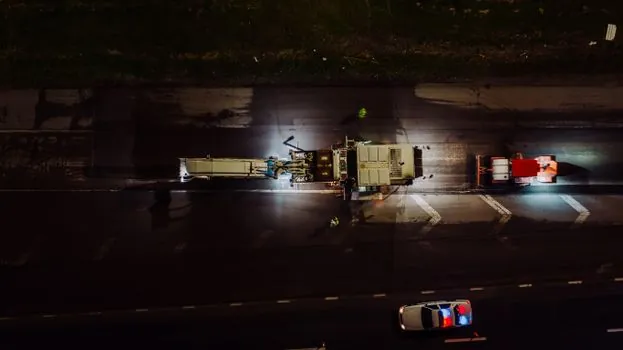
Most early mat defects map back to a missed gate, not a bad mix. Cold screed causes tearing and aggregate pickup at the leading edge; missing auger calibration causes centre-of-paver streaks under 1 m; poor joint matching causes early raveling; inconsistent roller pattern causes low density in wheelpaths [S2][S3]. Field segregation worksheets explicitly list each of these failure modes with measurable thresholds, including segregation patches under 0.1 m² and roller-tire marks, so the inspector can tie a defect back to a specific shift and a specific gate [S2]. The repair is to walk back through the four gates, not to lay more mix on top of a problem.
Trackable signals to watch over the next quarter: NIOSH guidance updates for pavers outside the 1997 highway-class scope, NICET 0207 exam-cycle changes, and the wider rollout of digital paver-inspection templates that bind each gate to a photo and a GPS pin [S1][S2][S4].
Spec-level background on the components involved: tensile testing machine.
Related analysis: Casting Mold Specs for Hardware Manufacturing: Process, Steel, and Envelope.