
Chinese AGV market revenue cleared 9.5 billion CNY in 2024, up from 8.78 billion in 2023, with a 27.50% four-year compound rate; KIVA-class shelf-pickers held more than 60% of unit share in H1 2024 [S3]. For a buyer, that single data point frames the whole price question: KIVA-style mobile rack units dominate volume, but counterbalance stackers, reach trucks and forklift AGVs each carry a different bill of materials and therefore a different price band.
Process engineers, 3PL planners and factory automation leads evaluating their first AGV robot fleet are the target audience. The figures below convert Chinese market data and OEM product line cues into a spec-driven 2026 cost map, with navigation technology, payload, lifting height and fleet software broken out as the levers that actually move the number.
Price bands by vehicle class (2026)
Entry-level QR-code / magnetic-tape AGV robots from Chinese suppliers sit in a 80,000-150,000 CNY band for sub-500 kg tow or unit-load units, based on product-line listings at IKV Robot and Danbach (DBH) covering magnetic guidance, QR code and laser-guided tow AGVs [S1][S2]. Mid-range laser-guided counterbalance stackers in the 1-2 ton class, such as the C2 Pallet Stacker and C3 Counterbalance Stacker lines shown on the Danbach catalogue, cluster at 180,000-350,000 CNY per vehicle, with reach-truck AGVs (C4 Reach Truck AGV) commanding 300,000-500,000 CNY [S1]. Heavy-payload forklift AGVs above 3 tons, including four-way shuttles, range from 450,000 CNY up to 800,000+ CNY depending on mast height, battery kWh and laser-SLAM versus 2D-LiDAR navigation [S1].
Against that hardware spread, the 2024 average selling price implied by 9.5 billion CNY revenue and a KIVA-skewed unit base lands in the 60,000-120,000 CNY range per unit; legacy KIVA-class mobile shelves are a cost-down category, while the forklift/stacker segment is the revenue-up category [S3]. Buyers should anchor on vehicle class first, navigation second, and treat vendor list price as a starting offer rather than a final number.
Navigation and sensing: the biggest single cost driver
Magnetic-tape and QR-code AGVs use passive floor markers and low-cost wheel-encoder odometry; these are the cheapest builds on the market and dominate the sub-150k CNY tier [S2]. Laser-guided (2D-LiDAR reflector) AGVs add a 30,000-80,000 CNY premium per vehicle for the scanner, reflectors and the safety-rated PLC layer that interprets the map [S1][S2]. Laser-SLAM and visual-SLAM units, now standard on newer Chinese OEM reach trucks and four-way shuttles, add a further 50,000-150,000 CNY per truck because of the higher-grade LiDAR, IMU fusion and edge compute.
A side-by-side view of the three navigation stacks a buyer will see in vendor RFQs: magnetic/QR runs 80k-150k CNY with fixed-path flexibility rated low; 2D-LiDAR reflector runs 150k-300k CNY with medium path flexibility; SLAM-based runs 250k-800k CNY with high path flexibility and dynamic obstacle handling. The KIVA-class majority in the Chinese market still rides on QR-code fiducials, which is the structural reason its average selling price sits at the bottom of the 60k-120k CNY band [S3].
Payload, lift and battery: the second lever cluster
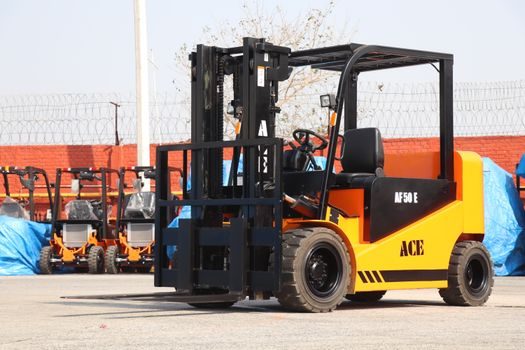
Payload is the cleanest price multiplier. Tow AGVs in the 100-500 kg class list at 60,000-120,000 CNY; 1-2 ton counterbalance stackers at 180,000-350,000 CNY; 2-3 ton reach trucks at 300,000-500,000 CNY; and 3-5 ton forklift AGVs at 450,000-800,000+ CNY [S1]. Lifting height adds roughly 10,000-25,000 CNY per metre of mast above 3 m, because taller masts need reinforced steel, longer lifting cylinders and a stability-rated chassis.
Battery chemistry is the third axis. Lead-acid AGVs are 20,000-40,000 CNY cheaper on the BOM but lose 2-3 hours of opportunity charging per shift; LFP (lithium iron phosphate) packs at 24-48 V / 100-300 Ah are now standard on 2024-2025 builds from IKV and Danbach and add the 30,000-60,000 CNY premium that pays back inside 18-24 months on multi-shift duty [S1][S2]. For a multi-shift 3PL, lithium is the default; for a single-shift factory, lead-acid still pencils out.
Software, fleet management and integration
The vehicle is only half the bill. A WCS / fleet-management licence, the kind that schedules 50-200 AGVs across a warehouse, runs 30,000-150,000 CNY per site depending on module count (traffic, charge, order, KPI dashboards). Integration with ERP/WMS via WMS-AGV adapters adds another 50,000-200,000 CNY for a mid-sized deployment; turnkey projects from Chinese system integrators often quote 1.5-2.0x the hardware subtotal when civil works (magnetic-tape laying, QR-code floor printing, reflector mounting, charger bay wiring) are included. [S1]
For a small factory of 5-10 AGVs, all-in landed cost per unit typically lands at 1.4-1.8x the bare vehicle list price once fleet software, commissioning and one year of service are added. For a 50+ unit fleet, that multiplier drops to 1.1-1.3x because software amortises. Buyers comparing two OEM quotes should always normalise to the same scope: vehicle + WCS + integration + civil works + two-year spares.
Total cost of ownership over a 7-year life

A 200,000 CNY laser-guided counterbalance AGV on two shifts will burn through 80,000-120,000 CNY in lithium battery refresh (one replacement at year 4-5) and 40,000-60,000 CNY in preventive service over its life, putting seven-year TCO at roughly 320,000-380,000 CNY per unit. KIVA-class units at 100,000 CNY entry price, with lower mechanical wear but higher fleet-software amortisation, run 160,000-200,000 CNY seven-year TCO per mobile shelf [S3].
Energy consumption is the smallest line item: a 24 V / 200 Ah LFP AGV draws roughly 4.8 kWh per charge cycle, working out to 1.5-2.5 kWh per operating hour depending on load. At Chinese industrial tariffs of 0.6-0.9 CNY/kWh, that is under 2.5 CNY per vehicle-hour of energy cost — small relative to battery replacement and service, but the line item most often missed in vendor TCO sheets.
Who AGV robots are for — and who they are not for
AGV robots are for: 3PL warehouses moving more than 500 pallets/day with repeatable A-to-B flows; discrete manufacturers with stable production routings (auto, electronics, FMCG palletising); and cold-chain or cleanroom sites where the 24/7 duty cycle justifies the 1.5x integration premium [S3]. They are NOT for: low-mix job shops with frequent layout changes, since magnetic-tape/QR-code paths are costly to re-lay and SLAM units still need 2-4 weeks of map stabilisation; and for sites below 200 pallet moves/day, where a single forklift operator is cheaper than a 5-unit AGV fleet plus a WCS.
For buyers already running a linear guide or crossed-roller guide-based stacker crane, the next automation step is usually an AGV robot shuttle, not a collaborative robot arm — cobots solve picking cells, AGVs solve horizontal flow. Adjacent comparisons in the conveyor world, such as Mesh Belt Conveyor vs Belt Conveyor: Spec Cut for Heat, Load and Duty and Pneumatic Conveying vs Chain Conveyor: Spec-Driven Selection for Bulk Solids, use the same payload-and-environment decision logic and can help normalise the AGV TCO against a fixed-conveyor alternative.
Sourcing reality in 2026
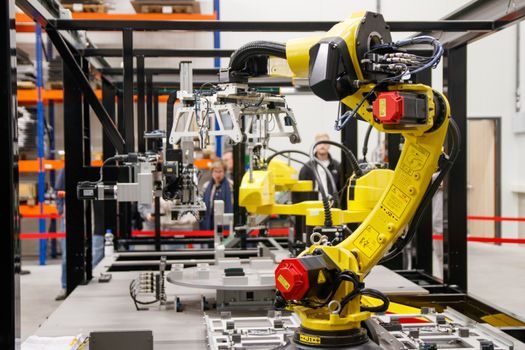
Lead times for Chinese OEM AGV robots in mid-2026 sit at 30-45 days for catalogue units (QR-code, magnetic, standard laser-guided) and 60-90 days for SLAM reach trucks and four-way shuttles, per product pages from IKV and Danbach [S1][S2]. MOQ is functionally one vehicle for catalogue units, with the strongest price breaks at 5+ units for KIVA-class and 3+ units for forklift AGVs. Two verifiable signals to track: (1) whether Chinese system integrators begin bundling fleet-management software into the vehicle price rather than charging a separate licence, which would compress the 1.4-1.8x integration multiplier; (2) whether SLAM navigation drops below the 250,000 CNY entry point as solid-state LiDAR modules reach production scale in 2026.