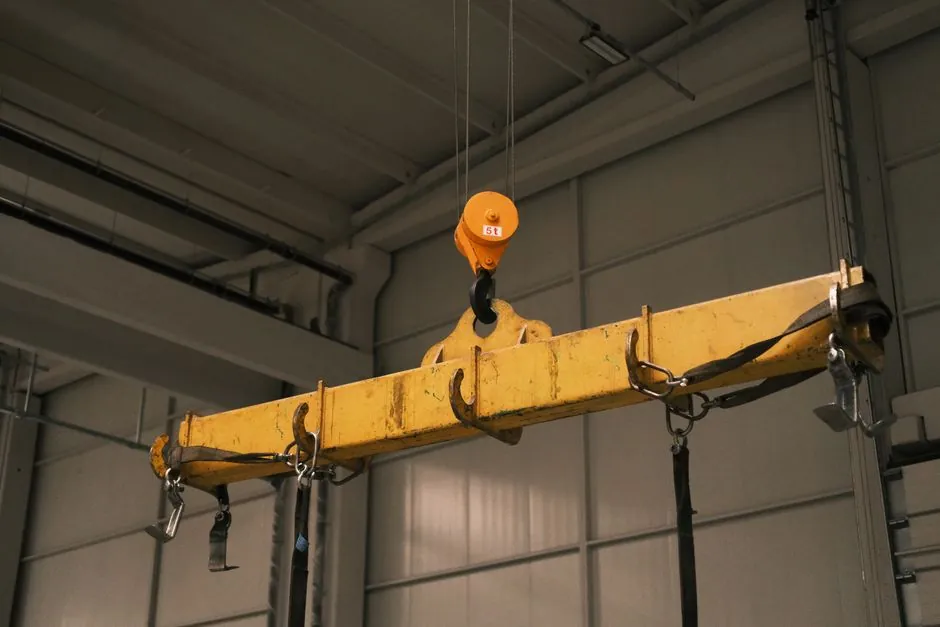
ASRS stacker crane selection is driven by four mechanical decisions: pallet envelope, storage depth (single vs double), fork type (straight vs telescoping fork), and the upstream/downstream conveyor interface, with most reference cells built around the L1200xW1200xH1200 mm pallet [S2].
The system itself is a stack of high-rise racking, one or more stacker cranes, a conveyor line, the Warehouse Control System (WCS) layer, and the Warehouse Management System (WMS) layer; choosing the Access unit as a tray or material box, and the conveyor as roller, chain, or drum, sets the throughput ceiling before any cycle-time math is done [S2].
Pallet, Depth, and Fork-Type Decision Map
The first cut in any stacker crane spec is the unit-load envelope. EBILTECH's reference cell sizes to L1200xW1200xH1200 mm and lets the integrator pick single-depth or double-depth aisles depending on SKU count versus desired storage density, with straight or fork-style extraction chosen to match the rack face geometry [S2]. Double-deep layouts roughly double the rack face positions per aisle but require telescoping forks or twin-deep reach mechanisms, and they add a small indexing penalty to every cycle compared with single-deep extraction [S2][S5].
For lower-throughput lines, a radio-shuttle + stacker hybrid is a credible alternative to pure double-deep: the stacker handles the aisle face, while a pallet runner (radio shuttle) drives pallets deep into the tunnel, so a single crane services more positions and the FIFO-in-random-store behaviour is preserved [S5]. Where cycle time dominates over density, single-deep with straight forks remains the lower-risk baseline [S2].
Drive, Control, and Safety Stack
Modern stacker cranes are coordinated by a PLC plus motion controller, with servo drives on the vertical lift and travel axes and a variable-frequency drive on the auxiliary hoist; Mitsubishi Electric's e-F@ctory stacker-crane solution uses vibration control and position calibration to stabilise the mast at high speed, and runs fault-avoidance logic on the inverter itself to keep cycle times consistent [S3]. Cycle-time reduction, shorter startup, and shorter maintenance windows are explicitly listed as the engineering outcomes of parameterising the inverter rather than hard-coding motion profiles [S3].
Safety is layered, not optional: the crane stability problem (a tall mast carrying a swinging payload at 3-6 m/s travel) is addressed mechanically with anti-sway control and electrically with safe stop on the servo bus, while the operator-side hazard is addressed with light curtains and aisle interlocks tied into the WCS [S3]. For greenfield cells this is now table stakes; for retrofits it is often the single largest non-mechanical line item [S3].
Throughput, Layout, and Cycle-Time Math
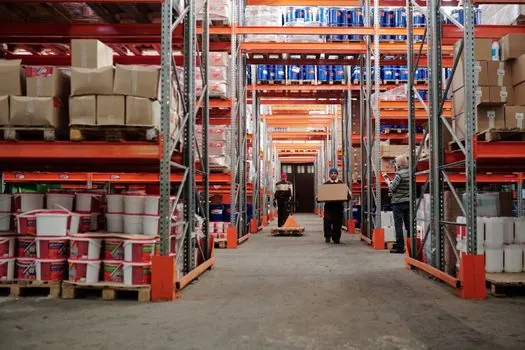
Throughput is a function of crane count, aisle length, and average X-Y-Z travel. ASRS reference designs typically target single-digit-minute SGLI (single-load, single-instruction) cycle times for unit-load cranes, with twin-aisle configurations adding a buffer table at each end of the crane so the stacker never waits on the conveyor [S2]. The pallet-runner hybrid reduces the number of cranes required because each crane covers more positions per aisle, trading shuttle traffic for crane cycle count [S5].
Conveyor pairing matters as much as crane choice. The Pallet Jack-up conveyor, Pallet turntable conveyor, and Pallet chain/roller conveyor are the standard inbound/outbound cells in an EBILTECH-style ASRS, with the level-shifting elevator used when the stacker aisle lives on a different floor from the dispatch conveyor [S2]. Specifying the wrong interface (for example, a drum-type conveyor upstream of a chain-driven crane pickup) is the most common cause of integration slip in retrofits, because the positional tolerance of the upstream cell must be tighter than the crane's fork-insertion window [S2].
Options Comparison: Crane, Hybrid, and Shuttle-Only
Three configurations cover most unit-load ASRS asks, and they line up against density, cycle time, and retrofit cost as follows [S2][S5]:
Pure stacker crane (single or double deep): highest positional accuracy, lowest cycle-time variance, moderate density, higher crane capex per position [S2].
Stacker crane + pallet runner / radio shuttle: density gains of 2-4x over single-deep by extending tunnel length, FIFO supported, slightly higher software complexity, lower crane count per cubic metre [S5].
Four-way shuttle or multi-layer shuttle without a stacker: best when aisles are short or ceiling height is constrained, but the stacker-crane model still wins for very tall cells (typically above 12-15 m) because the mast-based lift scales more cleanly than shuttle hoists [S2].
Selection Criteria and Common Pitfalls
Selection criteria for a unit-load stacker crane project resolve to seven items: pallet size and weight, storage height, target SGLI cycle time, aisle width tolerance, fire and seismic class, WMS/WCS protocol stack, and future SKU growth [S2][S4]. Fork style (straight vs telescoping fork) is the eighth item and is usually driven by whether double-deep is in scope [S2].
Common pitfalls: undersizing the upstream conveyor positional tolerance, picking double-deep to chase density without budgeting for the slower SGLI, ignoring the seismic class of the rack-support building, and treating the WMS/WCS boundary as plug-and-play when in practice it is a custom mapping exercise per crane vendor [S2][S3]. ISO 9001-certified racking suppliers (for example, Jiangsu-based ASRS OEMs with OEM/ODM service) are the norm at the entry tier, but cycle-time guarantees still live with the crane maker, not the rack maker [S4].
Standards, Sourcing, and Integrator Checklist
There is no single global standard for the stacker crane itself; racking typically references ISO 9001 quality systems and regional rack-design codes, while the electrical stack references IEC 60204-1 for machine safety and EN ISO 13849-1 for the safety-related control parts of the crane drive (the integrator is responsible for the actual certification, not the OEM datasheet) [S4]. Sourcing is dominated by Chinese ASRS OEMs at the entry and mid tier, with European and Japanese suppliers holding the high-cycle, high-availability segment; the entry-tier ASRS rack + crane system is commercially quoted at roughly US$ 0.80 per kg minimum-order, a useful order-of-magnitude sanity check rather than a project price [S4].
Trackable signals for the next planning window: (1) whether your WMS exposes a REST or AS/RS-standard interface, because anything older will force a custom WCS shim; (2) the seismic zone of the building, which is the single biggest driver of rack + crane structural cost; and (3) the planned SKU growth in the next five years, which determines whether single-deep is enough or double-deep is the cheaper long-run answer. For a deeper dive into a related unit-load cell, the stacker crane selection notes for automotive parts logistics walk through a high-mix variant of the same decision tree, and a broader view of floor-loading decisions sits in the steel section selection map for renovation projects.
Component reference pages worth checking: pallet stacker, and crane scale.