For interior finishing crews, the air pick selection window is 0.8-1.5 kW at 6.3 bar (90 psi) working pressure, with 19 mm (3/4 in) or 28 mm (1-1/8 in) hex shank tooling, 900-1500 BPM, and an integrated anti-vibration handle that keeps hand-arm vibration under 5 m/s², per HVAC-side field practice that maps directly onto interior M&E and partition work [S7].
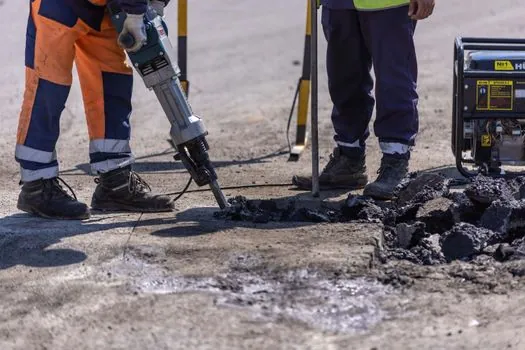
Inside a finished room, the same pneumatic percussive tool class that scales weld slag on a hull is used to chase brick, channel plaster, chip tile beds, break out door frames, and excavate floor screed, but the tolerances are tighter and the dust, vibration and HAVS exposure gates are different from a demolition site. Picking the wrong class burns air, throws silica, and over-vibrates the operator's wrist inside one shift [S4][S7].
Why an Air Pick, Not a Demo Hammer or Needle Scaler, for a Finished Interior
An air pick is a piston-driven chipping tool that converts compressed air into axial hammer blows on a chisel shank, with no rotary torque transmitted to the operator, so it can break out masonry substrate without spinning a fastener or a workpiece [S3][S6]. Output is rated in blows per minute and joules per blow, with hand-held chipping classes sitting at 1000-3000 BPM and 2-10 J per blow, and a 19 mm bore at 40-50 Hz (2400-3000 BPM equivalent) being the working minimum for vertical wall chipping inside a fit-out [S4][S5].
For interior finishing specifically, the common task mix is plaster and mortar removal, brick and block chasing for conduit, tile and screed breakout, and frozen or over-poured concrete clean-up around service risers, all of which want axial percussive energy, not rotary torque. That puts the air pick above the needle scaler (which only descales paint and weld slag) and below the electric demolition hammer (which is too aggressive on finished substrates and is banned on many wet or ATEX interior sites) [S1][S4].
Bore, Stroke and BPM Bands Scaled to Interior Substrates
The single most informative spec on the nameplate is piston bore, because bore scales piston area and, with stroke, sets per-blow energy [S4]. For interior work, three bands are useful in practice:
Light wall-chasing band, 19 mm bore, 40-50 mm stroke, 2-3 J per blow at 50-60 Hz, handpiece mass roughly 2-3 kg, sized for plaster removal, brick chasing and 50-100 mm concrete breakout around electrical and plumbing chases without throwing excessive dust per square metre [S4][S5].
Mid floor and slab band, 25-28 mm bore, 60-70 mm stroke, 5-8 J per blow at 40-50 Hz, sized for 100-150 mm reinforced floor screed and tile-bed breakout, where a 19 mm pick stalls on aggregate [S4].
Heavy backhoe-tilting band, 65-100 mm bore, 100-150 mm stroke, 80-100 J per blow at 25-35 Hz, which is out of scope for a finishing crew and belongs to a primary breaker; specifying it inside a fit-out is a procurement error [S4].
Stroke-to-bore ratio is the vibration and fatigue indicator: ratios above 3:1 are high-vibration tools that need AV grips and ISO 5349 exposure logging on the operator's shift sheet [S4].
Shank and Chuck Match to Interior Chisel Inventory
Three shank systems dominate 2026 air-pick fittings: round shank 10-12 mm for light chipping, hex shank 12-19 mm (10.6, 14.6, 17.3, 20 mm hex) for most chipping-hammer chisels, and 1/2 in square or 3/4 in hex for rotary-hammer conversions into concrete [S5]. For interior finishing, 19 mm (3/4 in) hex and 28 mm (1-1/8 in) hex are the working points, with quick-change retainers on the 2-3 kg class cutting chisel-change time on a production line by an order of magnitude versus a spring-clip retainer [S5][S7].
The selection rule is to match the chuck to the consumable inventory the site already owns, not the catalogue. A shop already running 19 mm hex chisels should not buy a 17.3 mm hex pick; the small dimension difference locks out the existing inventory and forces duplicate spares. For paint and weld-slag work, the 12-needle scaler head (replaceable 3 mm steel needles in a cage) is the production workhorse, with needle sets in standard, beveled and chisel-tip forms [S5].
Air Budget, Hose ID and Compressor Match on a Finish Site
Hand-held pneumatic scalers and chipping picks need 6-25 CFM at 90 psi (6.2 bar) working pressure, and air consumption per stroke scales with piston bore, not with the BPM figure on the nameplate [S4][S5]. The 1/2 in bore class (light panel work) typically asks 4-6 CFM, the 5/8 in class 7-10 CFM, the 3/4 in class 12-18 CFM, and 1 in+ descaling hammers 20-30 CFM, so the same 0.8-1.5 kW interior pick at 19 mm bore lands in the 12-18 CFM band [S5].
Three compressor-side rules hold in field practice. (1) Hose ID must be at least 3/8 in for the 1/2 in bore class, 1/2 in for the 3/4 in class, and 3/4 in for 1 in+ bore, because an undersized hose drops effective pressure at the tool and the rated BPM no longer holds at the work point [S4][S5]. (2) Add 30-50% margin on the compressor CFM rating, because a reciprocating compressor's delivered CFM is typically 70% of its displacement at 90 psi [S5]. (3) On long hose runs above 10 m, step up one hose ID size to keep pressure drop under 0.5 bar at the tool inlet [S4].
Hand-Arm Vibration, Noise and Silica Gates Inside a Finished Space
Hand-arm vibration is the gate most interior finishing crews fail first. The 0.8-1.5 kW / 19-28 mm hex band with an integrated AV handle keeps HAVS below 5 m/s² at the grip, which is the practical limit for an 8-hour shift under EU field practice; picks without an AV handle sit well above that and force a much shorter daily trigger time [S7]. Stroke-to-bore ratio above 3:1 should trigger ISO 5349 exposure logging on the operator's timesheet regardless of the AV handle claim on the brochure [S4].
Noise inside a finished space is a separate problem. Picks and chipping hammers run 95-110 dB(A) at the operator, so ear protection is mandatory, and the tool should never be run inside an occupied office or hotel fit-out without coordination on the work window. Demolition sites with mixed concrete and steel cutting should pair the air pick with a separate air quality monitor for silica dust, since 19-32 mm picks on concrete can easily exceed occupational exposure limits without on-tool water suppression or local exhaust ventilation [S4].
Comparison: Air Pick vs Needle Scaler vs Air-Assisted Airless for Interior Finishing
The three tool classes overlap in the catalogue but fail different selection checklists. A direct comparison on the four axes that drive an interior crew's buying decision: [S4]
Primary output metric. Air pick: BPM and joules per blow on a chisel shank, no rotary torque. Needle scaler: BPM on a 12-needle 3 mm steel cage, surface impact only, low per-blow energy. Air-assisted airless: fluid pressure and fan-width atomization, measured in PSI and tip orifice, no mechanical impact at all [S5][S9][S10].
Substrate it removes. Air pick: plaster, mortar, brick, tile bed, 50-150 mm concrete, frozen material. Needle scaler: paint, weld slag, rust, thin-gauge scale on steel, light surface texturing. Air-assisted airless: latex, enamel, lacquer, primer on trim, doors and cabinets with controlled atomization at lower pressures [S1][S4][S9][S10].
Air / power budget. Air pick: 6-25 CFM at 90 psi depending on bore class. Needle scaler: 4-8 CFM at 90 psi, smaller piston. Air-assisted airless: electric pump at 1000-3300 PSI fluid pressure with a small atomizing air assist; not a pneumatic-hand-tool air budget and not interchangeable with compressor CFM planning [S5][S9][S10].
Where it fits on a finishing job. Air pick: substrate removal before drywall, screed, tile or M&E rough-in. Needle scaler: weld cleanup on structural steel embedded in the fit-out, paint stripping on metal trim. Air-assisted airless: final topcoat on trim, doors and cabinets where finish quality and overspray control matter [S5][S9][S10].
For substrate removal, the air pick is correct; for finish-coat spray on trim, doors and cabinets, an air-assisted airless system with adjustable fan width and pre-orifice fine-finish tips is the workhorse, not a chipping tool [S9][S10].
Who the Air Pick Is For, and Who Should Pick a Different Tool

The air pick is the right call for interior finishing crews that already run a compressor fleet, for ATEX or wet interior zones where electric breakers are banned, for long horizontal runs where cordless battery tools cycle too fast, and for M&E rough-in where chasing and breakout dominate the day's work [S4]. It pairs with the same compressor drop that feeds an air impact wrench on the same site, so the air-supply and hose-ID rules above apply across both tool classes, as detailed in the air impact wrench spec map [S1].
The air pick is the wrong call for finish-coat work, where the tool throws dust and vibration, and where a finishing material airless sprayer with controlled atomization at lower pressures is the correct spec, and for fine surface prep on visible trim, where a needle scaler head is the right consumable rather than a wide chisel. For door, cabinet and trim finish work in occupied or near-finished spaces, the air-assisted airless system is the matched tool class and lives on a different procurement line [S9][S10].
On a 19-28 mm hex interior pick sized into the 0.8-1.5 kW / 900-1500 BPM band with an AV handle under 5 m/s² and a compressor drop sized at 12-18 CFM with a 1/2 in hose, a finishing crew can chase brick, break out tile bed and chip plaster substrate across a fit-out; the next trackable signals to watch are ISO 5349 logging compliance on the operator timesheet and silica-dust readings against occupational exposure limits, both of which gate whether the chosen pick class is actually safe to keep on the interior site.
This topic is covered further in Scaffolding selection for HVAC installation: tower, modular, and rooftop frame rules.