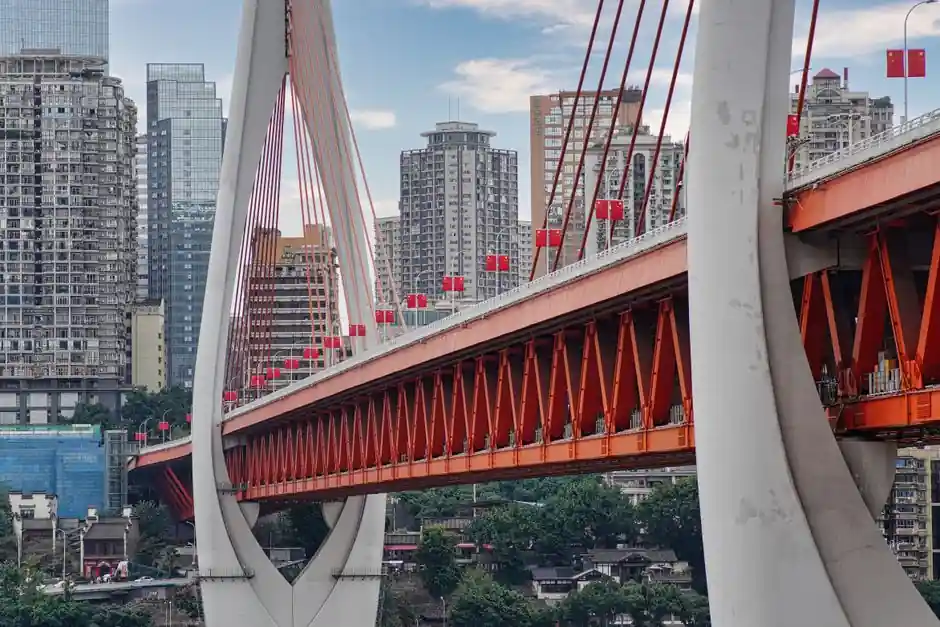
ZLP-series cradles in 500 kg, 630 kg, 800 kg and 1000 kg load ratings cover roughly 90% of bridge-construction suspended-platform inquiries logged in supplier catalogues in 2026-08, with wire-rope diameters from 8.3 mm up to 10.2 mm and modular platform lengths of 1-10 m [S1][S2][S3].
Bridge projects diverge from façade work in three ways: the suspension point is rarely a clean roof beam, the working platform travels vertically along piers, girders and box sections rather than across a flat wall, and the deck height often exceeds 100 m, which forces hoists into longer wire-rope and cable runs. That is why bridge-specific variants emphasise counterweighted suspension, hot-dip galvanised or powder-coated steel, and modular sections that can be ganged into 7.5-10 m working decks.
ZLP Model Line and Rated Load Envelope
ZLP500, ZLP630, ZLP800 and ZLP1000 are the four production ratings commonly stocked by Chinese OEM factories, with platform basket sizes from 5×0.69×1.18 m (ZLP500) up to 7.5×0.69×1.18 m (ZLP800/ZLP1000) and counterweight blocks of 800 kg, 1000 kg, 1000 kg and 1200 kg respectively [S1]. Working height is 0-200 m on the OEM data sheet, while bridge-specific catalogues quote 30 m standard with custom extension to 100 m and cable length 100 m as a default spool [S5].
Hoist power scales with rating: 1.5 kW×2 for ZLP500 and ZLP630, 1.8 kW×2 for ZLP800, 2.2 kW×2 for ZLP1000, paired with copper-wound LTD5.0 / LTD6.3 / LTD8.0 / LTD10.0 traction hoists and 15 kN rated lifting force per hoist [S1]. Lift speed sits at 9.3 m/min ±5% across the ZLP range, and the bridge-specific OEM datasheet lists 8-12 m/min lifting and 6-10 m/min horizontal traverse, with electromagnetic service brake [S5].
For comparison, EN 1808:2021 is the European safety standard for suspended access equipment, and the OEM CE + ISO 9001 dual-certification stack in the 2026 listings aligns procurement with most EU and Middle East bridge-tender specifications [S3][S4].
Safety Lock, Wire Rope and Suspension Geometry
Safety locks are LSG20 (20 kN) on ZLP500/ZLP630 and LSG30 (30 kN) on ZLP800/ZLP1000, locking at a 3°-8° tilt angle on the working rope, while bridge OEMs spec the automatic safety lock as standard with overload and leakage protection on the control box [S1][S5]. Wire-rope options are 8.3 / 8.6 / 9.1 / 9.3 / 10.2 mm galvanised steel, with four 100 m pieces as a typical bridge-job kit and 18-20 mm safety rope run in parallel [S1][S2].
Suspension mechanism on the bridge cradle uses a hot-dip galvanised front beam with 1.3 m overhang and 1.1-1.6 m adjustable support height, and the modular cage can be extended in 1 m increments from 1 m up to 30 m on custom orders [S1]. For deck-underside or pier access, the suspension can be switched from roof beam to counterweighted outrigger, which is the typical bridge-pier configuration; counterweight mass is 800-1200 kg depending on the ZLP rating [S1][S5].
Two independent wire ropes (one working, one safety) and an upper-limit switch are the minimum sensor stack; bridge-class suppliers add phase-failure protection and an emergency-stop on the IP-rated electric control box, and the platform itself is offered in painted steel, hot-dip galvanised steel or aluminium alloy, with the alloy option cutting basket mass by roughly 40% versus mild steel [S1][S4][S5].
Power, Voltage and Site Electrics
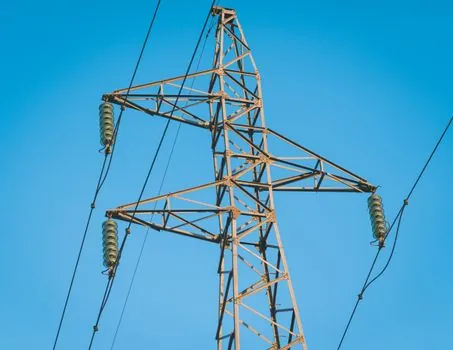
Standard power is 380 V / 50 Hz three-phase, with build-to-order options for 220 V / 60 Hz three-phase and 220 V / 60 Hz single-phase, so a single ZLP cradle can be configured for European, Middle East, North American and most Asia-Pacific grid supplies without rewinding the hoist [S1]. Power cable cross-section is 3×2.5 + 2×1.5 mm² as standard, with 1.5 / 2.5 / 4 / 6 mm² options for longer vertical runs where voltage drop matters above 100 m lifts [S1].
Control voltage is 24 V or 36 V low-voltage on the OEM control box, which is the safer choice when workers handle the pendant on a wet deck. The electromagnetic service brake and hoist thermal protection are both integrated, and bridge-specific datasheets quote a working temperature window of -20°C to +40°C, which covers most temperate-climate pier and girder projects [S5].
Selection Criteria: Load, Length, Height, Counterweight
Four parameters drive the model choice. (1) Rated load covers workers, tools, grit-blast pots, paint rigs and small formwork: 500 kg is the minimum for two-person inspection, 630 kg is the general-construction default, 800 kg handles longer decks, and 1000 kg is the heavy-pier choice [S1][S4]. (2) Platform length is set by the work face: 5 m suits pier-cap work, 6 m suits standard girder bays, 7.5-10 m suits wide box-girder soffits, and the OEM can gang sections up to 30 m on custom builds [S1][S5]. (3) Working height sets wire-rope and cable length: 0-200 m on the standard data sheet, but the bridge OEM quotes 30 m as standard and 100 m as the typical custom ceiling [S1][S5]. (4) Counterweight and suspension geometry: 800-1200 kg of dead weight plus an outrigger beam is the minimum for deck-underside access where the platform hangs below the suspension point [S1].
Bridge procurement is typically led by the deck-underside access problem: an overhead bridge crane or suspended platform chosen here must clear stay cables, hanger rods and inspection gantries, which often forces a narrower 0.69-1.18 m basket and a 1.5-1.8 m platform-extension clearance rather than the wider façade-cleaning cradles. Where the access problem is more about a movable work cage that can be re-positioned across a long deck, the cradle starts to overlap with construction machinery and equipment such as under-bridge inspection units; in that case a ZLP800 or ZLP1000 with 7.5-10 m deck length is the right pick, while a ZLP500 is only appropriate for short inspection windows on 2-person shifts.
Bridge Use Cases: Pier, Soffit, Cable-Stay, Painting
Five use cases dominate. (1) Pier-column inspection and repair: ZLP500 or ZLP630 with 5-6 m deck, 30-50 m hoist height, hot-dip galvanised cage for marine-corrosion environments [S1][S5]. (2) Box-girder soffit work: ZLP800 or ZLP1000 with 7.5-10 m modular deck, 2×1.8 kW or 2×2.2 kW hoist pair, electromagnetic brake to handle the higher moment on long platforms [S1][S5]. (3) Cable-stay and hanger maintenance: short 1-2 m single-section ZLP630 cradle, two independent wire ropes and the LSG30 safety lock to manage the angled lift geometry [S1][S2]. (4) Bridge painting and grit-blasting: ZLP800 minimum to handle 200-300 kg of pot, hose and ventilation plus two painters, with overload and leakage protection in the control cabinet [S1][S5]. (5) Routine inspection and cleaning: ZLP500 in aluminium-alloy basket, where the lighter dead-weight reduces counterweight demand on cantilever piers [S1].
Limitations and What the ZLP Cradle Will Not Do
A ZLP suspended cradle is a vertical-access device; horizontal travel along a 500 m deck is not what it is built for, and a contractor expecting to move 200 m along a bridge every shift should be looking at an under-bridge inspection vehicle or a rail-mounted gantry instead [S4]. Wind is the second hard limit: most OEM manuals cap operating wind at 12-13 m/s, and the working temperature window of -20°C to +40°C rules out extreme-cold Arctic builds without an arctic-rated control box and cold-store grease [S5].
Three failure modes show up repeatedly in the field. First, wire-rope fatigue on long vertical runs above 100 m if the rope is undersized for the lift height; the OEM data sheet calls for 8.3-10.2 mm rope, and going below 8.3 mm on a 150 m bridge pier is a known cause of safety-lock nuisance tripping [S1][S2]. Second, counterweight slip on the outrigger beam when the front-beam overhang is set above 1.3 m or the support height is above 1.6 m, both of which are outside the OEM-stated geometry envelope [S1]. Third, electrical single-phasing on long cable runs above 100 m if the cable is not upsized to 4 mm² or 6 mm²; the control box will fault on under-voltage at the hoist terminals, which is the most common field complaint on bridge projects that try to reuse a façade-platform cable [S1].
Standards, Compliance and Tender Language
EN 1808:2021 is the European safety standard for suspended access equipment, and ISO 18916:2023 is the cited platform-performance reference in 2026-08 B2B procurement guides, both of which are now embedded in most EU and Middle East bridge-tender pre-qualification questionnaires [S3]. For North American projects, OSHA scaffold requirements are the cited cross-reference on OEM datasheets, even when the unit is CE-marked, and local regulations plus the equipment manual override the OEM sheet on any conflict [S4].
The certification stack most commonly quoted in 2026-08 listings is CE plus ISO 9001, with explosion-proof certification offered on the higher-end ZLP800 and ZLP1000 models for petrochemical and LNG-terminal jetty projects [S2]. Procurement language should pin the standard, the model rating, the wire-rope diameter and the counterweight mass in the same line, and reject any datasheet that lists the model without the LTD hoist code, the LSG safety-lock code and the platform-basket dimensions.
Total Cost of Ownership Notes
2026-08 export price bands from the supplier listings run roughly $800-1,800 per set for a ZLP630, $1,050-1,150 for an aluminium ZLP630 bridge variant, $1,450-1,750 for a galvanised ZLP630, and $1,480-1,500 for the higher-safety ZLP630 with the LSG30 lock [S3]. Heavier ZLP800 and ZLP1000 units with custom deck length, longer cable, and 100 m wire-rope spools push into the $1,800-3,500 band, and a 38 m or 56 m truck-mounted boom lift, which competes on under-bridge access for shorter spans, runs $6,000-85,967 per unit [S3].
The non-obvious cost line is counterweight handling: a ZLP1000 with 1,200 kg of concrete or cast-iron blocks plus a 100 m wire-rope and cable spool adds roughly 1.5-2.0 t of logistics mass, which is what pushes a ZLP1000 onto a flatbed truck rather than into a container. Aluminium-alloy baskets cut that logistics mass but raise the unit price by 20-35% versus painted steel, and hot-dip galvanised steel adds roughly 10-15% versus painted but roughly doubles corrosion life in marine pier environments [S1][S3].
For a related view on access-class equipment selection, see this suspended platform selection map for HVAC installation, which uses the same ZLP envelope but applied to mechanical-rooms and curtain-wall work, and this scaffolding selection guide for road maintenance, which is the right cross-reference when the access problem is a low-height deck soffit rather than a 100 m pier.
Track three signals through 2026-Q4: (1) any EN 1808:2021 amendment that tightens the safety-lock tilt-angle window below the current 3°-8° range, which would force a re-spec of LSG20 and LSG30 locks on in-service bridge fleets; (2) OEM price movement on ZLP630 hot-dip galvanised units, which is the volume benchmark for bridge tenders in Asia and the Middle East; (3) demand for aluminium-alloy ZLP1000 baskets in HSR and metro viaduct projects, which is currently the fastest-growing niche in the bridge-access catalogue.