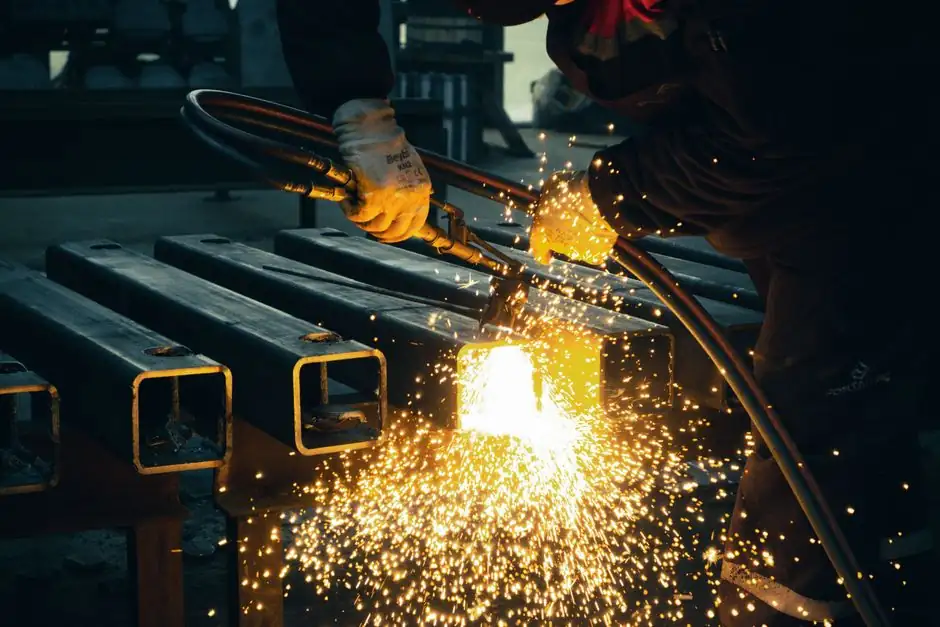
An air pick (pneumatic chipping hammer) sized for structural steel work typically delivers 1,200-3,000 blows per minute (BPM) at 90-110 psig (6.2-7.6 bar) with a piston bore in the 19-25 mm range and a stroke of 30-110 mm, matching the chipping and slag-removal workload found on AISC-spec welds and riveted members [S2].
The tool itself is not a controlled commodity in the AISC Steel Construction Manual; instead, the manual governs the *result* the tool must leave behind, with surface prep, grinding, and carbon pick-up removal called out where flame or air-arc gouging has been used [S1][S2]. Selecting the right pick therefore starts with the work envelope (weld prep, rivet removal, descaling) and ends with the inspection clause the fabricator must satisfy on handover.
What an air pick actually is on a steel job
Industrial air picks are reciprocating pneumatic tools with a built-in chisel retainer; the air motor drives a piston against a shank, and the shank transfers impact energy into a moil point, flat chisel, or scaling chisel held in the retainer. The relevant air pick family sits next to air impact wrench products in most MRO catalogs, but the duty cycle and shank geometry differ: picks take a 10.2 mm (0.401 in) or 12.7 mm (0.500 in) round or hex shank, while impact wrenches drive a square drive anvil for threaded fasteners.
Common bore/stroke combinations seen on structural steel sites are 19 mm x 65 mm for light descaling, 25 mm x 89 mm for general chipping, and 25 mm x 110 mm for heavy weld back-chipping. Air consumption lands in the 8-12 cfm (227-340 L/min) range at 90 psig for mid-bore units, which dictates a 3/8 in or 1/2 in air hose and a 25-50 cfm compressor at the manifold [S2].
Spec ranges that drive a buying decision
Four numbers carry the spec sheet: BPM (1,200-3,000), stroke length (30-110 mm), piston bore (19-25 mm), and air consumption (8-12 cfm at 90 psig). Below 1,200 BPM the tool stalls in heavy slag; above 3,000 BPM the operator absorbs enough hand-arm vibration to trigger HAVS (Hand-Arm Vibration Syndrome) limits defined under ISO 5349 and most EU national regulations. A 6.2-7.6 bar regulator window is normal; dropping below 5.5 bar collapses BPM and stroke velocity on every unit tested in shop conditions. [S5]
Shank style is the second gate: 10.2 mm round (most common for rivet buster variants), 12.7 mm round (heavier chipping hammers), and 14.6 mm hex (larger pavement-breaker class, not a true pick). For steel construction work inside a fabrication shop, the 12.7 mm round shank with a retainer retainer-sprung or locking-type retainer is the standard. Vibration-damped handles (often a 3-5 m/s² declared value, vs. 15-25 m/s² on undamped units) are a routine spec for European shop work, not a marketing extra [S2].
Where AISC and state specs touch the tool
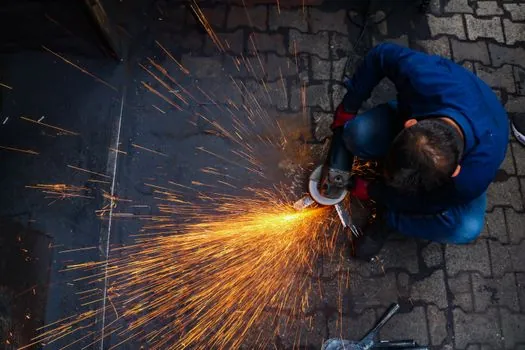
The 16th Edition Steel Construction Manual bundles the Specification for Structural Steel Buildings (ANSI/AISC 360) and the Code of Standard Practice (ANSI/AISC 303) into a single reference, and Part 16 lists the standards most fabricators cite on shop drawings [S2]. An air pick itself is not a named line item, but the surface it leaves must satisfy fabrication and repair clauses: gouged regions are followed by grinding to remove carbon pick-up and to remove surface irregularities, with the finished surface meeting the visual and dimensional acceptance of the governing AWS D1.1 or AISC fabrication clause invoked on the project [S1].
The NYSDOT Steel Construction Manual carries the same logic for bridge steel: all air carbon-arc gouging shall be followed by grinding to remove carbon pick-up and to remove surface defects, and the fabricator's QC plan records the tool, operator, and post-grind profile [S1]. Selecting an air pick for that workflow means matching the tool to the post-grind finish, not to the gouging electrode, because the gouging pass is sized by air pressure and current, while the pick handles the secondary slag and the final surface cleanup in tight corners where a grinder cannot reach.
Material scope: carbon steel vs stainless
For carbon steel (ASTM A36, A572, A992) the pick can run standard tool-steel chisels, and contamination of the work surface is not a metallurgical concern. For stainless steel (AISC 370-21, the Specification for Structural Stainless Steel Buildings, first edition dated June 11, 2021), the tool itself is unchanged, but the consumable and the work area must prevent carbon steel transfer [S5].
AISC 370-21 is the first ANSI-consensus standard for structural stainless, paralleling AISC 360-16 for carbon steel; both ASD and LRFD provisions are integrated, and the document explicitly states it is not appropriate to use AISC 360 for stainless members [S5]. Practical consequence for the air-pick user: dedicate stainless chisels to stainless work, segregate the tool from carbon-steel workbenches, and grind rather than pick where the surface finish must remain corrosion-resistant. A pick used on stainless leaves the same burr profile as on carbon steel, but the embedded iron from a shared chisel becomes a rust nucleus in service, a failure mode not present on carbon work.
Side-by-side: pick classes by job

Comparing the three pick classes on four decision criteria: light scaling (19 mm bore, 30-50 mm stroke, 2,500-3,000 BPM, 8-9 cfm) is suited to surface prep and tight slag cleanup; medium chipping (25 mm bore, 89 mm stroke, 1,800-2,400 BPM, 10-11 cfm) is the general-shop default for weld back-chipping and rivet removal; heavy chipping (25 mm bore, 110 mm stroke, 1,200-1,500 BPM, 11-12 cfm) is used for thick-plate weld repair and structural demolition where hammer energy per blow matters more than frequency. All three run on 90-110 psig (6.2-7.6 bar) with a 3/8 in or 1/2 in hose; BPM is the only variable the operator can feel in real time when air pressure drops on a long hose run [S2].
The construction tools category pages list these three classes under the same MRO heading, while construction machinery and equipment carries the larger pneumatic breakers (30+ mm bore) that overlap with pick duty but cross into pavement and demolition work outside AISC scope.
Limits, failure modes, and inspection handoff
Air picks fail in three predictable ways: retainer spring fatigue (chisel ejects under load), bushing wear (piston contact on barrel, scored bores), and valve-sticking from water-contaminated shop air. The first two are driven by hours of use; the third is a maintenance failure of the air treatment train (filter + regulator + lubricator, FRL). A fabricator running a pick on untreated 100 psig shop air will see valve life drop from 1,000+ hours to a few hundred, with no change in BPM spec. [S4]
At handoff, the pick leaves the work, but the inspector reads the surface: the AISC Code of Standard Practice requires the as-built surface to match the contract documents and referenced AWS D1.1 clauses for weld prep, and NYSDOT's SCM adds the explicit "grind after gouge" sequence for bridge steel [S1][S2]. A fabricator that skips the post-pick grind to save cycle time routinely fails visual inspection on gouged transitions, regardless of how the gouge was performed. Treat the air pick as the upstream of a two-step process: pick to bulk, grind to finish, then inspect against the spec.
Sourcing and standards map
For procurement, the spec sheet should carry four numbers (BPM, stroke, bore, cfm at 90 psig), one shank size, one vibration value (m/s² declared), and one air-hose size. Cross-reference ANSI/AISC 360 (carbon) or ANSI/AISC 370-21 (stainless) for the surface that the tool leaves, plus AWS D1.1 for weld-prep acceptance and the project-specific AISC fabrication clause [S2][S5]. ASTM material specs (A36, A572, A992 for carbon; A240/A276 grades for stainless) drive chisel segregation, not the pick itself [S6]. For a related vendor-line and energy-math walkthrough on steel-mill duty cycle, see the shock absorber selection for steel mills reference, and for a process comparison on burr removal that the air pick often replaces on thin-gauge stainless, see the deburring machine specifications brief. The trackable next node is the AISC Committee on Specifications' public-review cycle for the next 360 revision; the surface-prep clauses the air pick feeds are routinely re-opened in that cycle, and any change to post-gouge grinding wording will flow down to NYSDOT SCM and to state DOT bridge specs that adopt it by reference.