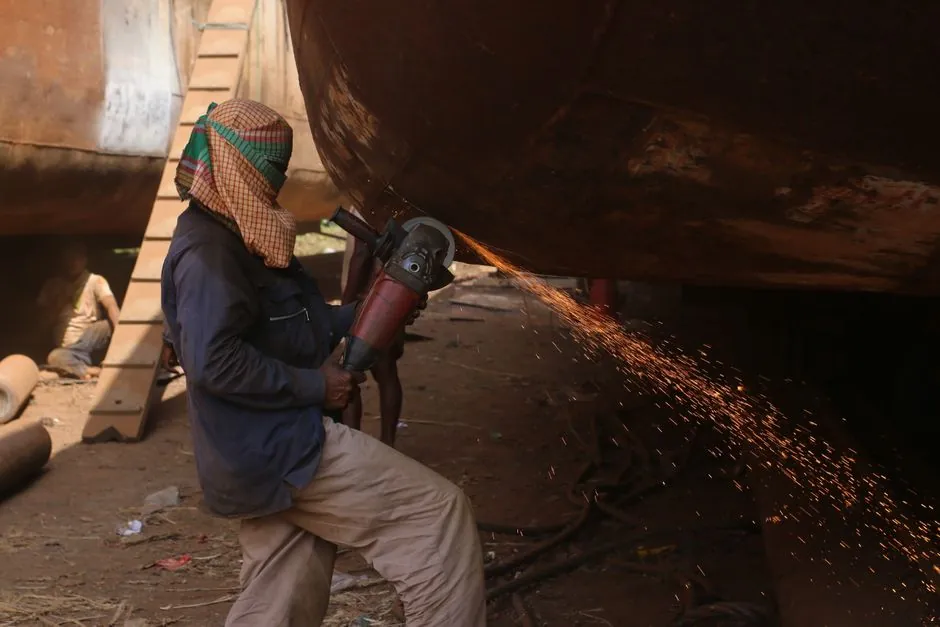
Floor grinders specified for steel construction typically run between 1 kW and 15 kW, with working widths spanning 230 mm to 800 mm and total machine weights from 40 kg for handheld edge units up to 640 kg for ride-on industrial platforms [S2][S4].
Steel substrate preparation demands heavier machines and harder-bond segments than concrete polishing, because heat dissipation, spark load, and abrasive wear on metallic surfaces differ markedly from mineral substrates [S1][S3]. A walk-behind four-disc floor grinder covers 32-34 inches per pass versus 10-12 inches for a single-disc unit, a ratio that translates directly into labor-hour math on large structural decks [S5].
Working Width, Disc Count, and Pass Coverage
Single-disc walk-behind floor grinders cover roughly 10-12 inches in a single pass, while four-disc planetary units reach 32-34 inches per pass, a 3x productivity step-up that drives equipment selection on industrial steel decks [S5]. CONTEC's OMEGA series spans 230-450 mm working widths at 2-5.5 kW for edge and mid-size work, while the DELTA II at 6.8/8 kW (187 kg) targets heavier removal passes [S2]. Tyrolit's FGE family covers 280 mm, 400 mm, 515 mm, and 780 mm widths, with the 780 mm flagship aimed at industrial halls, warehouses, and public buildings where throughput dominates [S1].
For steel construction, the 20-40 inch walk-behind class is the most commonly specified segment, with planetary head configurations (3 or 4 counter-rotating discs) preferred for uniform surface profile on plate steel and checker plate [S4][S5]. Counter-rotation matters on metallic substrates because it prevents the lateral pull that produces uneven scratch patterns, a defect that becomes visible under subsequent coating inspection.
Motor Power, Voltage, and Current Draw
Floor grinder power ratings for steel work cluster between 2 kW and 15 kW, with 400 V three-phase supply standard on mid- and large-size units, and 230 V single-phase reserved for sub-3 kW edge machines [S2]. The Tyrolit FGE400M1V uses a 4 kW motor on 400 V three-phase for renovation-class grinding, while the FGE515M3V accepts optional 1- or 3-phase operation to bridge site-supply variability [S1].
Current draw scales with motor size: CONTEC's 2 kW OMEGA draws roughly 8.5 A at 230 V, the 5.5 kW OMEGA 450 pulls 14-16 A at 400 V, and the 7.5 kW DELTA II-S hits 28-32 A, a figure that dictates feeder cable sizing and breaker selection on temporary site panels [S2]. For steel deck work where continuous load runs long shifts, the 6.8-8 kW dual-power DELTA II is a common crossover point, balancing amp draw against material removal rate. Motor rotation speeds in the 1290-2900 rpm band govern segment contact velocity, with variable-frequency drives on units like the OMEGA 450 (0-1440 rpm) allowing torque tuning when shifting from steel descaling to coating removal.
Weight Class and Operator Footprint
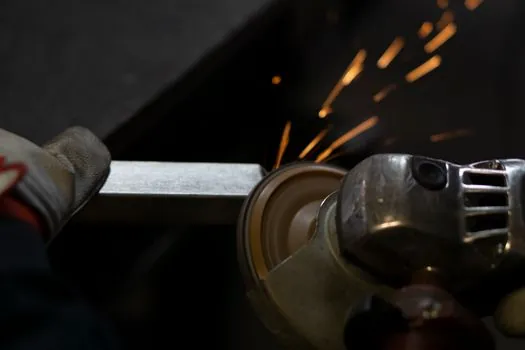
Weight correlates directly with grinding pressure and segment life on steel substrates: 40-75 kg units handle edge work, 90-187 kg covers mid-range renovation, and 320-640 kg platforms are reserved for industrial halls and airport-scale decks [S2]. Walk-behind designs keep the operator upright, reducing both fatigue and silica-dust exposure compared with handheld grinding, a meaningful factor when grinding coatings off structural steel in semi-enclosed bays [S5].
Handheld grinders in the 4-7 inch disc range are essential complements to walk-behind machines, used for weld seam blending, rebar cutoff, and corner cleanup where larger equipment physically cannot reach [S3][S4]. The trade-off is grind consistency: handheld pressure fluctuates with the operator, so pass-to-pass uniformity on plate steel is inferior to a weighted walk-behind pass, a reason most steel-prep specifications pair the two classes rather than substituting one for the other.
Dust Extraction and H-Class Filtration
Professional floor grinding on steel substrates generates metallic fines plus any residual coating dust, and H-class certified extraction is now standard on serious equipment lines [S1]. Tyrolit's VCE-series extractors are H-class rated and matched to the floor grinder range, a coupling the OEM describes as a system solution rather than a generic vacuum pairing [S1].
For steel work specifically, dust collection serves three jobs at once: capturing combustible metal fines, controlling respirable particulate from old coatings (frequently lead- or chromate-bearing on legacy structures), and keeping the abrasive contact zone clean so segments cut rather than smear. Walk-behind machines integrate with common dust-prevention systems more readily than handheld units, a practical reason walk-behinds dominate open-deck steel prep despite their higher capital cost [S5].
Selection Criteria: Matching Machine to Steel Task
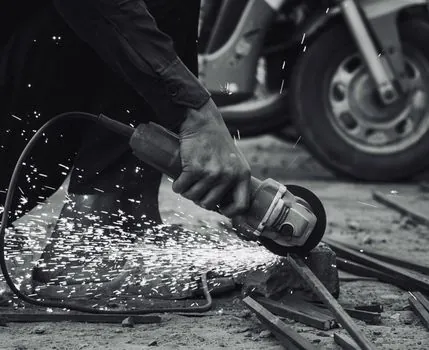
For a comparison of the main floor-grinder classes against steel-construction decision criteria, the table below lines up working width, power, weight, and typical task. Handheld 4-7 inch units score high on access but low on pass coverage. Walk-behind single-disc units (10-12 inch pass) suit small rooms and weld touch-up. Walk-behind planetary and four-disc units (32-34 inch pass) carry large-area deck preparation. Ride-on platforms (640 kg class) cover warehouse and runway throughput where labor cost per square meter is the binding constraint [S4][S5].
Selection logic: choose the smallest machine that meets the area and access constraints, then step up in weight and disc count only when removal rate, not coverage, becomes the bottleneck. For structural steel in industrial bays, the 400-515 mm mid-class walk-behind (4-7.5 kW, 90-187 kg) is the most common specification sweet spot [S1][S2].
Limitations and Failure Modes on Steel Substrates
Floor grinders specified for concrete will underperform on steel if applied directly, because bond hardness and segment composition differ; diamond tools glaze on certain ferrous alloys, while aluminum-oxide segments wear fast on hard welds [S3]. A grinder that's too small for the project delivers low material removal and overheats the workpiece, while an oversized unit is harder to control and damages thin-gauge deck plate [S4]. Handheld machines also lack consistent weight-on-wheel, so grinding consistency varies with operator technique, a known source of rework on cosmetic-finish specifications [S5].
For grinding processes on construction sites more broadly, related reference coverage of construction tools and construction machinery and equipment places floor grinders inside the wider power-tool and surface-prep ecosystem, useful context for procurement teams standardizing across trades. Edge and weld cleanup overlaps with handheld angle grinder workflows on the same structural elements.
Standards, Sourcing, and Sizing Anchors
Floor grinder specifications are vendor-driven rather than standards-driven, so the binding reference points are manufacturer datasheets: Tyrolit FGE-series (280-780 mm width, 4-15 kW class), CONTEC OMEGA and DELTA series (230-800 mm width, 1.8-15 kW) [S1][S2]. For abrasive selection, the alloy steel substrate dictates segment bond, and floor grinder configuration choices feed into finishing-tool selection covered in the fettling grinder reference class.
Cross-trade signal: where steel deck prep feeds into finished-floor installation, the same planning logic that drives conveyor chain selection for packaging lines applies, namely, match equipment to the binding constraint first and let other parameters follow.