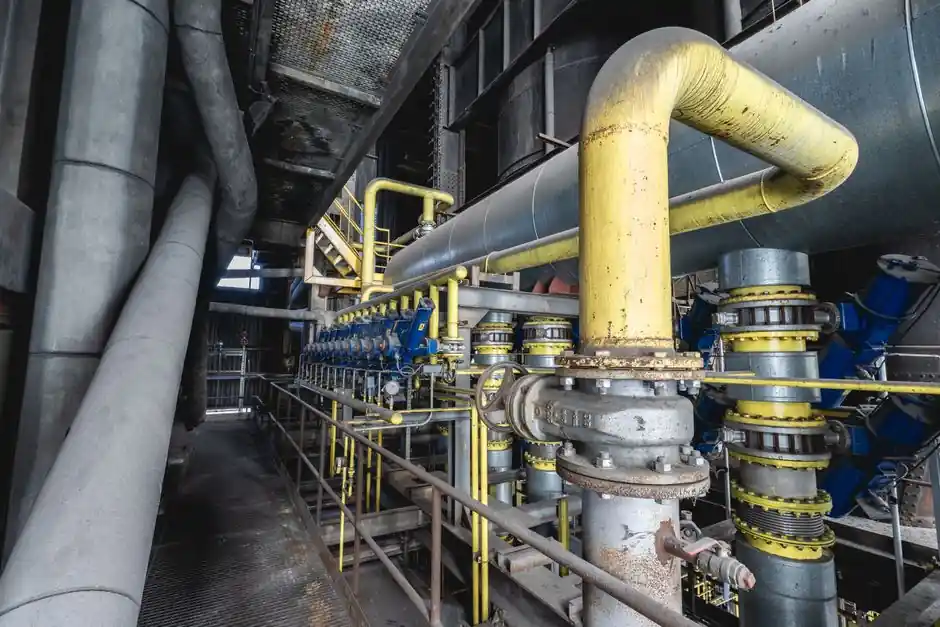
For remote valve sites, the actuator decision reduces to four variables: available power, required stroking speed, modulating duty cycle, and hazardous-area classification. All-electric units are displacing pneumatic hardware on new remote builds because the supporting infrastructure (PV array, battery bank, 24 VDC or 480 VAC distribution) is usually already present for instrumentation, and the electric actuator needs no compressor, no air line, and no air-treatment skid [S1][S2].
The trade-off is not free: in a normalized load test at 1.1 kW input power, the electric linear system showed the most consistent displacement profile and the lowest power consumption, while the pneumatic system required careful pressure regulation to match it [S1]. Where the remote site already runs an instrument-air header, that balance shifts back toward a pneumatic actuator sized for the valve's breakaway torque.
Power, Air, and Energy Budget at a Remote Site
An all-electric actuator converts mains or DC power directly into rotary or linear motion through a motor and gear train (ball screw, planetary gear, or part-turn reducer), so its steady-state draw is the motor nameplate plus control electronics, typically tens to a few hundred watts during stroking and a few watts on hold [S3][S4]. A pneumatic actuator needs a continuous supply of clean, dry air at the working pressure (commonly 4-7 bar / 60-100 psi for spring-return units), which on a remote site means a compressor, receiver, dryer, and filter set drawing power year-round [S2].
The energy delta is what changes the remote-site math. Compressor efficiency for small electric compressors at low duty cycles is poor, and standby leakage from fittings, dryers, and pilot solenoids keeps the air system consuming power even when no valve is moving. Where a site has a reliable 480 VAC three-phase feed or a DC bus fed by solar plus battery, eliminating the air package and specifying an electric actuator removes a major parasitic load and a major failure mode (water in the air line, regulator freeze, desiccant changeout) [S2][S4].
Speed, Modulation, and Control Bandwidth
Pneumatic actuators respond quickly because air is compressible and the solenoid valves that pilot them can be near-instant; a spring-return quarter-turn pneumatic can stroke in well under a second on small valves, which is the reason ESD (emergency shutdown) and HIPPS (high-integrity pressure protection system) chains have historically been pneumatic [S2][S3]. Electric actuators move more deliberately: a 90° part-turn electric unit on a 2" ball valve typically strokes in 10-30 seconds depending on gear ratio, and electric linear units stroke at screw pitch / motor RPM, both well below pneumatic cycle rates [S3][S4].
For modulating control, the comparison flips. Electric actuators deliver high accuracy, high repeatability, and tight motion control because the drive signal is voltage and current, both easy to regulate, and onboard encoders or potentiometers feed back position to within a small fraction of a percent of stroke [S3][S4]. A pneumatic modulator can match that only with a high-quality positioner, a stable supply pressure, and clean air, and even then the compressibility of air limits the achievable deadband [S3]. Sites running continuous composition, level, or flow loops therefore favor the electric option, often paired with an electric ball valve for tight shutoff plus modulating trim.
Hazardous Area, Intrinsic Safety, and Certifications

Pneumatic actuators have a long-standing advantage in explosive atmospheres because the actuator body itself has no live electrical parts, so the hazardous-area classification is driven by the solenoid coil, limit switches, and positioner, which can be specified as intrinsically safe or purged to the zone rating [S2]. Electric actuators put motor windings, encoders, and sometimes heating elements inside the housing, so they require an explosion-proof or increased-safety enclosure rated for the zone (ATEX category 2/3, IECEx Gb/Gc, or Class I Div 1/2 equivalents), which adds cost and inspection burden [S2][S3].
For a remote site that already sits in a classified area (well pad, gas plant, ethanol terminal), the certification question can outweigh the energy and maintenance argument. Where the area is unclassified and power is available, electric wins; where the area is Zone 1 / Class I Div 1 and ESD response time is critical, pneumatic remains the default [S2]. This trade-off mirrors the wider process-equipment certification decision between ATEX and IECEx, where zone, gas group, and inspection regime drive the spec.
Maintenance, Diagnostics, and Remote Visibility
Pneumatic hardware needs periodic air-system attention: filter element replacement, dryer desiccant changeout, leak checks on fittings, and lubrication of any sliding seals. Electric hardware needs far less routine service (no air lines, no compressor) but does need the motor, gearbox, and position-sensing electronics inspected on the OEM interval, and the electronics add a layer of firmware and sensor diagnostics that pneumatic units do not have [S2][S3][S4].
That diagnostic layer is what sells electric on remote sites. Modern electric actuators expose torque profiles, stroke counts, motor temperature, and partial-stroke test results over HART, Foundation Fieldbus, PROFIBUS PA, or Modbus, so a SCADA poll can flag a failing actuator weeks before it sticks [S3]. For a manned remote site, the air package is a known quantity; for an unstaffed or rarely-visited site, the predictive data from the electric unit is often the deciding factor, and it pairs naturally with the pneumatic valve actuator retrofit path where the same data can be retrofitted via smart positioners.
Decision Matrix for Remote Valve Sites
Three criteria dominate the spec: available power source, required stroking time, and modulating versus on-off duty. On all three, the scoring is binary for typical remote-site cases: grid/solar power present, ESD stroke time not safety-critical, modulating control required, score electric; instrument air present, sub-1-second ESD stroke required, on-off or simple diverting duty, score pneumatic [S2][S3][S4].
A useful side-by-side, drawn from the research: Pneumatic actuator design is simple, force depends on air pressure, speed is high, accuracy and repeatability are low without feedback, motion-control capability is low, efficiency is low, initial cost is lower, data collection is still developing, it tolerates harsh and hazardous environments, it accepts higher ambient temperature, noise is high, maintenance is high, and it is ideal for end-to-end positioning [S4]. Electric actuator design is complex, force depends on screw pitch/lead, speed is low, accuracy and repeatability are high, motion-control capability is high, efficiency is high, total cost of ownership is lower, data collection is highly developed, environment suitability is governed by IP rating, ambient temperature is lower, noise is low, maintenance is minimal, and it is ideal for multi-point positioning [S4]. The same source notes that electric actuators can change their motion profile fairly easily as long as the required torque, speed, or load inertia does not increase, which is a real benefit on remote sites where process conditions drift [S4].
When Electric Is Wrong, and When Pneumatic Is Wrong
Electric is the wrong call when the site lacks reliable power, when a safety function demands sub-second stroking, when ambient temperature sits outside the electric motor's rated range (cold-weather oil and gas pads in northern winters push beyond standard electric actuator limits unless a heater option is specified), or when the valve breakaway torque exceeds what an economically sized electric gear train can deliver without an oversized (and over-priced) unit [S2][S3]. Pneumatic is the wrong call when the site has no air supply and no desire to build one, when modulating control is the primary duty, when noise is a constraint (residential-adjacent metering stations, indoor analyzer rooms), or when the operator wants real-time stroke, torque, and PST data without a separate smart positioner [S2][S3][S4].
For most greenfield remote valve sites in 2026, the spec defaults to an electric actuator on any valve that modulates or participates in condition-based monitoring, and reserves pneumatic hardware for the ESD valves, the blowdown valves, and any valve that strokes during a power outage (spring-return pneumatic failsafe on loss of air, spring-return electric failsafe on loss of power, both work but the pneumatic failsafe is faster). For actuator I/O on remote sites running Foundation Fieldbus or Ethernet-APL, a remote I/O module typically aggregates the actuator feedback alongside the flow, pressure, and temperature transmitters, keeping the cable run and the marshalling cost down.