Carbon steel typically returns 200–550 MPa yield strength in common grades (Q235, A36, 1018, 1045) while structural aluminum alloys (5052, 6061-T6, 6063-T6) land in the 90–275 MPa band, so the rule of thumb is aluminum trades strength for mass, not the reverse [S6][S7].
Mechanical Properties Compared on Hard Numbers
Micro/nano-indentation studies of aluminum alloy, low-carbon steel, and alloy steel with a cylindrical flat-tip indenter show that extracted elastic modulus and yield-strength values from the same load-depth curve diverge by more than 3× between the softest Al and the hardest steel tested — confirming that the gap is intrinsic, not a measurement artifact [S1]. For welding-built assemblies, refilled friction-stir-spot welding of Q235 low-carbon steel to 5052 aluminum demonstrates that dissimilar joints can be made with controlled rotation speed, but the operating window is narrow and joint efficiency depends on intermetallic layer control [S6]. Resistance spot welding of 16Mn high-strength steel to 6063-T6 aluminum with different electrodes produces interface zones with tongue-like Fe-Al phases; the choice of electrode cap geometry directly drives nugget strength and is the single biggest process lever [S7].
Corrosion, Molten Metal, and Erosion Behavior
Aluminum forms a self-healing oxide film (Al₂O₃) that resists atmospheric corrosion in the 4–9 pH range, which is why 5052 and 6061 ship as-rolled for architectural screens and curtain meshes without coating [S5]. Carbon steel has no equivalent passive layer and relies on galvanizing, painting, or alloying for the same duty. The reverse case — aluminum inside molten metal service — is worse: erosion tests on low-carbon steel and alloy tool steel immersed in common molten Al-Si and Al-Fe melts show that the erosion (dissolution) rate of low-carbon steel rises with Si content in the melt and falls as Fe content in the melt climbs toward saturation [S4]. Practical takeaway: never specify bare low-carbon steel for tooling, troughs, or impellers in contact with molten aluminum without a protective coating or a high-Fe, high-Si saturating melt. For more on the joining side of this tradeoff, the Steel Fiber Selection: Five Hard Gates That Decide Spec Before You Quote reference lays out the parallel gating logic for steel reinforcement.
Joining Methods: Weld, Friction-Stir, or Mechanical
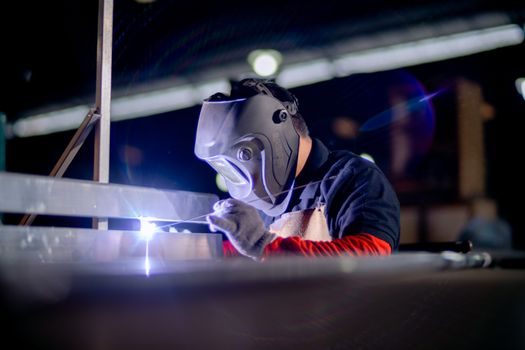
Dissimilar Al/steel joints fail by one of two mechanisms: brittle Fe-Al intermetallics at the weld interface, or galvanic corrosion at the faying surface in the presence of an electrolyte. Refilled friction-stir-spot welding on Q235/5052 equal-thickness coupons is the current research front for suppressing the intermetallic layer, with rotation speed and dwell time as the dominant control variables [S6]. Resistance spot welding of 16Mn to 6063-T6 requires electrode selection matched to the higher-melting steel side; an aluminum-cap electrode on a steel stack burns the cap before the steel reaches welding temperature, while a steel-cap electrode on an aluminum stack picks up aluminum and fails to maintain contact resistance [S7]. The mechanical-fastener route — rivets, threaded inserts, flow-drill screws — avoids the intermetallic problem entirely and is the default for shipbuilding and rail car bodies where fatigue and inspection access dominate. The comparison below lines the main selection paths against four decision criteria: mass, strength, corrosion envelope, and joinability.
Side-by-Side Comparison: Aluminum vs Carbon Steel on 4 Decision Criteria
Weight per cubic meter: aluminum alloy roughly 2700 kg/m³ vs carbon steel roughly 7850 kg/m³ — a 2.9× difference that cascades into handling, transport, and foundation loads [S2][S3]. Typical yield strength: aluminum 5052-O ~90 MPa, 6061-T6 ~240–275 MPa; carbon steel Q235 ~235 MPa, A36 ~250 MPa, 1045 normalized ~350 MPa — carbon steel leads in almost every common grade [S6][S7]. Corrosion in atmosphere: aluminum passive oxide, near maintenance-free in 4–9 pH exposure; carbon steel requires coating or galvanizing for equivalent life [S5]. Weldability to the other family: friction-stir and resistance-spot feasible only with tight process windows due to Fe-Al intermetallics; mechanical fastening is the safer default for field-repairable joints [S6][S7]. A useful adjacent read on equipment-side selection is the Hot Chamber vs Aluminum Die Casting Machine: Spec-Driven Selection Frame, which extends the aluminum-alloy discussion into machine-pairing.
Who Should Pick Aluminum, Who Should Pick Steel
Specify aluminum alloy when the load case is dominated by mass-inertia (vehicle body panels, overhead architectural mesh, lightweight enclosures), when the part sees atmospheric corrosion in the 4–9 pH band with no molten-metal exposure, or when the assembly needs high thermal or electrical conductivity — 6061-T6 sits near 167 W/m·K thermal conductivity versus roughly 45–55 W/m·K for low-carbon steel, an order-of-magnitude difference that matters for heat sinks and busbars. Specify carbon steel when the load case is wear, impact, or contact with molten aluminum; when stiffness (modulus ~200 GPa vs ~69 GPa for Al) drives deflection limits; when the structure runs hot above 200 °C where aluminum loses strength rapidly; or when cost per MPa is the gate — carbon steel is consistently cheaper per unit yield strength at the 235–350 MPa band. For applications that fall between the two, the Stainless Steel Buying Guide 2026: Grade, Finish, Form, and Price Gates covers the third major option in this same selection space. [S1]
Standards, Sourcing, and Trackable Signals
Aluminum alloy form factors ship to common specs including ASTM B209 (sheet/plate), ASTM B221 (extruded bar/pipe), and EN AW-5052 / 6061 / 6063 designations for the most-used structural grades [S2]. Carbon steel plate, sheet, coil, and tube are stocked to ASTM A36, ASTM A516, JIS G3101, and GB/T equivalents (Q235 for the welded-fabrication grade commonly paired with aluminum in lab studies) [S3][S6]. Both metals are tracked in mill-test-certificate form with chemistry and mechanical properties reported per heat, which is the lowest-cost verification step before any structural call. Two signals worth watching for 2026: (1) the publication of full joint-efficiency curves for refilled FSSW of Q235/5052 at thicknesses above 2 mm, which would open heavier-gauge dissimilar fabrication [S6]; (2) updated erosion-rate maps for low-carbon steel in high-Si molten Al alloys, since the existing data confirms Si accelerates dissolution and any protective-coating guideline would come out of that work [S4]. For shop-floor handling around either material, the Angle Grinder Buying Guide 2026: Disc Size, Wattage and Job Fit covers abrasive-process selection that applies equally to Al and steel stock prep.
For component-level specifications, see carbon steel, aluminum alloy, and carbon fiber.