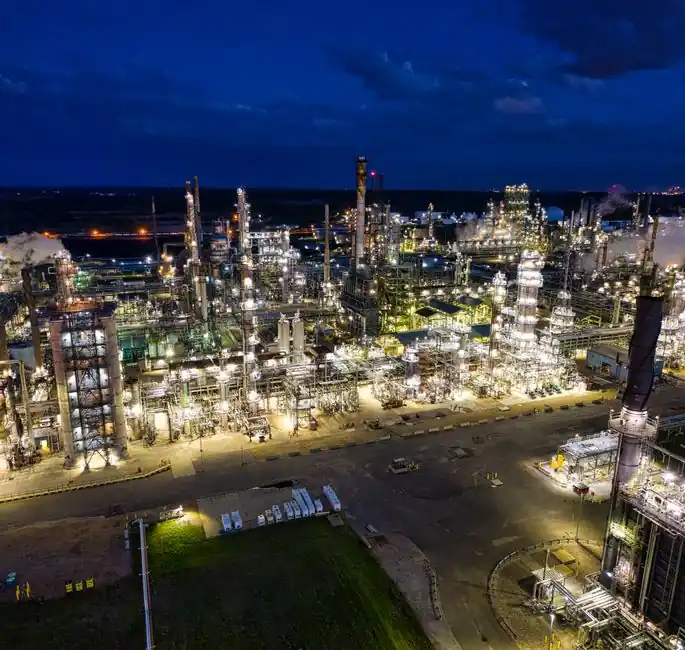
Two industrial-scale ammonia cracking units are now in active commissioning or operation, defining the equipment supply envelope for the 2026-2028 build cycle: thyssenkrupp Uhde's uhde-branded 28 mtpd demonstration plant [S3] and Air Liquide's 30 mtpd pilot unit at the Port of Antwerp-Bruges, started up 13 November 2025 [S5].
Large-scale ammonia cracking technology is supplied by two distinct vendor tiers, ammonia licensors (Casale, KBR, thyssenkrupp Uhde, Topsoe) and industrial gas majors or EPCs (Air Liquide, Air Products, Linde, Johnson Matthey, Technip Energies), with Duiker Clean Technologies as a standalone burner specialist [S2]. Smaller-scale and modular cracking technology is being pushed by Amogy (electrically heated tubular), Fortescue & Siemens and H2SITE (palladium-membrane), Mitsubishi Heavy Industries (steam-heated) and Syzygy Plasmonics (photocatalytic) [S2].
Process envelope: 30-40 bar feed, 800-900 C catalyst beds, SMR-style tube metallurgy
Across both demonstration and pilot units the reaction envelope is converging on liquid ammonia pressurised to around 30-40 bar and catalytically decomposed at 800-900 C in tubular reactors, a configuration that mirrors the upstream end of a conventional steam methane reformer (SMR) and lets EPCs reuse proven reformer tube metallurgy and burner packages [S2][S4].
Air Liquide's Antwerp pilot uses reactor tubes developed in-house to maximise energy integration, with hot-stream heat recovery recycled inside the unit; the pilot is sized at 30 tonnes of ammonia per day, and the company frames it as the first industrial-scale cracker of its kind [S5]. thyssenkrupp Uhde's uhde ammonia cracking process is built explicitly on its SMR heritage from more than 130 reference ammonia plants, uses ammonia plus offgas as burner fuel for a "zero carbon intensity" heat duty, and routes NOx and N2O through its own DeNOx and EnviNOx systems, the latter defined as Best Available Technology under EU rules [S3].
TRL status: most reference plants are at TRL 8, integrated operation to TRL 9 still pending
thyssenkrupp Uhde's 28 mtpd demonstration plant is being equipped with commercial-size tubes and burners specifically so it can be a direct stepping stone to TRL 9 on a commercial scale [S3]. Air Liquide's 30 mtpd Antwerp pilot is now running in commissioning, which the company describes as the missing link to convert shipped ammonia back into hydrogen at industrial scale [S5].
For the wider vendor set, the industry consensus as recorded at the AEA Annual Conference 2024 is that full integrated process operation under relevant conditions still needs demonstration to reach TRL 9 [S2]. The 25 million tonnes per year of ammonia already moved by road, rail, ship and pipeline globally is the existing logistics base the new crackers tap into, rather than a forecast hydrogen trade volume [S5].
Fast-start target: 15-minute cold-to-operational vs the 2-4 hour baseline
Traditional ammonia cracker startup has historically required 2-4 hours to reach operational conditions, driven by gradual heating to limit thermal shock, catalyst activation protocols and nitrogen purging of the loop [S4]. A 15-minute cold-to-operational target is now being framed as the new benchmark for crackers tied to intermittent renewable power and on-demand hydrogen offtake, with the cited technical obstacles being thermal-stress management, catalyst longevity under rapid heating, and safety case work for accelerated startup [S4].
Reaching sub-15-minute startup will require advanced preheating strategies, rapid catalyst activation techniques, and reactor designs rated for accelerated thermal cycling, which links the discussion of cracker design back to the broader question of how fast an upstream electrolyser or ammonia import terminal can be cycled without damaging downstream power supply equipment and industrial UPS buffers. Process intensification along these lines is consistent with the smart-manufacturing trajectory already visible in adjacent process plants.
Downstream purity: from direct burner use to PEM-grade 99.97 mol.% H2
Downstream of the cracker furnace, the required hydrogen purity of the cracked syngas varies from "no purification" in historical uses (metallurgy, heavy water) and direct co-firing in retrofitted gas turbines, up to 99.97 mol.% H2 for low-temperature PEM fuel cells per ISO 14687:2019 [S2]. The 99.97% spec is met by mature pressure-swing adsorption (PSA) packages and by membrane reactor integration; this is the same purity band targeted at large-scale energy import hubs in east Asia and western Europe where ammonia is cracked and the hydrogen pushed into pipeline networks [S2].
Air Liquide's own framing in November 2025 is that the Antwerp pilot "provides a concrete path" for industrial customers to meet the EU Renewable Energy Directive (RED III) 2030 targets of at least 42% renewable hydrogen in industrial use and 29% renewable energy in transport, so the regulatory pull is now a binding demand signal rather than a voluntary green-procurement policy [S5].
Comparison of the main cracker options on four spec axes
Specifying an ammonia cracker in 2026 is essentially a four-axis decision: scale, heat source, downstream purity, and TRL readiness. The table below lines the dominant options up against those axes using only what the research supports. [S2]
On a scale axis, thyssenkrupp Uhde's uhde process sits at 28 mtpd demo with commercial-scale tubes and burners [S3], while Air Liquide's Antwerp pilot is 30 mtpd and the first to be in active industrial operation [S5]. On heat source, thyssenkrupp Uhde burns ammonia plus offgas with DeNOx / EnviNOx emission control rated as EU BAT [S3], whereas Amogy uses electrically heated tubular reactors aimed at fuel-cell loads and smaller scales [S2]. On downstream purity, both large-scale flows feed conventional PSA or membrane polishing for PEM-grade H2 per ISO 14687:2019 [S2], while Duiker Clean Technologies positions as a burner-technology supplier rather than a full cracker licensor [S2]. On TRL readiness, full integrated operation to TRL 9 is still pending for the wider vendor set even as Topsoe, Air Liquide and thyssenkrupp Uhde have published commercial design intent [S1][S2][S3][S5].
Supply-side constraints: catalyst, tube metallurgy, NDT and process burners
Three equipment categories are the near-term bottleneck for ammonia cracker build-out, irrespective of vendor. Nickel-based catalysts have been the industry default since the 1950s, with later generations using advanced ceramic and metallic supports to extend activity and life under the 800-900 C operating window [S4]. Reformer-grade tube metallurgy and burners are the second constraint, which is why both thyssenkrupp Uhde and Air Liquide have chosen to develop proprietary tube designs rather than rely on generic SMR components [S3][S5]. Third is the non-destructive testing (NDT) workload for high-temperature reactor tubes and welds, which drives material specifications, inspection intervals and the maintenance schedule that owners have to plan against from day one [S1].
Material prediction work also feeds back into the burner and refractory supply chain, because nitridation, thermal cycling and ammonia-containing flue gas shift the corrosion regime compared with a fired-heater SMR; getting those degradation modes modelled correctly is what lets EPCs write a defensible spare-parts and turnaround plan, and a number of cracker spec sheets now require anti-static equipment for ammonia unloading and catalyst handling as a baseline. Process power is the fourth axis that is easy to underestimate: electrically heated variants such as Amogy's need a tightly regulated DC power supply architecture with rapid load-follow, and even SMR-derived crackers need a stable switching power supply chain for instrumentation, valves and burner management.
Limitations and open questions for the next 12-18 months
Three open questions still gate the next 12-18 months of ammonia cracker procurement. First, the actual integrated operating hours at the Antwerp pilot and at Uhde's 28 mtpd demo will determine whether the full process chain can be sold at TRL 9 or whether individual sub-units still need de-risking [S2][S3][S5]. Second, fast-start at sub-15 minutes remains a published target rather than a demonstrated capability, and the catalyst-longevity data under accelerated heating does not yet exist in the public domain [S4]. Third, the published purity ceiling is 99.97 mol.% H2 per ISO 14687:2019, but the cost and footprint of the PSA or membrane polishing train, and whether that polishing train scales linearly to 100+ mtpd crackers feeding a hydrogen pipeline, is still an active engineering question [S2].
Trackable signals over the next 12-18 months are: (a) thyssenkrupp Uhde publishing commercial-scale operating data from the 28 mtpd demo, which would move the uhde process from demonstration into standard licensable design [S3]; (b) Air Liquide scaling the Antwerp pilot design, or licensing it to an EPC partner, which would establish the second industrial-scale reference plant [S5]; and (c) any new TRL 9 announcement from Topsoe, KBR, Casale, Linde, Air Products, Johnson Matthey or Technip Energies, since each new entrant shifts the equipment supply curve for tubes, burners, catalysts and DC power supply balance-of-plant [S1][S2].
For related coverage, see Coexistence vs cooperation vs collaboration: how to pick the right HRC tier.