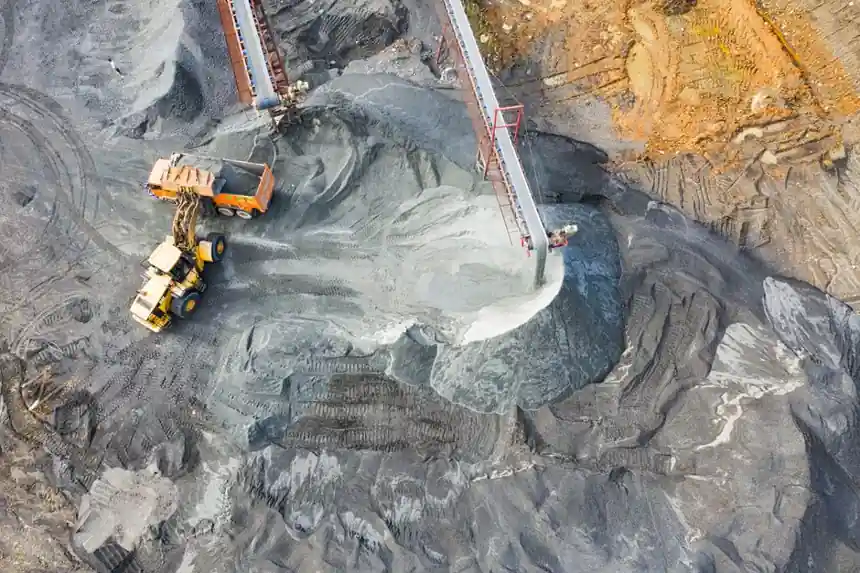
Mining absorbed 42.5% of global ammonium nitrate (AN) explosive consumption in 2025, the single largest application segment [S6]. Prilled low-density AN is the oxidiser backbone of ANFO and the key component of bulk emulsions, packaged products, and slurry explosives used across surface metal, coal, quarry, and underground operations [S4].
A typical open-pit operation processing 10 million tonnes of ore per year, running a 0.4 kg/t powder factor and a 2:1 stripping ratio, will burn through about 12,000 tonnes of explosives annually, with AN as the dominant mass input [S2]. The same source frames drill-and-blast explosives cost (excluding blasting services) at roughly 0.3 $/t of ore at pre-conflict AN prices near 0.25 $/kg [S2].
What AN-Based Explosives Are, and How They Are Built
AN is made by reacting ammonia with nitric acid, then prilled into porous, low-density beads specifically engineered to absorb around 5–6% fuel oil on the mine bench, producing ANFO [S1][S3]. Industrial-grade low-density prill is coated with a waxy or paraffin anti-caking layer to preserve porosity, control flow, and resist moisture pickup in storage silos or boreholes [S1].
U.S. The balance of the mix is at the bench: bulk emulsions and packaged agents like Orica's Amex and Dyno Nobel's ANFO lines, all of which use prilled AN as the primary oxidiser [S1][S4].
Who It Is For, and Where ANFO Is the Wrong Tool
ANFO is the default dry-hole bulk explosive: cheap, pumpable or augured, safe to mix on site, and well matched to blasthole diameters from roughly 75 mm up to 311 mm in dry conditions [S1][S4]. It is the workhorse in surface coal, iron ore, copper porphyry, gold open pit, and aggregate quarries where holes are dewatered before loading.
ANFO is the wrong product in wet holes. Bulk emulsions and water gels (slurries) are specified instead because water in the hole desensitises ANFO and drops detonation velocity. ANFO is also a poor fit for very small-diameter underground production holes, where packaged emulsions or permissible explosives (per MSHA/ATEX-style rules) take over. For engineers planning drill-and-blast around switching power supply reliability at the bench, the mining dump truck fleet, and the industrial UPS feeding emulsion sensitiser plants, the explosive selection sets the upstream material-handling chain [S1][S4].
Price and Supply: the Russia–Ukraine Aftermath
Russia was the single largest global AN exporter before February 2022, and the temporary Russian export ban (February to May 2022) reshuffled trade flows into Europe, Africa, and the Americas [S2]. Shipment-level data put the 2019–2023 global average AN price at 0.3 $/kg; by Q4 2022 the global average had risen 230% to 0.7 $/kg, before drifting back toward historical norms [S2].
By 2024, mining buyers had split into two camps: those still pulling discounted Russian AN where sanctions and shipping insurance allow, and those exiting Russian supply entirely for ESG and shareholder-perception reasons, accepting higher unit costs as the trade-off [S2]. The wider ammonium nitrate market is projected to reach 24 billion USD by 2026, growing at a minimum 4% CAGR off rising fertiliser plus ANFO demand, which keeps mining buyers competing with agricultural buyers for the same molecule [S5].
Storage, Handling, and the Regulatory Stack
By itself, AN is a stable oxidiser that will not burn; the hazard profile emerges only when it is contaminated, confined, or exposed to incompatible combustibles [S3]. U.S. storage and handling fall under OSHA's hazard communication standard, with the National Fire Protection Association (NFPA) and the Institute of Makers of Explosives (IME) publications recognised as the industry standard of care [S3].
Once AN is mixed with fuel oil into ANFO, or with emulsifiers into a blended bulk product, the Bureau of Alcohol, Tobacco, Firearms and Explosives (ATF) takes over as primary regulator for storage, security, inventory records, and employee background checks [S3]. Transport sits with PHMSA, and individual AN drivers must hold a hazardous-materials endorsement (HME) on their CDL plus a TSA background check [S3].
The 4 August 2020 Beirut port disaster, in which approximately 2,750 tonnes of AN stored in a warehouse ignited and killed at least 218 people, with economic damage above 6.7 billion USD, is the standing reference event behind tighter segregation, quantity-distance, and contamination rules now applied to mining magazine design [S5].
Selecting AN Grades and Bulk Systems on a Mine Site
Specifying AN for a mine means locking in three decisions: prill density (low-density for ANFO, high-density for some emulsion matrices), anti-caking coating (paraffin for security-sensitive sites, wax for general industrial use), and supply form (prill in bulk tanker, prill in 25 kg or 1 t bag, or 83% hot liquor for on-site emulsion plants) [S1]. Dyno Nobel runs four industrial SKUs into mining: industrial-grade porous prill, LoDAN low-density prill with paraffin coating, 83% AN liquor for emulsion matrix, and a 10% liquid fertiliser line that shares the same manufacturing train [S1].
The comparison below frames the main bulk options a mine planning engineer will see on a tender:
ANFO (prill + 5–6% fuel oil) is the lowest unit cost, is best suited to dry blastholes, and has the simplest on-site logistics; bulk emulsions (e.g., Orica's bulk heavy ANFO blends) tolerate wet holes, give higher bulk strength and better gas dynamics, but require an emulsion plant and a sensitiser dosing system that depends on a stable power supply and DC power supply chain [S4]. Packaged products (Amex, Nitropril-based ANFO) are specified for small-diameter underground work, selective mining, and sites without bulk infrastructure [S4].
Failure Modes and Field Constraints Engineers Should Price In
Loss of porosity through prill degradation in storage is the silent cost driver: anti-caking coating breakdown or moisture absorption reduces fuel-oil uptake, drops ANFO density, and pulls detonation velocity below the ~3,500–4,500 m/s window expected from a healthy mix [S1][S3]. Storage magazine design must keep AN away from contaminants (fuel, organics, reducing metals) and away from incompatible materials, per NFPA 400 / IME Safety Library guidance [S3].
Supply tightness in southern African and Australian coal and PGM operations has been reported as a recurring constraint, with bulk emulsion and ANFO deliveries gated by truck availability, magazine permits, and rail cycle time, not by the actual AN molecule [S7]. The practical mitigation is dual sourcing across two regional prill suppliers, an on-site 83% AN liquor tank for emulsion matrix make-up, and contract terms that pass through at least 70–80% of the underlying ammonia/nitric-acid feedstock index [S1][S7].
Verification and Testing at the Bench

Incoming AN quality is checked for prill density, oil absorption, particle size distribution, and moisture content before it is loaded into a bulk truck or auger. Standard checking and testing apparatus used at the magazine includes density cups, oil-absorbance rigs, and moisture balances, all of which feed into a lot-acceptance test against the supplier certificate of analysis [S1][S3].
For plants running continuous emulsion sensitiser skids, the emulsion matrix temperature and the switching power supply feeding the dosing pump electronics are part of the same reliability chain; a 5–10 °C drift in matrix temperature or a brownout on the sensitiser skid can knock a bulk emulsion out of specification just as cleanly as a bad prill lot. Bench-scale detonation-velocity testing in a representative water-filled borehole, typically per IME or site-specific procedures, remains the final gate before a new AN grade is released to production holes [S3].
Trackable signals for the next 6–12 months: the price spread between Russian AN into CIS-adjacent markets and FOB Gulf/Hexham AN into Africa, the timing of new African and Australian bulk-emulsion plant commissioning, and any change to U.S. ATF quantity-distance thresholds that would alter magazine footprint at new mine builds. The transformer expedite premium dynamics into remote mining sites will continue to track the same logistics bottleneck, since both AN and heavy electrical kit compete for the same limited rail and port slots.